

NAD+ vs Niacinamide for Skin: Which One Should You Use?
NAD+ and niacinamide show up on the same serum shelf promising similar things for your skin, but they aren’t the same ingredient, and they’re not competing for the same job
NAD+, short for nicotinamide adenine dinucleotide, works like a cellular battery inside every cell in your skin, carrying the energy your cells need to repair themselves and keep functioning day to day. Niacinamide, also known as nicotinamide, is a form of vitamin B3, and it’s the material your skin uses to build that battery on its own. Your skin relies on that precursor route because NAD+ itself is a large, charged molecule, and skin is built specifically to keep molecules like that out. Niacinamide is small enough to get through.
Yet a NAD+ serum often costs more all the same, even though niacinamide is the one that gets through, directly and cheaply.
By the end, you’ll know what each one does, when paying more for NAD+ makes sense, and whether niacinamide alone already covers what you’re looking for.
NAD+ vs Niacinamide Benefits for Skin
Niacinamide has direct benefits on your skin. At 2 to 5 percent, it strengthens your skin barrier, calms inflammation, fades hyperpigmentation, and reduces oxidative stress, backed by decades of research. You’ll likely notice it first in less redness and a calmer complexion, with dark spots fading gradually over time. On top of that, it also feeds into the pathway your skin uses to build that same battery, though how much converts depends on your skin’s age, stress level, or inflammation.
NAD+ works differently. It acts inside the cell, fueling energy production, supporting DNA repair, switching on sirtuins, and keeping your mitochondria running the way they should. Think of it as your skin’s power supply, keeping the machinery behind repair and renewal running smoothly. Researchers connect these same processes to slower cellular aging and stronger resilience, and a topical NAD+ product is trying to support all of that from the outside in.
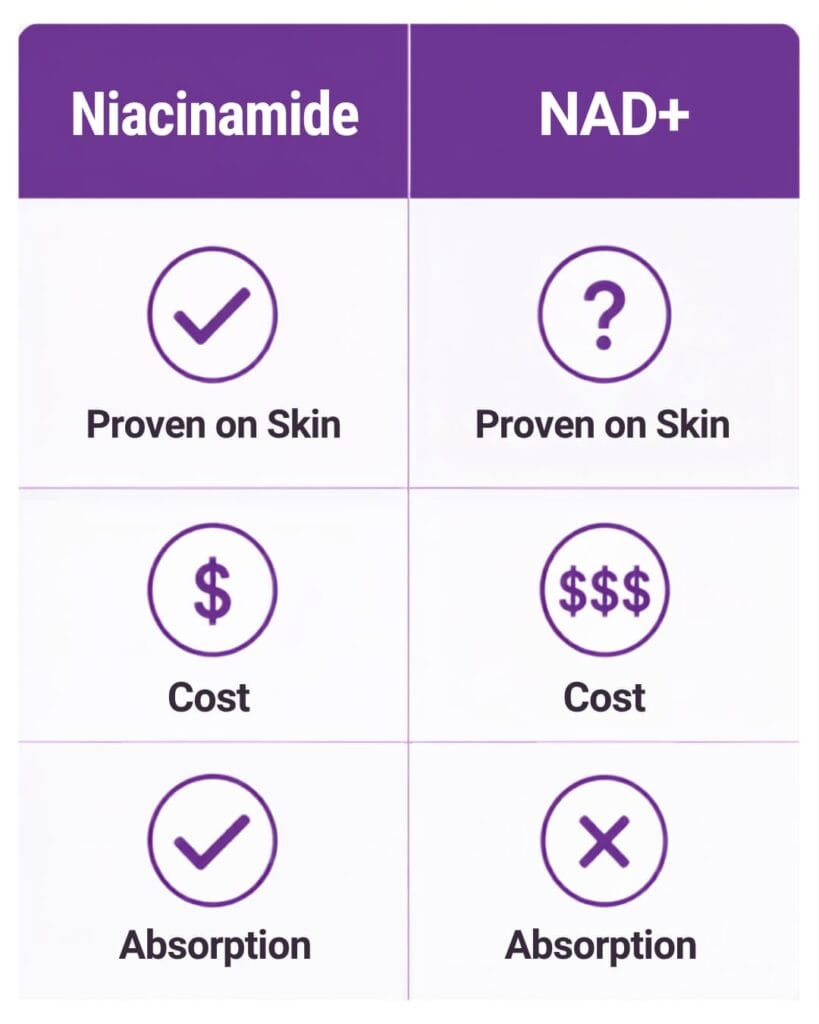
Where they act is one difference, and how well that’s been proven is another. Niacinamide’s benefits have been proven on skin, while NAD+’s have only been shown on cells in a lab.
One case series gets closest to testing NAD+ directly on real skin. Researchers used microneedling to carry NAD+ past the skin barrier and directly to living cells, as a standard application can’t reach that deep on its own. In a group of 36 women with melasma, severity dropped by 59 percent over 21 weeks. Yet no group in the study used microneedling alone, and microneedling by itself is already known to improve melasma, so it can’t confirm NAD+ caused the improvement.
NAD+ Supplements vs Topical Niacinamide
As a supplement, NAD+ is far too large for your cells to absorb. That’s why most companies prefer the precursors instead, niacinamide, NR, and NMN.
Of these three, NMN and NR are the most preferred. Taken orally, doses ranging from around 250 milligrams up to a couple grams a day have shown blood NAD+ rising in step with the dose across human trials, exactly what a longevity supplement is supposed to do. Niacinamide needs a much higher oral dose to raise NAD+ at all. At that dose, it can trigger a negative feedback loop, working against the same enzymes it’s meant to support.
NMN and NR also appear in some topical products, though whether they work on skin hasn’t been established yet, while niacinamide remains the only one of the three that’s well established topically.
Are NAD+ Serums Just Expensive Niacinamide
A NAD+ serum costing more than a niacinamide one isn’t necessarily a rip-off. Check the ingredient list for niacinamide or nicotinamide named as the active. If niacinamide is the actual active behind the NAD+ name, the extra cost might be buying you texture, a specific formulation you prefer, or added antioxidants, as long as you know what you’re paying for.
What’s harder to justify is paying more for NAD+ itself. It’s an unstable molecule, breaking down when it’s exposed to light, heat, or the wrong pH, even before the bottle gets opened. A clear jar sitting on a store shelf gives it every chance to degrade before it reaches your skin, while opaque, airless packaging protects it far better. Learn more by reading “NAD+ Benefits for Skin: Does It Really Work?” for a full breakdown of what to look for in a NAD+ product.
So the real question isn’t the cost itself. It’s what’s in the ingredient list and how it’s packaged
Should You Use NAD+ or Niacinamide
Niacinamide is the right call for most people. It handles oil control, uneven tone, visible pores, and redness, all with one ingredient, and it’s affordable. If you want a track record over a promise, this is it. For specific options, “The 10 Best Niacinamide Serums for Every Skin Type” breaks down which ones are worth adding to your routine.
Consider a NAD+ or precursor product if something newer and still being tested appeals to you. It means paying mostly for research proven on cells, since the one skin study we have can’t confirm NAD+ actually did anything.
You can even decide to use both. Niacinamide already sets off the same reaction your skin uses to build NAD+ on its own, so you can layer them without any conflict. Patch test first, and keep the rest of your routine simple.
But if anti-aging is the goal and the budget’s tight, set both aside and prioritize retinoids and sunscreen. Neither niacinamide nor NAD+ matches retinoids in the anti-aging department