Azelaic Acid vs Hydroquinone for Hyperpigmentation, Dark Spots and Melasma
Last updated on August 21st, 2026
Hydroquinone was the gold standard for dark spots, melasma, and hyperpigmentation for decades. Dermatologists prescribed it freely, patients trusted it, and nobody questioned it.
Then the concerns started. A condition called ochronosis, where skin darkens permanently with prolonged use, prompted the EU to ban it from over-the-counter cosmetics. Other countries followed.
Azelaic acid stepped in as the modern alternative. As a pharmacologist, I find the clinical data stronger than most people expect. Studies comparing azelaic acid vs hydroquinone at prescription strength show comparable results, and you can use it indefinitely.
Which one is right for you depends on your skin tone, what type of hyperpigmentation you are dealing with, and how long you need to treat it.
How Hydroquinone Works
Hydroquinone targets melanin production in two ways, which is both the reason it works so well and the reason it carries risks.
Hydroquinone starts by inhibiting tyrosinase, the enzyme that drives melanin production, slowing pigment synthesis in treated areas. But it does not stop there.
It is also directly cytotoxic to melanocytes, meaning it damages and destroys the cells that make melanin, healthy ones included. A study on guinea pigs using just 2 percent hydroquinone saw melanocyte counts fall from around 900 to 52 after three weeks. That is why it works fast. It is not managing the problem. It is eliminating the source of it.
Because it targets healthy melanocytes alongside overactive ones, you can end up with uneven lightening. This is called the halo effect, where the skin around a treated area fades noticeably lighter than the surrounding skin.
Prescription strength sits at 4 percent. Compounded formulas go higher, up to 6, 8, and 10 percent for stubborn cases, though the risks climb considerably at those concentrations.
How Azelaic Acid Works Differently
Azelaic acid shares tyrosinase inhibition with hydroquinone, so both slow melanin production through the same enzyme pathway. But that is where the similarity ends.
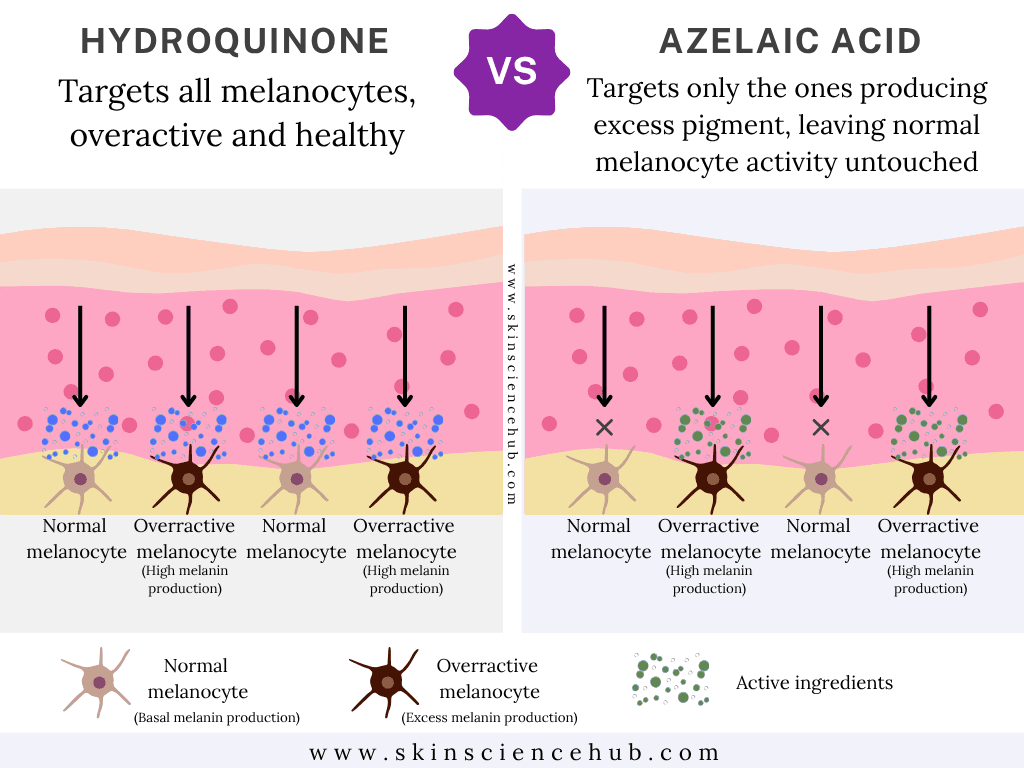
Hydroquinone acts on all melanocytes, overactive and healthy alike. Azelaic acid targets only the ones producing excess pigment, leaving normal melanocyte activity untouched. Your complexion evens out, and your natural color stays.
Azelaic acid also reduces inflammation. Post-inflammatory hyperpigmentation, the dark marks left after acne or skin injury, is driven by inflammation as much as by excess pigment. Hydroquinone addresses the pigmentation. Azelaic acid addresses both the pigmentation and the process creating it.
That combination is what makes it particularly effective for acne-prone skin. It is not just fading existing marks. It is working on the cycle that keeps producing them.
Azelaic Acid vs Hydroquinone at a Glance
| Azelaic Acid | Hydroquinone | |
|---|---|---|
| How it works | Selectively targets overactive melanocytes and reduces inflammation | Targets all melanocytes, overactive and healthy |
| Speed | 8 to 12 weeks for visible fading | 4 to 6 weeks for visible fading |
| Ochronosis risk | None | Yes, with prolonged use or concentrations above 4% |
| Long-term use | Safe to use continuously with no time limit | Maximum 8 to 12 weeks before a break is needed |
| Pregnancy | Safe. First-line for pregnancy-related melasma | Not safe. Absorbed into the bloodstream |
| Darker skin tones | Low risk. Dermatologists recommend it first | Higher risk of ochronosis and uneven lightening |
| Sun spots | Does not work | Effective |
| Best for | Melasma, dark marks from acne, acne-prone skin, long-term treatment | Sun spots, fast results, stubborn melasma |
Which One Is More Effective for Hyperpigmentation
What Head-to-Head Studies Show
The most cited comparison pits 20 percent azelaic acid against 2 percent hydroquinone. After 24 weeks, 73 percent of the azelaic acid group achieved good to excellent results, compared to 19 percent on hydroquinone. That looks like a decisive win, but 2 percent hydroquinone is the weakest available concentration. It is not what dermatologists prescribe for significant hyperpigmentation, so the gap tells you less than it appears to.
The fairer test compares hydroquinone vs azelaic acid at prescription concentrations. Farshi ran exactly that comparison and found no statistically significant difference in outcome at 24 weeks, though azelaic acid showed a trend toward better responses.
The strongest evidence comes from a 2023 systematic review and meta-analysis that pooled six randomised controlled trials and 673 patients. It found that azelaic acid produced greater reductions in melasma severity scores than hydroquinone. The authors concluded that azelaic acid may be better at reducing melasma severity overall, though larger long-term studies are still needed to confirm these findings.
At comparable concentrations, these two ingredients perform similarly. The strongest available evidence gives azelaic acid a slight edge.
Speed of Results
Hydroquinone is faster. Most people see visible fading within four to six weeks, while azelaic acid typically takes eight to twelve weeks.
For a one-off situation like a wedding or upcoming event, hydroquinone delivers. For melasma and chronic hyperpigmentation, use azelaic acid. It catches up by month three, and you can continue using it safely, with no risk of ochronosis.
Which Dark Spots Each One Treats
Both azelaic acid and hydroquinone treat melasma. Azelaic acid has a slight research edge, and since melasma needs ongoing management, it is the choice you can sustain. Most people see noticeable fading within three months of consistent use.
Post-inflammatory hyperpigmentation leaves dark marks after acne or skin injury. Use azelaic acid for those. It reduces the inflammation that causes those marks and fades the pigmentation. For acne-prone skin, that means it clears active breakouts and fades existing marks at the same time.
Sun spots and age spots, the flat brown patches that develop from years of sun exposure, respond well to hydroquinone. Azelaic acid does not work on them. If sun spots are your main concern, use hydroquinone
Hydroquinone vs Azelaic Acid Side Effects
Hydroquinone’s Risks
Redness, burning, stinging, and contact dermatitis are the most commonly reported side effects. Ochronosis, however, is a different risk altogether.
Ochronosis is a paradoxical darkening that develops with prolonged use, particularly beyond three months or at concentrations above 4 percent. The skin does not simply fail to lighten. It darkens, taking on a bluish-grey discoloration that is very difficult to reverse. People start hydroquinone to fade dark spots and end up with permanent discoloration that is harder to treat than what they started with. Ochronosis is more common in darker skin tones, and the risk climbs with both concentration and duration of use.
Stopping hydroquinone also brings its own risks. Once you stop, rebound hyperpigmentation is common, and pigmentation can return worse than before. Sensitization risk also grows the longer you use it.
Hydroquinone is also absorbed systemically, and this has raised concerns about potential carcinogenic effects from metabolites produced in the liver. No study has confirmed that topical application causes cancer in humans, but this theoretical risk is part of why dermatologists are increasingly cautious about long-term use.
Azelaic Acid’s Side Effects
Clinical trials consistently report azelaic acid’s side effects as mild and short-lived. Some people experience tingling or mild burning in the first one to two weeks, and occasional dryness is another side effect. These settle as your skin adjusts.
No ochronosis. No rebound hyperpigmentation when you stop. No systemic absorption concerns at topical concentrations. There is no point at which continued use becomes a safety concern.
Is Hydroquinone Banned?
In many parts of the world, yes. The European Union banned it from over-the-counter cosmetics in 2001, citing safety concerns including ochronosis. Japan and Australia followed with similar restrictions.
In the United States, 2 percent hydroquinone was sold over the counter for decades. That ended in 2020 when the FDA removed its OTC approval. You now need a prescription to access it, and the standard prescription strength is 4 percent.
Azelaic acid faces no such restrictions. It is available over the counter at concentrations up to 10 percent and by prescription at 15 to 20 percent globally.
Can You Use Hydroquinone Long Term?
Hydroquinone is not a long-term treatment. Dermatologists typically prescribe it for eight to twelve weeks, then recommend an equal break, because continuous use beyond three months raises the risk of ochronosis considerably.
Melasma is a chronic condition that does not go away on its own. When you stop hydroquinone, the pigmentation usually returns. So you start again, stop again, and repeat. With every new course, your risk of ochronosis and sensitization grows.
Azelaic acid is built for long-term use. It is just as safe at month twelve as it was at month one, so you can treat continuously for as long as your skin needs it.
Which One Is Right for You?
For Darker Skin Tones
Hydroquinone’s risks are not evenly distributed. Darker skin tones face a significantly higher risk of ochronosis. Hydroquinone is also more likely to cause uneven lightening, leaving patches noticeably lighter than surrounding skin. And if it irritates your skin, that irritation can trigger post-inflammatory hyperpigmentation on top of the hyperpigmentation you are already treating. These are not rare outcomes for darker skin. They are well-documented patterns.
Azelaic acid sidesteps all three. Because it only targets overactive melanocytes, it cannot cause patchy lightening. And since it reduces inflammation, you are far less likely to develop dark marks from irritation.
Studies in patients with Fitzpatrick skin types IV to VI, covering medium brown to dark skin tones, show 20 percent azelaic acid delivers significant improvement in hyperpigmentation with a strong safety profile. Dermatologists increasingly recommend it as their first-line treatment for hyperpigmentation in these skin tones.
For a deeper look at the best ingredients for hyperpigmentation in darker skin, [link to hyperpigmentation post].
During Pregnancy
Hydroquinone is absorbed through the skin and reaches systemic circulation. This raises serious concerns about exposure to your baby during pregnancy and through breast milk, and the standard recommendation is to avoid it entirely.
Azelaic acid is different. Clinical studies show no evidence of risk to the developing baby, and dermatologists routinely recommend it during pregnancy and breastfeeding. For pregnancy-related melasma, also known as chloasma, azelaic acid is the first-line treatment and one of the very few skincare ingredients safe to use throughout your entire pregnancy.
For Sensitive Skin, Speed and Long-Term Use
If you have sensitive or rosacea-prone skin, use azelaic acid. Hydroquinone triggers irritation in these skin types, and that irritation worsens the rosacea and feeds the very pigmentation you are trying to treat.
If you want an ingredient for long-term treatment, use azelaic acid. It stays effective month after month and carries no risk of ochronosis, no matter how long you use it.
If speed is your priority, hydroquinone is the right tool. It fades pigmentation faster than any other topical option, and for severe or stubborn melasma that has not responded to gentler treatments, it is still the strongest short-term option available. Many dermatologists recommend transitioning to azelaic acid for maintenance once that initial course ends.
When in doubt, start with azelaic acid. It is the safer, more sustainable option for most people, and it works just as well as prescription hydroquinone given enough time.
For a full breakdown of the best azelaic acid serums, read the best azelaic acid products for hyperpigmentation.
Can You Use Azelaic Acid and Hydroquinone Together?
Yes, and there is clinical evidence supporting it. A double-blind randomized trial found the combination outperformed hydroquinone alone. Over four months, it produced greater reductions in melasma severity and faster results.
The combination does cause more side effects. Half of patients reported burning, stinging, or dryness, compared to about a third on hydroquinone alone, and most were mild and resolved without stopping treatment.
If you want to use both, sequence them. Applying both at the same time sounds like it would work faster, but it just increases irritation without adding any benefit. Start with hydroquinone for eight to twelve weeks to get pigmentation under control, then switch to azelaic acid for ongoing maintenance. Some dermatologists recommend alternating nights instead. Apply azelaic acid first, let it absorb, then apply hydroquinone on top.
My guide covers both, including when hydroquinone needs a doctor’s care and which brighteners you can safely use on your own.
The Bottom Line
Both ingredients fade dark spots and melasma. The clinical evidence is clear on that.
Hydroquinone carries real risks with prolonged use. Ochronosis, rebound hyperpigmentation, and forced breaks limit how long you can use it. When you need fast results in the short term, it delivers.
Azelaic acid takes longer to show results, but the evidence shows it performs just as well as prescription-strength hydroquinone over time. You can use it month after month, and it stays just as safe and effective as the day you started.
For most people, azelaic acid is the better long-term choice. If melasma or chronic hyperpigmentation is what you are dealing with, it is the one you can stay with.