

How to Determine Your Skin Type
Last updated on August 9th, 2026
Determining your skin type feels confusing because your skin constantly changes. It gets oilier in summer and drier in winter, breaks out when you’re stressed, and feels tight after you wash it. So naturally you think your type is shifting too.
But it’s not. Your skin type comes from genetics and stays the same through nearly all of your life. What changes is how your skin type behaves under different conditions. Your oil glands produce a certain amount of sebum, and that determines whether you’re normal, oily, dry, or combination. Stress changes how your skin type looks, and so do climate and your skincare routine, but none of those things touches your actual type. Hormones are the only real exception, from shifts like puberty or menopause.
Once you know this difference, you stop buying product after product trying to fix your type. You manage it instead.
I’ll show you the 4 base skin types, where sensitivity layers on top of them, how to identify yours with a simple morning tissue test, and what to do when your results don’t fit one category because skin is dynamic and your needs shift constantly.
What Are the 4 Skin Types?
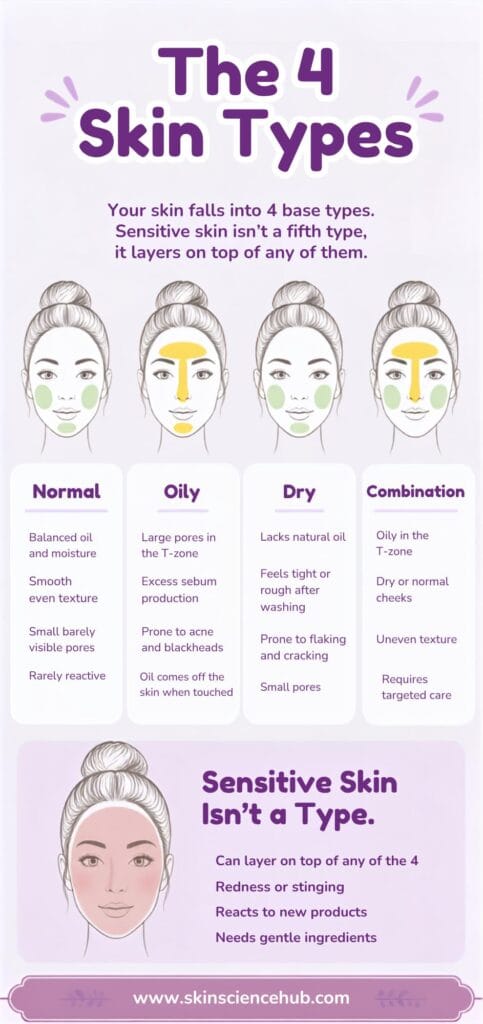
- Normal skin feels comfortable all day. Your pores stay small and breakouts are rare.
- Oily skin turns shiny and feels slick by midday, especially across your forehead, nose, and chin.
- Dry skin feels tight, flaky, or rough on your face, especially right after washing.
- Combination skin keeps your T-zone oily while your cheeks stay normal to dry.
Sensitive skin is not a separate type. It layers on top of any of the 4, showing up as redness, stinging, or burning whenever you try a new product.

How to Identify Your Skin Type
Most people try to guess or figure out their skin type by how their face generally feels. But that’s hard to trust because how your skin behaves shifts with weather, the season, or whatever you put on it.
That’s where the tissue test comes in. It shows you how oily or dry your skin is.
The tissue test works best in the morning, since your skin makes more oil during the day than at night. Catching it first thing gives you a clean read on your natural oil production, before anything else gets in the way.
The Tissue Test Method
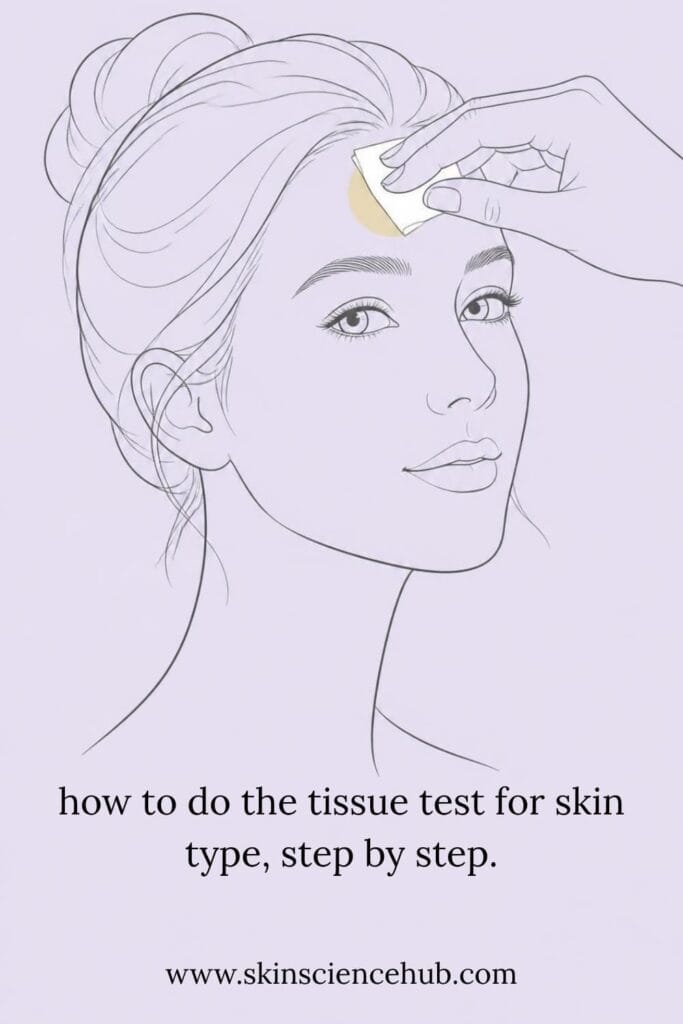
Press a clean tissue against your forehead for a few seconds, then check your nose, each cheek, and your chin. Wherever oil shows up tells you which part of your face makes the most oil.
Your T-zone has more oil glands than your cheeks, so your forehead, nose, and chin naturally make more sebum than the sides of your face. That’s just how facial anatomy works, and it’s exactly why combination skin exists and why so many people have it.
Understanding Your Skin Type Test Results
- Oil everywhere? That’s oily skin.
- Oil only in your T-zone, cheeks clean? That’s combination skin.
- Clean tissue and your face feels comfortable? That’s normal skin.
- Clean tissue and your face feels tight? That’s dry skin.
Do this test 3 mornings in a row, since one test alone won’t tell you enough. Too many variables affect your results, from how well you slept to the room temperature to what you ate the night before. If you get the same result 3 times, then that’s your actual type.
This tells you your base type. Sensitivity works differently. You’ll notice it in how your skin reacts, not in what shows up on the tissue.
1. Normal Skin
Normal skin means you won the genetic lottery. Your oil glands produce just enough sebum, and your skin barrier holds onto moisture the way it should, so your pores stay small, your texture looks smooth and even, and breakouts are rare, showing up at most around your period. Your face feels comfortable all day too, with no tightness after washing and no oily buildup by afternoon, and most products sit well on your skin without causing irritation.
If this sounds like you, you’re rare. Most people fall into one of the other categories or shift between them seasonally.
2. Oily Skin
Oily skin happens when your glands make too much oil and pump it out all day long. Your forehead, nose, and chin get shiny within a few hours of washing your face, and by lunch your whole face feels wet and greasy, cheeks included, because true oily skin covers your entire face, not just your T-zone.
That extra oil fills your pores and makes them look larger, and it mixes with dead skin cells to clog things up, which is why blackheads and whiteheads develop so frequently. The effect shows up off your face too, your phone screen picks up greasy smudges, and makeup won’t stay where you put it, sliding around or separating as the day goes on.
When you blot your skin with tissue paper, the paper comes away covered in oil. Not just a little shine but actual visible oil that makes the tissue translucent.
3. Dry Skin
Dry skin means your glands don’t make enough oil, and your skin barrier can’t hold onto moisture the way it should, so water escapes constantly.
Your skin flakes visibly, especially on your cheeks, and your pores look tiny and almost invisible across your whole face. Fine lines show up more prominently, your skin looks dull even when you’re well rested, and foundation clings to those dry, flaky patches instead of sitting smoothly.
After washing, your face feels tight right away, and that tightness can turn itchy within minutes. Products absorb fast and disappear into your skin because your barrier can’t hold them in, so by midday your face feels tight again even if you moisturized that morning.
4. Combination Skin
Combination skin happens when your T-zone produces more oil than your cheeks do, a genetic pattern that stays consistent year-round.
Your T-zone gets shiny with large, visible pores, especially around your nose, but your cheeks stay normal to dry, with small pores and sometimes flaking. At midday your nose feels oily and greasy while your cheeks feel comfortable or tight, so you might blot oil from your forehead while your cheeks need moisturizer.
You’ll see this exact T-zone-oily, cheeks-dry split show up every single day, not just some days depending on the weather.
Sensitive Skin Isn’t a Type
Sensitive skin isn’t its own category. It layers on top of oily, dry, normal, or combination skin, and it shows up because your barrier doesn’t keep irritants out the way it should, letting products penetrate deeper and cause inflammation.
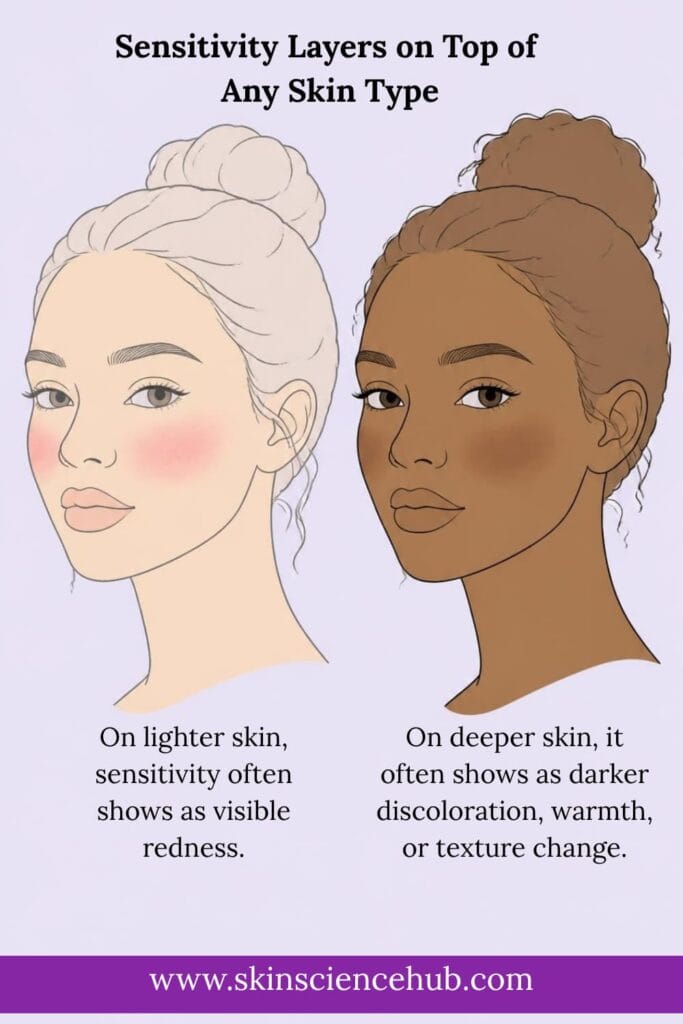
You may have sensitive skin if products cause immediate reactions. Your face gets red as soon as you apply something new, fragrances make your skin burn, and acids sting within seconds. Even gentle cleansers leave your skin irritated, and retinoids trigger redness right away no matter how carefully you introduce them.
Your cheeks may develop broken blood vessels that look like tiny red threads under the skin, or red patches that show up without warning. On deeper skin tones, these signs often show up instead as darker discoloration, warmth, or a change in texture. Temperature changes make your face flush, and stepping outside in cold wind leaves your skin stinging. Your face feels hot when others around you feel fine.
What If Your Results Are Mixed?
Your skin’s needs shift constantly, and that can make correctly identifying your type more confusing, even though your actual type never changes. Age changes what your skin needs, and so do medications, climate, underlying conditions, and your everyday routine.
Age doesn’t change your type though. A 20-year-old with oily skin will have oily skin at 40. But your needs change because fine lines develop, elasticity decreases, and cell turnover slows down. Your 40-year-old oily skin needs different care than your 20-year-old oily skin, even though the base type stays the same.
Don’t marry yourself to one fixed routine, because even when your base type stays constant, what your skin needs right now still changes. This doesn’t mean you need different products for every shift. You just need to understand that variation is normal.
Some results don’t fit one category cleanly. Your tissue test shows oil but your face feels tight. Your pores look large but your skin flakes. These mixed signals mean something specific.
Tight Skin with Oil on the Tissue
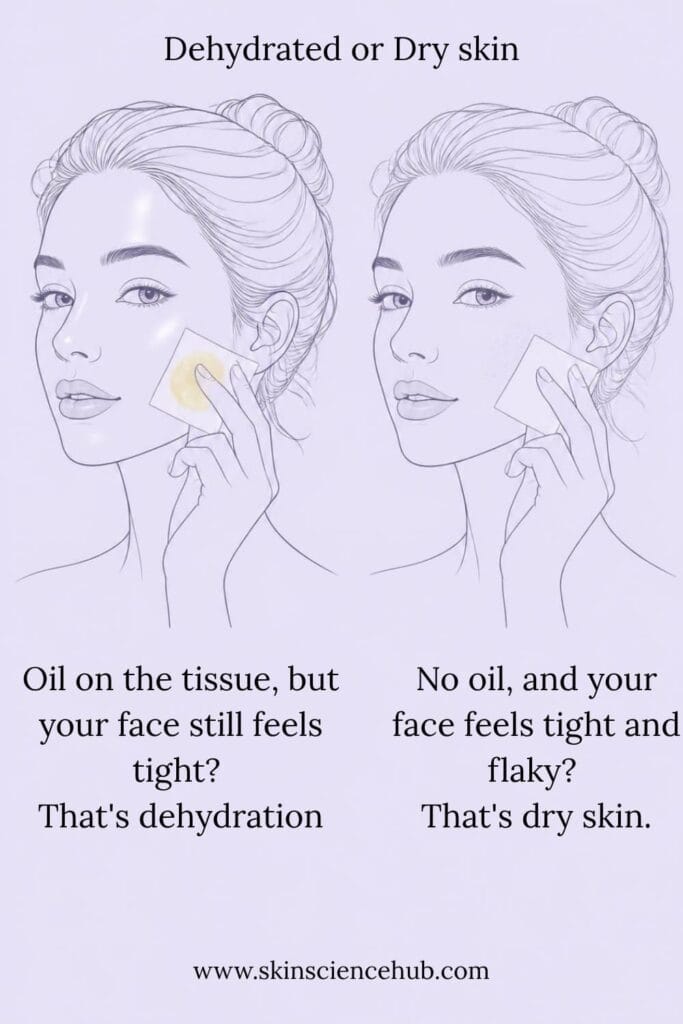
This is dehydration, not dry skin, and it confuses everyone. How can you be oily and tight at the same time?
Your barrier isn’t holding water properly, so your skin loses moisture. Your oil glands respond by making more sebum to compensate, but oil can’t replace water. The tissue shows oil because your glands are working overtime. Your face feels tight because your cells are dehydrated.
You can have oily skin that’s dehydrated, or dry skin that’s dehydrated. Dehydration isn’t tied to one type, any of the 4 can lose water and trigger it.
Large pores with flaking and tightness
This is dry skin, not oily or combination. Large pores alone don’t determine your type, because they can come from sun damage, genetics, or aging just as easily as from oil production. What tells you the type is what’s on the tissue and how your face feels.
No oil on the tissue plus tightness equals dry skin, regardless of pore size.
Different results in different seasons
Climate changes how your skin behaves, not what your actual type is. If you’re oily in summer humidity and dry in winter heating, that’s seasonal shifting, not combination skin. Combination skin holds the same oily T-zone and dry cheeks pattern all year, regardless of season.
Reactions to many products
This doesn’t automatically mean sensitive skin. Switch to a plain cleanser and plain moisturizer, nothing else, for two weeks. If your skin calms down, you were using the wrong products for your type. If it doesn’t, that’s true sensitivity, because sensitive skin reacts even to gentle products formulated for it.
Products that worked suddenly stopped working
Your skin itself may have genuinely changed, not just its day to day presentation. Puberty or menopause might be why. Both can permanently turn your oil production up or down, not just for a few weeks, for good. Pregnancy can shift things too, though that one usually settles back down after birth. Run the tissue test again to find out where your skin actually stands now.
Bottom Line
Your skin type is genetic. Your glands make a certain amount of oil, and your barrier holds water a certain way, and no product can change that underlying mechanism, only how it presents day to day.
Use the tissue test on clean skin in the morning for three days in a row to determine your skin type accurately, because consistent patterns show your real type. One day won’t tell you enough. If your tissue shows oil but your face feels tight, that’s dehydration, not your type.
Once you determine your baseline type, stop trying to change it. Manage what you have instead. Your needs shift with age, climate, and hormones, but hormones are the one thing among those that can genuinely shift your baseline too, through major stages like puberty or menopause. Your type otherwise stays constant. Build a routine that works with your genetics, not against them. Learn how in my Simple Skincare Routine guide

This was such a great post! Thanks for sharing!
I love the tips! As someone that has struggled to find my skin type, this is defintely helpful and I will be using these clues to find my skin type!
Great info. I always thought i was oily in the t-zone. Hmmm maybe not.
Thanks for sharing .
Very interesting! Thanks for sharing.
This is great! I have been trying to focus on having a better skincare routine and taking better care of my skin in general. I will be trying this test to make sure I have the skin type I think I do!
Love this!!
My daughters have been struggling with products not working and I have been telling them that they need to do a proper skin test to find out what their skin type is. We will be trying this for the next three mornings to see if they land where they think they do.
Great post!