
Skin Cycling Routine: What Works (And What Doesn’t)
Last updated on June 23rd, 2026
If you have been struggling with irritated skin from acids and retinoids, the skin cycling routine was probably the first thing someone recommended to you. As a pharmacologist, I’ve seen this four night method help people use retinoids and exfoliants without damaging their skin barriers. It works.
But once your skin builds tolerance, that same rigid schedule stops delivering results. Sticking with it isn’t discipline. It’s just using the wrong tool for where your skin is now.
This guide walks you through how skin cycling works and when Dr. Whitney Bowe’s four night schedule stops being the right fit for your skin.

What Is the Skin Cycling Routine?
The skin cycling routine is a four night skincare method developed by dermatologist Dr. Whitney Bowe. It alternates active treatment nights, one for chemical exfoliation and one for retinoids, with two recovery nights focused on barrier repair. This structure lets your skin benefit from powerful ingredients without the cumulative damage that comes from using them every night.
Dr. Whitney Bowe created skin cycling to solve a problem she kept seeing in her practice. People were using retinoids and chemical exfoliants correctly on their own, but the moment they started layering multiple actives every single night, their skin fell apart. Irritation, peeling, and eventually, patients who gave up on ingredients that genuinely work.
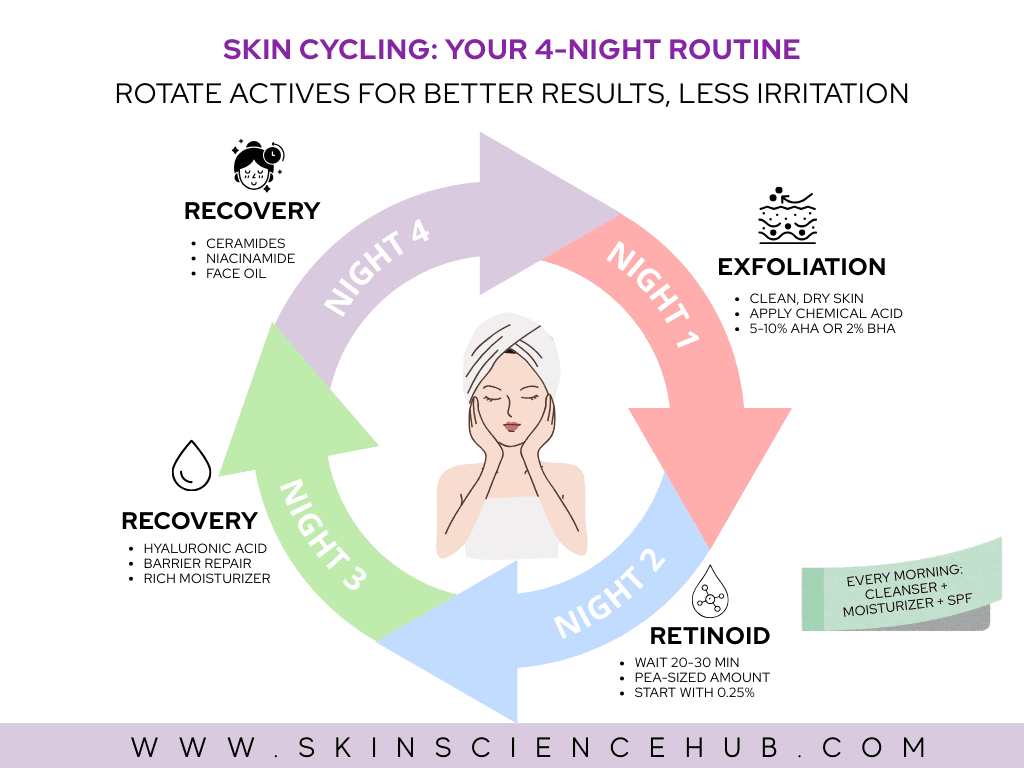
Her solution was a structured four night rotation:
- Night 1. Chemical exfoliation
- Night 2. Retinoid application
- Night 3. Recovery and barrier repair
- Night 4. Continued barrier support
Simple. And the simplicity is exactly why it spread so fast.
Your skin barrier is a wall of dead skin cells held together by fats called ceramides and fatty acids. As a pharmacologist, this is the part I find most people underestimate. Retinoids speed up cell turnover. Acids dissolve the bonds between dead cells. Both temporarily weaken that wall while they work, but your barrier needs 48 to 72 hours to rebuild. That is exactly what nights 3 and 4 are for.
For anyone overwhelmed by conflicting skincare advice, the four night schedule removes the guesswork. You follow a pattern rather than making nightly decisions. That structure works well at the start, but your skin outgrows it.
So let’s get into exactly what each night looks like and why the order is different.
How to Follow the Skin Cycling Routine: Night by Night
Night 1 – Chemical Exfoliation
Salicylic acid is oil soluble, so it goes into the pore rather than sitting on top of your skin. If you are skin cycling for acne, this is your acid. Glycolic acid stays on the surface, smoothing texture and fading sun damage, so it works better if ageing or uneven tone is your main concern. Lactic acid and polyhydroxy acids do similar work but more gently, and they are a smarter starting point if your skin is sensitive or new to exfoliants.
A quick guide based on your concern:
- Acne prone skin – Salicylic acid (BHA) 0.5 to 2%
- Ageing or sun damage – Glycolic acid 5 to 10%
- Sensitive skin – Lactic acid 5% or PHAs
One thing most people get wrong is applying acid to damp skin. Moisture drives deeper penetration, and deeper penetration on an unprepared barrier almost always causes irritation. Apply to completely dry skin, wait few minutes, then moisturise.
Night 2 – Retinoid Application
Wait 2-3 minutes after cleansing before applying your retinoid. Apply a pea sized amount across your whole face. If you are new to retinoids, start at 0.25% retinol and build from there.
A realistic skin cycling schedule for building retinoid tolerance looks like this:
- Weeks 1 to 4 – Once per cycle, every four nights
- Weeks 5 to 8 – Twice weekly if you have no irritation
- Weeks 9 to 12 – Every third night if your skin is tolerating well
- After 3 months – Every other night for some people
- After 6 months – Daily use is possible, though not necessary for everyone
When you have no redness, peeling, or sensitivity after application, you are ready to increase frequency. If irritation appears, drop back to what worked and stay there a little longer. By week eight on 0.25% retinol, your skin should feel settled. That is your cue to move to every third night.
Nights 3 and 4 – Recovery
These two nights are when your skin actually repairs itself. Don’t skip them.
Apply a hyaluronic acid serum to draw moisture back into the skin, then follow with a ceramide rich moisturiser to rebuild the barrier. On night 4, seal everything in with a face oil or an occlusive balm on top.
Your actives do the disrupting. Recovery nights do the rebuilding. You need both.
Your Morning Routine
Your evening routine rotates every night, but your morning routine stays exactly the same every day.
Rinse or gently cleanse to remove overnight products. Apply a vitamin C or antioxidant serum to defend against environmental damage during the day. Follow with moisturiser, then SPF 30 to 50. Both retinoids and acids make your skin more vulnerable to UV damage. Skipping sunscreen while using them undoes a lot of your progress.
That’s the standard four night framework. But how closely you follow it depends entirely on your skin.

Adapting Skin Cycling for Your Skin Type
The skin cycling routine is a starting point, not a fixed rule. Your skin type, where you live, and the season you’re in all affect how your barrier responds, so adjusting from the beginning saves you weeks of unnecessary irritation.
Sensitive or Reactive Skin
If your skin stings easily, flushes from products, or you have rosacea or eczema, two recovery nights probably isn’t enough. Extend to a six night cycle with four recovery nights instead. Start with 5% lactic acid or PHAs rather than glycolic acid, since glycolic drives deeper penetration and more irritation at the same concentration.
Cold weather and low humidity compromise your barrier regardless of skin type, so if you notice increased dryness or tightness during winter, add an extra recovery night straight away. Switch to cream based products instead of gels, apply moisturiser to damp skin, and seal with an occlusive like petroleum jelly on recovery nights.
You may be interested in
Combination Skin
You can follow the standard four night cycle but apply products differently across your face. Use salicylic acid only on your T zone where oil concentrates, and apply hydrating products more generously on drier cheek areas. If your skin runs oily in summer but tight in winter, adjust your cycle length seasonally rather than keeping it the same year round.
Oily and Resilient Skin
If you have been using retinoids for three or more months with no irritation, the standard four night cycle may be too slow for your skin. Some people with resilient skin progress to a three night cycle, exfoliation, retinoid, one recovery night, and eventually use retinoids every other night.
You are ready to increase frequency when you have no flaking, no sensitivity, and your skin concerns like acne or uneven texture are not improving at your current pace. That is your skin telling you it can handle more.
When the Skin Cycling Routine Stops Working
Skin cycling is a genuinely good starting point. But at some point, the four night schedule stops fitting your skin, and pushing through it doesn’t help. Understanding where the routine falls short saves you months of slow or zero progress.
1. How Often Should You Use Retinoids in Skin Cycling?
Most active ingredients are designed for consistent, frequent use once your skin builds tolerance. Retinoids, for example, work best with regular application because their effects on cell turnover are cumulative. Using retinol every fourth night slows your results significantly, especially for acne and dark spots where consistency drives improvement.
If you have been using a retinoid for over a month and still can’t tolerate it more than once a week, the cycling schedule is not your problem. The product is too strong for your skin. The solution is a gentler formulation you can use more often, not a slower rotation of the same irritating product.
2. Do You Actually Need to Exfoliate?
Not everyone does. Your skin sheds dead cells naturally, and retinoids already accelerate that process by increasing cell turnover. If you are using a retinoid consistently, adding a separate exfoliation night is redundant for most people. You are running two treatments that do the same job.
If your skin is calm and your retinoid is working, drop the exfoliation night. Your skin doesn’t need both.
3. Why the Same Acid Performs Differently Across Products
A 10% glycolic acid from one brand performs completely differently than the same percentage from another. pH levels, buffering agents, and formulation quality all change how deeply an acid penetrates. Some 10% products are gentle enough for frequent use. Others are meant for once a week. A 2% salicylic acid from The Ordinary behaves differently than the same percentage from Paula’s Choice for exactly the same reason.
Putting every product on the same four night schedule ignores these differences entirely.
Who Should Try the Skin Cycling Routine
Despite its limitations, the skin cycling routine works well for specific groups of people. Knowing whether you fall into one of them saves you weeks of frustration.
1. Skincare Beginners
If you have never used retinoids or chemical exfoliants before, skin cycling gives you a clear structure instead of guesswork. The four night schedule prevents the most common beginner mistake, which is using too many actives too quickly and ending up with a damaged barrier before you see any results.
You are likely a beginner if you use only a cleanser and moisturiser, or if you tried actives before and gave up from irritation.
2. People Recovering from Over-Exfoliation
If your skin is currently irritated from layering too many acids, retinoids, and actives at once, stepping back into a structured rotation helps your barrier recover without abandoning active ingredients entirely.
Your skin stings from products that never bothered you before. It looks red without obvious cause. Moisturiser goes on but the tightness comes back within an hour. Breakouts won’t heal. If that sounds familiar, the recovery nights built into skin cycling are exactly what your skin needs right now.
If you fit either of these groups, skin cycling is worth trying. If you don’t, a more targeted routine built around your specific concerns will serve you better.

Skin cycling works best when you know which actives to separate. My guide shows you exactly that.
The Bottom Line
Skin cycling works. For beginners and people recovering from over exfoliation, the structured rotation prevents the barrier damage that makes most people quit active ingredients before they see results.
But it’s not a permanent solution, and the biggest mistake people make is staying on a schedule that stopped serving them months ago.
Try the four night cycle if you’re new to actives. Adjust it as your skin builds tolerance. Move past it entirely if you have acne, melasma, or dark spots that need daily treatment to improve.
The best routine is the one your skin actually responds to. Not the one that’s trending.