Microbiome Skincare: How to Restore Your Skin’s Good Bacteria
Last updated on June 23rd, 2026
Your skin hosts trillions of bacteria right now. They live in your pores, feed on your sebum, and cover every inch of your face. Their job is to keep your barrier strong, your inflammation low, and your complexion balanced.
Most skincare routines destroy them anyway.
That deep cleansing face wash strips beneficial bacteria along with dirt. Antibacterial products eliminate the same microorganisms that naturally prevent acne, eczema, and inflammation. When the good bacteria die off, harmful ones take over, your barrier weakens, and the breakouts keep coming. So you cleanse more thoroughly, use stronger products, and the cycle repeats.
Most mainstream skincare was formulated before we properly understood the skin microbiome, so products designed for deep cleansing were causing real damage without anyone realizing it. The science has caught up. The formulas haven’t.
Here’s how to stop.

What Is Microbiome Skincare?
Most skincare products treat your skin like a surface to be sanitised. Microbiome skincare treats it like an ecosystem to be protected, and that single shift in thinking changes everything about how you choose products.
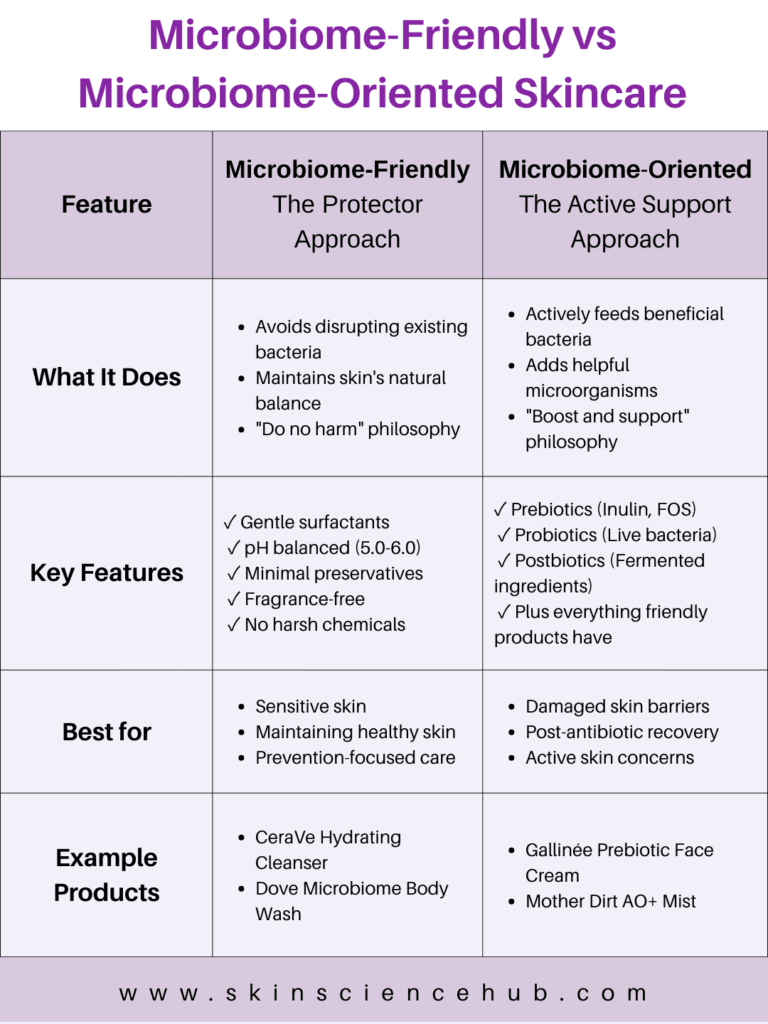
There are two distinct approaches, and knowing the difference will save you from wasting money on the wrong things.
Microbiome-friendly products protect your existing bacterial balance without actively adding anything new. They use gentle surfactants that clean without stripping, maintain a pH between 4.5 and 5.5 where beneficial bacteria thrive, and leave out the harsh preservatives that kill off your skin’s natural community. They don’t do anything dramatic. They simply stop doing damage, which turns out to be more powerful than it sounds.
Microbiome-oriented products go further by actively feeding and supporting your bacteria through three specific ingredient types.
- Prebiotics feed your existing beneficial bacteria. Ingredients like inulin and alpha-glucan oligosaccharide work as nutrients that good bacteria can use but harmful bacteria cannot, so you’re essentially starving the bad while nourishing the good.
- Probiotics introduce live or lysed beneficial bacteria, typically Lactobacillus or Bifidobacterium strains, that temporarily colonise your skin and reinforce your existing bacterial community.
- Postbiotics are the byproducts of bacterial fermentation, things like lactic acid, peptides, and fatty acids. They deliver the benefits of probiotics without requiring live bacteria in the formula, which makes them far more stable in skincare products.
You can use products from either category, or combine both. Neither approach is inherently superior because the right choice depends on how damaged your microbiome currently is, and we’ll get to that shortly.
Similar Articles to check out
Does Microbiome Skincare Really Work?
Yes. But the results depend heavily on where you’re starting from, so let’s be precise about who benefits most and why.
Research shows that supporting your skin’s bacterial balance reduces inflammation, strengthens barrier function, and improves conditions like acne and eczema. If you have barrier damage from harsh products, recent antibiotic use, sensitive skin, or inflammatory conditions like rosacea, you’ll likely see the most noticeable improvements because you have the most to recover from. People with relatively healthy skin still benefit, but the changes are more gradual and subtle.
If you’re over 40, your microbiome faces a different set of challenges entirely. Bacterial diversity decreases with age, which affects collagen production and barrier function in ways that go beyond general restoration. We cover those specific needs in our guide to microbiome friendly anti-aging skincare.
One thing worth knowing before you start. Your skin may get worse before it gets better. Small breakouts, mild flaking, or increased oiliness are common in the first two weeks as your bacterial balance shifts. This is normal, and it means something is actually changing. By weeks three and four, inflammation starts decreasing, redness fades, and your skin feels noticeably more comfortable. You may not see results yet, but your skin is telling you to keep going. Don’t add new products during this phase, and don’t panic. If you develop painful cysts or severe reactions at any point though, stop and reassess.
Where microbiome skincare genuinely cannot help is worth being honest about too. Severe cystic acne, hormonal acne tied to your cycle, persistent rosacea with visible blood vessels, and diagnosed skin conditions need medical care. Microbiome skincare supports treatment but cannot replace it, because no topical product corrects hormonal imbalances, genetic conditions, or infections that require medical intervention. Work with a dermatologist for these issues.
If you’ve followed this routine consistently and your skin still isn’t responding, the issue may not be topical at all. Your gut microbiome has a direct relationship with your skin, and internal imbalances often show up as external problems that no cleanser or moisturiser can fix. We cover that connection in depth here: gut health and skin article.
7 Signs Your Skin Microbiome Is Damaged
If you’ve been following a consistent routine but your skin keeps misbehaving, the ingredients you just read about may have already done some damage. Here’s how to tell.
- Your skin feels tight and uncomfortable no matter how much you moisturise. Persistent tightness and sensitivity that doesn’t respond to moisturiser usually means your protective bacterial layer has been stripped away. You’re treating the symptom while the cause keeps going untreated.
- Your skin reacts to products it used to tolerate fine. When beneficial bacteria decline, your barrier becomes more permeable, so products that once felt completely neutral now sting, burn, or cause redness. Your skin isn’t suddenly becoming sensitive. It’s losing its protection, and those are two different problems with two different solutions.
- Breakouts increase despite consistent cleansing. More washing doesn’t equal clearer skin when your microbiome is damaged. Without beneficial bacteria keeping harmful ones in check, acne causing bacteria multiply freely. You’re dealing with a bacterial imbalance, not dirty skin, and cleansing harder only makes it worse.
- You have dry patches next to oily zones on the same area. A healthy microbiome helps regulate both sebum production and moisture retention. When it’s disrupted, that balance goes with it, and you end up with a flaky patch sitting right next to a greasy one.
- Your skin looks dull or feels rough despite moisturising. Beneficial bacteria support cell turnover and produce compounds that keep skin smooth. Without them, dead cells accumulate unevenly and your complexion loses its natural radiance, regardless of what you put on top.
- Blemishes and scratches heal noticeably slower than they used to. Your microbiome plays a direct role in skin repair. When bacterial balance is off, healing slows because your skin is missing the microbial support it needs to regenerate efficiently.
- Redness and inflammation appear without obvious triggers. Beneficial bacteria help regulate your skin’s inflammatory response. When they’re depleted, your skin overreacts to minor irritants and stays inflamed far longer than it should.
If three or more of these sound familiar, your microbiome likely needs restoration rather than more products. And restoring it is more straightforward than you might expect.
5 Common Ingredients Destroying Your Skin Microbiome
The products sitting on your bathroom shelf right now are probably doing more damage than you realise. Not because they’re poorly made, but because they were formulated before anyone understood what the skin microbiome actually needs. Here’s what to look for.
1. Harsh Preservatives
Most people focus on active ingredients and completely ignore preservatives, which is exactly where the problem hides. Methylisothiazolinone and formaldehyde-releasing preservatives like DMDM hydantoin and diazolidinyl urea don’t just preserve your product. They continue killing bacteria on your skin for hours after you rinse, suppressing both harmful and beneficial colonies and preventing your microbiome from ever establishing healthy balance.
Look for products with airless pump packaging, since these limit air exposure and require fewer preservatives overall. When preservatives are unavoidable, choose formulas that use multiple preservatives at lower concentrations rather than one aggressive ingredient at a high dose.
2. High-pH Cleansers and Bar Soaps
Your skin naturally maintains a pH between 4.5 and 5.5, and beneficial bacteria need that slightly acidic environment to survive. Traditional bar soaps sit at a pH of 9 to 10, which creates an alkaline environment where harmful bacteria flourish and beneficial ones die off rapidly. That tight, squeaky clean feeling after washing isn’t cleanliness. It’s your protective bacterial layer being stripped away.
Switch to a pH balanced cleanser around 5.5. Your skin should feel comfortable after washing, not tight.
3. Sulfates
Sodium lauryl sulfate and sodium laureth sulfate dissolve the protective lipid layer where beneficial bacteria anchor themselves. Without that foundation, good bacteria cannot colonise your skin or defend against pathogens, so even if you introduce beneficial bacteria through other products, sulfates will keep clearing them out.
Sulfate free cleansers clean just as effectively without destroying your microbiome’s habitat, and making this swap is one of the simplest changes you can make today.
4. Alcohol-Based Products
Denatured alcohol, ethanol, and isopropyl alcohol create environments where only problematic bacteria survive. Your skin compensates by overproducing oil, which then feeds acne causing bacteria, so you end up in a worse position than before. That cooling, refreshing sensation you associate with a good toner is actually your beneficial bacteria dying off. Check your toners and astringents, and if any of these alcohols appear in the first five ingredients, replace them.
Fatty alcohols are a completely different category. Cetyl alcohol, stearyl alcohol, and cetearyl alcohol are named alcohols because of their chemical structure, not because they behave like drying alcohols. They’re actually emollients that condition your skin and support your barrier. They won’t harm your microbiome, so keep using them.
5. Overuse of Chemical Exfoliants
Glycolic acid, salicylic acid, and other exfoliants work well when used correctly. The problem is frequency, not the ingredients themselves. Using acids daily means your microbiome never gets recovery time between treatments, so you’re maintaining constant disruption rather than allowing bacterial balance to stabilise.
Limit exfoliation to two or three times weekly. Your skin needs stability between treatments to support diverse bacterial communities, and honestly, the nights you skip the actives are doing just as much good as the nights you use them.

How Long Does It Take to Restore Your Skin Microbiome?
Think of your skin microbiome like an ecosystem rather than a single problem to fix. Ecosystems don’t recover overnight, and your skin is no different. But it does recover, and knowing what to expect at each stage makes the difference between sticking with the process and abandoning it too early.
Weeks 1 to 4: The Adjustment Phase
Your skin may get worse before it gets better. Small breakouts, mild flaking, or increased oiliness are common in the first two weeks as your bacterial balance shifts. This is normal, and it means something is actually changing. By weeks three and four, inflammation starts decreasing, redness fades, and your skin feels noticeably more comfortable. You may not see dramatic results yet, but your skin is telling you to keep going. Don’t add new products during this phase, and don’t panic. If you develop painful cysts or severe reactions at any point though, stop and reassess.
Weeks 6 Onwards: Visible and Lasting Improvement
Texture improves, breakouts decrease, and oil production normalises. By month three you’ll see dramatic improvements, and by month six your bacterial ecosystem functions stably without constant intervention. If you’ve spent years using harsh products, full recovery sits closer to that six month mark, but maintaining it becomes far easier than restoring it was.
Consistency beats perfection every time. You don’t need a flawless routine. You need a stable one. Pick your products and give them at least eight weeks before deciding whether they’re working, because switching too early just resets your timeline before your bacterial balance has had any real chance to stabilise.
Best Microbiome Skincare Products for Every Skin Type
What to Look For
Now that you know what damages your microbiome and how long restoration takes, here’s what to actually use. One quick check before you shop though. If a product makes microbiome claims but won’t disclose its pH or has sulfates in the formula, skip it regardless of how convincing the marketing sounds.
What to Skip Before You Shop
Some products actively undermine the process, so knowing what to avoid saves you money and frustration before you spend either.
Skip products that combine microbiome claims with harsh preservatives. If you see methylisothiazolinone or formaldehyde releasing preservatives like DMDM hydantoin alongside probiotic claims, the preservatives will damage your microbiome regardless of the beneficial ingredients added. The claims are real. The formulation cancels them out.
Skip prebiotic cleansers. Prebiotics need contact time to feed bacteria, and anything rinsed off within thirty seconds cannot do that job. Save prebiotics for leave on products where they can actually work.
Skip anything claiming to selectively eliminate only harmful bacteria. Good bacteria outcompete harmful ones through proper pH and nutrients, not selective elimination. That’s not how skin biology works.
And skip expensive for expensive’s sake. Many affordable products genuinely outperform luxury options because they focus on formulation rather than packaging.
Essential Products for Your Face
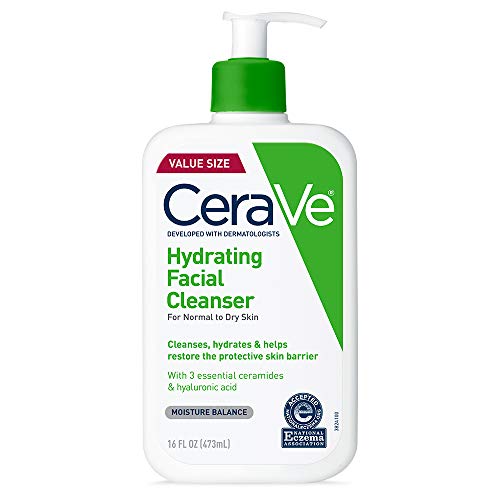
Gentle Cleanser. CeraVe Hydrating Cleanser maintains a pH of 5.5, includes ceramides and niacinamide, and cleans without sulfates. It stops the damage without disrupting your bacterial balance, which is exactly the foundation your skin needs right now. If you’re sensitive to niacinamide, La Roche Posay Toleriane Hydrating Cleanser or Vanicream Gentle Cleanser are both excellent prebiotic cleansers for sensitive skin and work just as well.