
7 Types of Peptides for Skin (And Which One You Need)

Last updated on April 6th, 2026 at 07:55 am

There are several types of peptides for skin, and they all do something different. Serums, moisturizers, eye creams, all promising firmer, younger-looking skin. But most people shopping for peptides don’t realise something important.

Not all peptides work the same way.

Some signal your skin to produce more collagen. Others deliver copper directly to repair tissue and calm inflammation. Some interfere with the muscle contractions that create expression lines over time. These are completely different mechanisms, and matching the wrong type to your concern is the most common reason peptides get written off as overhyped.

As a pharmacologist, I find peptides genuinely interesting because the science is more nuanced than most skincare content lets on. There are real gaps in the evidence worth knowing about, and there are specific peptide types with solid data behind them. Understanding that distinction changes how you shop.

This article breaks down every major type of peptide in skincare, what each one does, who it’s for, what the research shows, and how to use them without wasting money or undermining your routine.

Types of Peptides in Skincare: Which One Do You Need?
  • This post contains affiliate links. All recommendations based on ingredient research and formulation analysis. Purchasing from this link helps this site at no additional cost to you. Please read our affiliate disclosure for more information

What Are Peptides in Skincare?

Peptides are short chains of amino acids that tell your skin to produce collagen, repair tissue, and maintain its barrier. They’re the building blocks your skin uses to make proteins.

Think of amino acids as individual letters forming words (peptides), which then link into full sentences (proteins). Collagen, elastin, and keratin are all proteins, and because they’re large molecules, they can’t penetrate your skin’s outer layer.

Peptides can. They’re smaller, so they slip through and trigger responses deeper down, like signaling cells to produce more collagen or delivering minerals directly to repair tissue.

But ‘peptides’ on a label tells you almost nothing useful. The different peptide types in skincare, signal, carrier, neurotransmitter, enzyme inhibitor, and barrier repair, all work through completely different biological pathways. Match the right type to your concern and you’ll actually see results.
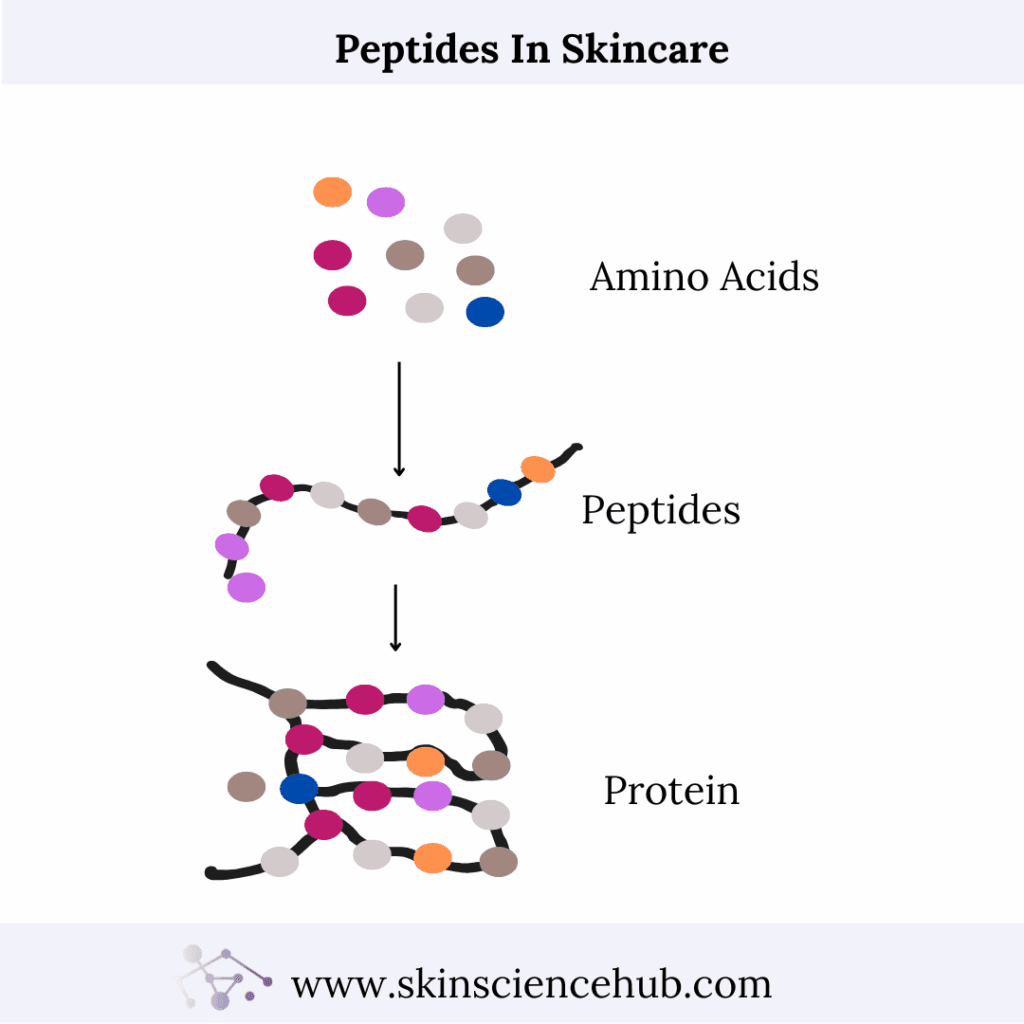
how peptides work in skincare

Do Peptides Work? What the Research Shows

Before spending money, it helps to know what the research looks like.

Most peptide studies are small, short, around 8 to 12 weeks, and company-funded. Results show modest but measurable improvements in fine lines and wrinkles. Matrixyl has the strongest evidence, with measurable improvements in wrinkle depth across multiple independent studies. Argireline shows measurable reduction in expression line depth. Copper peptides have solid evidence for wound healing and post-procedure recovery. Beyond those three, the data gets thinner for other peptide types.

There’s also a size issue. Most skincare peptides are larger than what skin can easily absorb, so some brands add penetration enhancers to help deliver the ingredient deeper. This is why results build gradually over weeks.

Topical Peptides vs Injectable Peptides

These two are very different, and it’s worth knowing why. Injectable peptides like BPC-157 and PDRN go directly into the bloodstream and produce fast, significant results. The impressive before-and-afters you may have seen online often come from those injectable treatments, not skincare serums. Topical peptides work locally on the skin and build results slowly over time. Both have their place, but they’re not interchangeable, and comparing them sets unrealistic expectations for what a serum can do.

The 7 Types of Peptides in Skincare

1. Signal Peptides for Collagen and Firmness

Signal peptides are the most researched anti-aging peptides in skincare, and for general loss of firmness and fine lines, they’re where to start.

They work by mimicking the tiny fragments that appear when collagen breaks down naturally. Your fibroblasts, the cells responsible for making collagen, detect those fragments and read them as “we need more collagen here.” So they ramp up production.

The most studied example is Matrixyl, listed on labels as palmitoyl pentapeptide-4. You’ll also see it as Matrixyl 3000 and Matrixyl Synthe’6 in more advanced formulations. These are the collagen peptides most worth looking for when reading an ingredient list.

Products to try:

  • Medik8 Liquid Peptides – Combines multiple peptide types in one serum, so you get broader coverage without stacking multiple products.
  • The Ordinary Matrixyl 10% + HA – A straightforward, affordable peptide serum for testing whether signal peptides work for your skin before committing to anything expensive.

2. Carrier Peptides for Repair and Healing

Carrier peptides are best for healing situations, post-procedure skin, active inflammation, or a barrier that’s been slow to recover.

Rather than triggering collagen production, they deliver minerals your skin needs for repair directly to where they’re needed. The most common example is copper peptides, specifically GHK-Cu, listed on labels as Copper Tripeptide-1. Copper is essential for collagen synthesis and wound healing, and these peptides shuttle it straight to the tissue that needs it most. They also calm inflammation, which is why dermatologists often recommend them after microneedling or laser treatments.

That said, copper peptides increase collagen-breaking enzymes with prolonged use, so most people cycle them rather than using them as a permanent daily serum.

Products to try:

  • NIOD CAIS – A more sophisticated copper delivery system worth considering if you’re post-procedure or dealing with persistent inflammation that other products haven’t resolved.
  • The Ordinary Buffet + Copper Peptides 1% – A good starting point for testing tolerance before committing to a more advanced formula.

3. Neurotransmitter Peptides for Expression Lines

Neurotransmitter peptides are specifically for expression lines, forehead lines, crow’s feet, and frown lines between the brows that are starting to stick around even when your face is relaxed.

They work by interfering with acetylcholine, the neurotransmitter that tells your facial muscles to contract. Less contraction means less repeated creasing, and over time, shallower lines. The most common example is Argireline, listed on labels as acetyl hexapeptide-8, and often marketed as “Botox in a bottle.” Research shows roughly 30% reduction in expression line depth with consistent use, which is modest compared to Botox’s 80 to 90%, but meaningful for people who want to avoid needles or maintain results between appointments.”

Results show within two to four weeks, faster than signal peptides, because the mechanism targets muscle activity directly.

Products to try:

More Types of Peptides in Skincare

4. Enzyme Inhibitor Peptides for Collagen Protection and Brightening

While signal peptides tell your skin to make more collagen, enzyme inhibitor peptides protect the collagen you already have. They work by slowing down matrix metalloproteinases, the enzymes that break collagen and elastin down over time. The result is skin that holds onto its structure longer.

Some enzyme inhibitors also slow down tyrosinase, the enzyme involved in melanin production, which gives them a secondary brightening effect. Rice peptides and soy peptides are the most common examples you’ll find on ingredient labels.

Worth noting though: most research on enzyme inhibitor peptides comes from lab studies, not clinical trials on human skin. That means we have a good understanding of how they work in theory, but less data on how well they perform in real-world use compared to signal or neurotransmitter peptides.

Products to try:

  • Rice Lipids Peptide Serum – Combines rice peptides with niacinamide and adenosine for barrier support and a visible improvement in skin radiance.

5. Antimicrobial Peptides for Skin Defense

Antimicrobial peptides are part of your skin’s natural immune system. They sit in the outer layer and fight off bacteria, fungi, and other pathogens before they can cause problems. Defensins and cathelicidins are the two main types your skin produces naturally.

In skincare, synthetic versions are used to support the skin’s microbiome, reduce infection risk in compromised skin, and calm inflammation. If you deal with acne, perioral dermatitis, or any condition where bacterial imbalance plays a role, this is the peptide category worth paying attention to.

6. Brightening Peptides for Hyperpigmentation and Uneven Tone

Brightening peptides target melanin production directly. They work by blocking the signals that trigger melanocytes, your pigment-producing cells, to overproduce. The result is a more even tone over time. These work well alongside vitamin C or niacinamide for a more comprehensive brightening approach.

Products to try:

  • BIOCHEM Nonapeptide-1 Brightening Serum – Targets melanin production directly with nonapeptide-1, making it a focused option for dark spots and uneven tone without the irritation risk of stronger brightening ingredients.

7. Barrier Repair Peptides for Sensitive and Reactive Skin

Barrier repair peptides strengthen your skin’s outer layer by supporting ceramide production and reducing inflammation. If your skin reacts easily or takes too long to recover after exfoliation, these peptides help restore normal barrier function. They’re also worth considering if you’re adjusting to retinoids and your skin needs extra support during that process.

Products to try:

Types of Peptides for Skin: Which One Do You Need?

Image inspired by Biomolecules Journal

Which Peptide Is Right for Your Concern?

Loss of Firmness and Fine Lines

Start with signal peptides. They have the strongest evidence base and work directly on collagen production. Look for Matrixyl, palmitoyl pentapeptide-4, Matrixyl 3000, or Matrixyl Synthe’6 on the label.

Expression Lines That Stick Around

Neurotransmitter peptides are your best option here. They target the muscle contractions that create forehead lines, crow’s feet, and frown lines. Look for Argireline or acetyl hexapeptide-8 on the label.

Post-Procedure or Healing Skin

Copper peptides are the most targeted option for recovery. They deliver minerals directly to tissue that needs repair and calm inflammation at the same time. Look for GHK-Cu or Copper Tripeptide-1 on the label. Use them in cycles, four to six weeks on, then take a break.

Dull Skin or Hyperpigmentation

Brightening peptides target melanin production directly, while enzyme inhibitor peptides offer a secondary brightening effect by slowing tyrosinase activity. Either works well alongside vitamin C or niacinamide for better results.

Sensitive, Reactive, or Damaged Barrier Skin

Barrier repair peptides are the right fit. They support ceramide production, reduce inflammation, and help your skin recover its normal function. Look for neurosensine or palmitoyl tripeptide-5 on the label.

How to Use Peptides in Your Routine and What to Avoid

Where Peptides Go in Your Routine

Your peptide serum belongs after cleansing and toning, before your moisturizer. Apply them to clean skin while it’s still slightly damp, then seal everything in with moisturizer on top. They work well morning and night, so there’s no reason to limit them to one part of the day.

What You Can Layer Peptides With

Peptide ingredients play well with most other actives in your routine. Hyaluronic acid, niacinamide, and retinol are all fine to use alongside them. If you’re using peptides in the same routine as retinol, apply your peptide serum first, let it absorb, then follow with retinol.

What Not to Mix with Peptides

Copper peptides and vitamin C are the one combination worth avoiding. They destabilize each other, which reduces the effectiveness of both. Use them at different times of day, copper peptides at night and vitamin C in the morning, or alternate them on different days.

How Long to Use Peptides and When to Cycle

Give any peptide product at least eight weeks before deciding whether it works. Most studies measure results at that point, and your skin follows a similar timeline. Copper peptides are the exception though. Use them four to six weeks on, then take a break. This is because prolonged use increases the enzymes that break collagen down, which works against the repair you’re trying to achieve.

Why Product Format Changes Results

Peptides need contact time with your skin to work. Cleansers and rinse-off products wash them away before absorption happens, so a leave-on peptide serum or moisturizer is the only format worth using.

The Bottom Line

You don’t need every type of peptide. You need the right one for your concern.

For firmness and fine lines, start with signal peptides. For expression lines, go with Argireline. For healing and recovery, copper peptides. For uneven tone, brightening peptides alongside vitamin C or niacinamide. For a struggling barrier, barrier repair peptides.

Results build gradually over months, not weeks. Peptides are gentle, well tolerated, and the best-evidenced types deliver real, measurable improvements with consistent use. Give them eight weeks and match the type to your concern.

FAQ

Yes. Different peptide types work through different mechanisms, so layering them doesn’t cause interference. A signal peptide serum and a neurotransmitter peptide serum can work well together. The one exception is copper peptides alongside vitamin C, which destabilize each other. Beyond that, using two or three complementary types is a reasonable approach if you have multiple concerns.

Retinol delivers stronger, faster results on collagen production and cell turnover, and the evidence base is significantly larger. Peptides are gentler, cause fewer side effects, and work for people who can’t tolerate retinoids. They’re not a direct replacement, but they’re a solid alternative or complement, particularly if your skin is sensitive or you’re in a phase where retinol isn’t an option.

Peptides are generally considered safe during pregnancy, which makes them one of the few anti-aging options available when retinoids are off the table. That said, always check with your doctor before adding anything new to your routine during pregnancy, as some products combine peptides with other actives that aren’t suitable during that time.

There’s no strict age threshold. Peptides make most sense once collagen decline becomes noticeable, which typically starts in the mid to late twenties. Starting earlier does no harm, but the benefits become more relevant as your skin starts losing firmness with age.

Similar Posts

Leave a Reply

Your email address will not be published. Required fields are marked *