

How to Layer Skincare: Morning & Night Routine Order
Last updated on March 20th, 2026 at 10:23 pm
Skincare layering advice online is all over the place. One article tells you niacinamide cancels out vitamin C. Another gives you an 11-step routine and calls it simple.
As a pharmacologist, I understand how these ingredients interact with your skin. I find a lot of this advice more confusing than helpful. Skincare layering is actually straightforward. Two rules and a few simple principles are all you need.
Take the niacinamide and vitamin C debate. You can use them together. The myth that they cancel each other out comes from older in vitro research using conditions that don’t reflect modern formulations. It has nothing to do with how today’s products actually work.
This guide covers how to layer skincare products for your morning and evening routine, the ingredients that genuinely don’t layer well together, and the questions that come up most often, so you can stop second-guessing and get on with it.

The Short Answer
How to Layer Skincare in the Morning
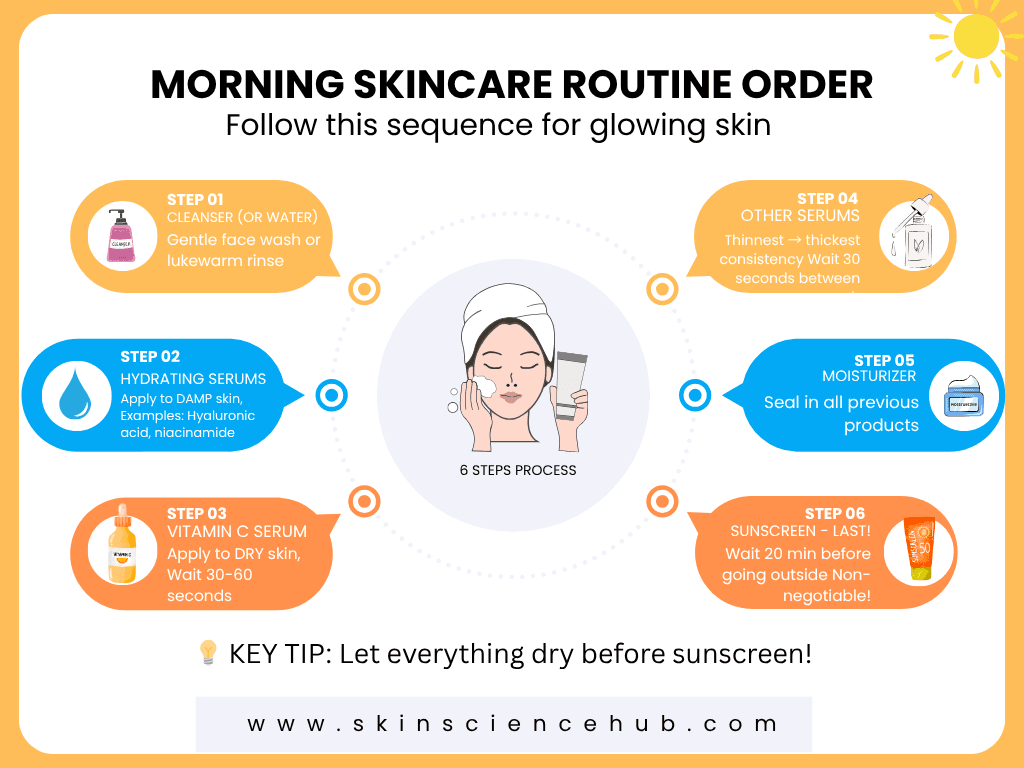
Step 1. Cleanser (or just water)
If you have oily or combination skin, wash with a gentle cleanser. If your skin is dry, a lukewarm water rinse is enough. Over-cleansing in the morning strips the barrier work your nighttime routine just did.
Step 2. Hydrating serums on damp skin
While your face is still damp, apply your hydrating serums. Good options here are hyaluronic acid, niacinamide, and peptides, all of which absorb better on damp skin than dry. Wait about 30 to 60 seconds before moving on.
Step 3. Vitamin C serum on dry skin
Let your skin dry completely before applying vitamin C. Vitamin C is pH-dependent, and research shows it penetrates skin most effectively at pH 3.5 and below. Applying it to wet skin raises the pH at the surface and reduces absorption. Wait about 30 to 60 seconds after applying it before moving on.
Step 4. Additional treatment serums
Layer any remaining serums from thinnest to thickest, waiting about 30 seconds between each. Azelaic acid, growth factors, and brightening serums all go here.
Step 5. Moisturizer
Apply your daytime moisturizer to seal everything in.
Step 6. Sunscreen, always last
Sunscreen goes on last, and the reason is chemistry. Most sunscreens work by forming a protective film on your skin surface, either absorbing UV radiation, reflecting it, or both. That film needs direct contact with your skin to work properly. Anything layered over it, including moisturizer, disrupts the film and reduces your actual SPF protection.
Wait a few minutes for everything underneath to absorb fully before applying sunscreen. If it goes on too soon, it pills. Apply it at least 20 minutes before going outside, because chemical filters need time to bind to your skin before they can absorb UV effectively.
How to Layer Skincare at Night
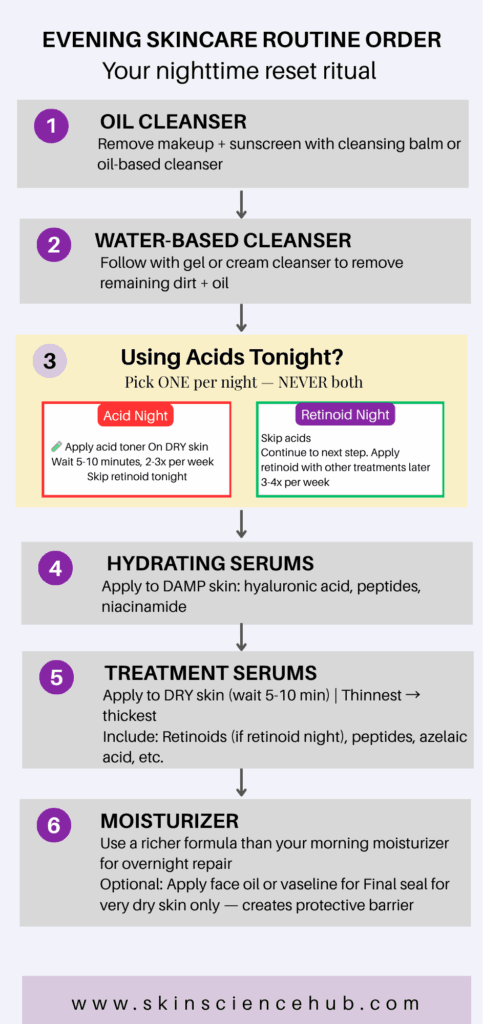
Step 1. Oil-based cleanser
Start with an oil cleanser, cleansing balm, or micellar water to dissolve sunscreen and makeup. Water-based cleansers alone can’t fully break down SPF, so this step matters more than most people realise.
Step 2. Water-based cleanser
Follow with your regular gel or cream cleanser to clear anything left behind. This is double cleansing, and it gives your actives a clean surface to actually work on.
Step 3. Acid night or retinoid night, not both
This is the most important decision in your evening routine, and it’s straightforward once you have a system.
On acid nights (2 to 3 times a week), apply your AHA or BHA toner, like Paula’s Choice BHA or The Ordinary Glycolic Acid, to dry skin and wait 5 to 10 minutes. No retinoids tonight.
On retinoid nights (3 to 4 times a week), put the acids away and move straight to step 4. You’ll apply your retinoid later in the routine with your other treatment serums.
Alternating them prevents over-exfoliation and keeps your barrier intact.
Step 4. Hydrating serums on damp skin
While your skin is still damp, apply hyaluronic acid, niacinamide, or peptide serums. The same logic from your morning routine applies here. Damp skin absorbs these ingredients better.
Step 5. Treatment serums on dry skin
Wait until your skin is completely dry, about 5 to 10 minutes after cleansing, then layer your treatment serums from thinnest to thickest. If it’s a retinoid night, retinoid goes first, followed by peptide serums, azelaic acid, and any other targeted treatments.
How to Layer Retinol
Knowing how to layer retinol correctly makes a real difference to how well it works and how much irritation you get.
The main rule is dry skin only. Applying retinol to damp skin increases absorption, but it also increases irritation significantly. Always wait until your skin is fully dry after cleansing, about 5 to 10 minutes, before applying it.
If your skin is sensitive, the sandwich method works well. Apply a thin layer of moisturizer, wait 5 minutes, apply your retinol, then follow with another layer of moisturizer on top. This slows absorption slightly and reduces irritation without affecting results.
And never use retinol and acids on the same night. Alternate them across the week and both will work better for your skin.
Step 6. Moisturizer
Use a richer moisturizer at night than in the morning. Your skin repairs and regenerates while you sleep, and a more substantial moisturizer supports that process by keeping your barrier sealed and hydrated through the night.
Step 7. Occlusive, for dry skin
If your skin is dry, seal everything with a face oil or a petrolatum product like Vaseline or CeraVe Healing Ointment. This is always your absolute last step. Nothing goes over it.
If you have oily skin, you don’t need this step. A good moisturizer seals your routine well enough at night, and adding an occlusive on top will likely feel uncomfortable and cause congestion. But if your skin is dry or your barrier is compromised, the occlusive step is worth adding at least a few nights a week. Your skin will feel noticeably different by morning.
Which Skincare Ingredients Don’t Work Together
Most ingredients in your routine can be layered without any issue. But a few combinations cause problems, and as a pharmacologist, I can tell you the issues are chemistry-based, not arbitrary rules someone made up. Either the ingredients deactivate each other, or combining them pushes irritation higher than either would cause alone.
Retinoids and acids on the same night
This is the one combination worth taking seriously. Using both on the same night doesn’t make your routine more effective. It strips your barrier, causes redness, and often sets your skin back further than if you’d used neither. Alternate them across the week and both will work better.
Benzoyl peroxide and retinol
Benzoyl peroxide oxidises retinol, which means it breaks the molecule down before it can do anything useful. If you use both, apply them at different times, benzoyl peroxide in the morning and retinol at night, or on separate nights entirely.
Benzoyl peroxide and vitamin C
Same problem. Benzoyl peroxide is an oxidising agent and vitamin C is easily oxidised, so using them together wastes the vitamin C. Morning vitamin C, evening benzoyl peroxide if you need both.
Multiple exfoliating acids together
Layering an AHA, a BHA, and a PHA in the same routine doesn’t give you triple the exfoliation. It gives you a damaged barrier. Pick one acid per session and rotate if needed.
What about vitamin C and niacinamide?
You can use them together. The concern came from one outdated study using conditions that have nothing to do with modern formulations. In practice they work fine layered, and many products combine them deliberately.
The Bottom Line
Skincare layering doesn’t need to be complicated, and it definitely doesn’t need to be stressful. The order matters less than most content online suggests. What actually makes a difference is consistency, using the right ingredients for your skin, and giving them enough time to work.
A simple routine you do every day beats a complicated one you abandon after two weeks. Start with the basics, cleanser, moisturizer, and sunscreen, and build from there only when your skin is ready for more.



I really liked how you simplified skincare layering without turning it into a long list of rigid rules. Your point about applying hydrating products on damp skin but using stronger actives like retinoids, acids, and vitamin C on dry skin was especappreciated the reminder that sunscreen should always be the final morning step and that petrolatum truly belongs at the very end. This is one of the clearest explanations I’ve read on the topic. Do you think azelaic acid is better treated like a gentle active in most routines, or would you still place it with stronger treatment steps for sensitive skin?
Great question. Azelaic acid is much gentler than the exfoliating acids like glycolic or salicylic. You can use it on the same night as retinoids without over-exfoliating.
For most routines, place it with your treatment serums on dry skin. Wait until your skin is dry after cleansing, apply it along with other treatments, then seal with moisturizer.
For sensitive skin, you have options. If your skin tolerates it well, keep it with treatments on dry skin. If you’re getting irritation from layering multiple actives, apply moisturizer first, wait a few minutes, then apply azelaic acid on top. This reduces irritation while still giving you results.
The key difference is that azelaic acid doesn’t compromise your skin barrier like glycolic or salicylic can. It plays well with other ingredients and rarely causes the sensitivity issues you see with retinoids or strong exfoliating acids. Treat it as a gentler active.