
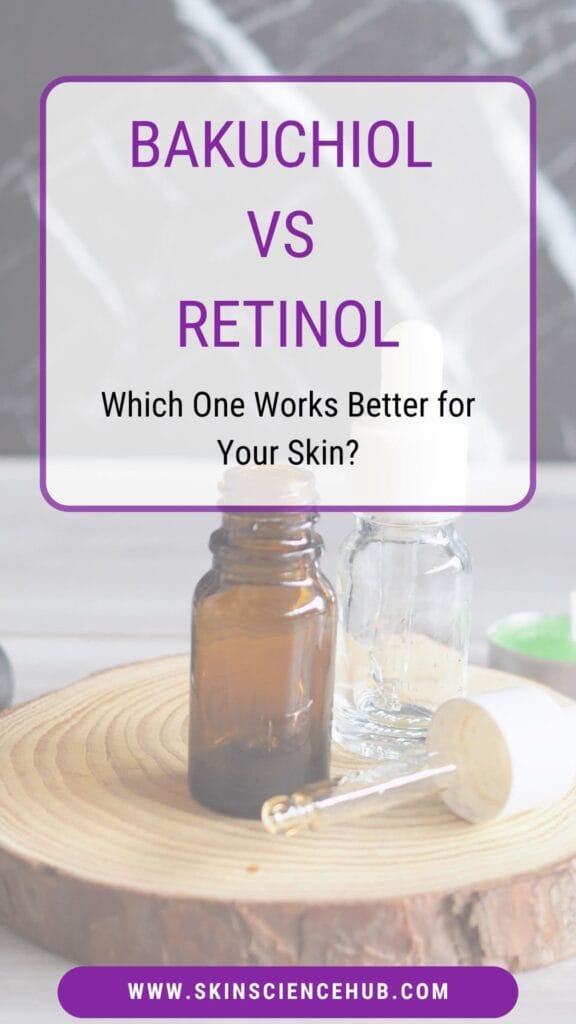
Bakuchiol vs Retinol: Which One Works Better for Your Skin?
Last updated on July 16th, 2026 at 10:45 am
Bakuchiol (pronounced bah-koo-chee-all) gets called “natural retinol” a lot, and the nickname is not entirely wrong. A 2007 study found it switched on many of the same skin genes as retinol, which is a surprising finding for a plant compound with no structural relationship to vitamin A.
Retinol has decades of clinical research behind it and remains the ingredient other actives are measured against. So when it comes to bakuchiol vs retinol, which one should you choose?
As a pharmacologist, my take is that both earn their place, but not always for the same concerns.
If you want to see how bakuchiol compares to other retinol alternatives, you can read Best Retinol Alternatives.
Bakuchiol vs Retinol at a Glance
| Bakuchiol | Retinol | |
|---|---|---|
| Source | Plant-derived (babchi plant) | Vitamin A derivative |
| Best for | Fine lines, surface pigmentation, texture, sensitive skin | Fine lines, stubborn pigmentation, acne |
| When to use | Morning or evening | Evening only |
| Time to see results | 12+ weeks | Varies by concentration |
| Irritation risk | Low | Common in first few weeks |
| Sun sensitivity | No | Yes |
| Safe in pregnancy | No retinoid risk, check with provider | No |
| Use together | Yes | Yes |
What Is Bakuchiol and How Does It Work?

Bakuchiol is extracted from the seeds and leaves of the babchi plant, Psoralea corylifolia, a plant used in Ayurvedic and traditional Chinese medicine for centuries. Chemically, it is a meroterpene phenol, which is a fancy way of saying it shares no structural similarity with vitamin A and is not a retinoid.
The “natural retinol” nickname came from what it does in skin, not what it is made of.
Bakuchiol activates gene expression patterns in skin that closely resemble what retinoids trigger, switching on the same genes responsible for collagen production, cell turnover, and the structural proteins that keep skin firm. It also has antioxidant and anti-inflammatory properties that help neutralize free radical damage.
As a pharmacologist, the receptor pathway is where bakuchiol’s tolerability comes from. Retinoids work by binding to receptors called RAR-β and RAR-γ, which regulate skin gene expression. Bakuchiol produces similar effects without binding those receptors, working through different cellular pathways, including some involving mitochondrial proteins. That is why it causes far less irritation and does not carry the teratogenic risk retinoids do during pregnancy.
Before you buy bakuchiol, look for it listed as the isolated compound on ingredient labels, not as Psoralea corylifolia extract. The extract is a weaker, far less studied form and not what the clinical research is based on.
What Is Retinol and How Does It Work?
Retinol is the ingredient other actives are measured against. It is a vitamin A derivative that converts into retinoic acid inside your skin in 2 stages. Your skin first converts retinol into retinaldehyde, and then retinaldehyde converts into retinoic acid, the form your skin can use.
Retinoic acid binds directly to those same RAR receptors, switching on genes that boost collagen production, accelerate cell turnover, and fade pigmentation. Because RAR activation drives cell turnover so rapidly, the skin barrier temporarily weakens, causing the dryness, redness, and peeling most people notice in the first few weeks.
For a deeper look at the full retinoid conversion ladder, including where retinaldehyde fits in, you can read What Is Retinaldehyde and How Does It Work on Skin.
What the Research Says About Bakuchiol vs Retinol
In 2014, Chaudhuri and Bojanowski published gene expression research confirming that bakuchiol activates many of the same skin genes as retinol, including those involved in collagen production and cell turnover. That work established bakuchiol as a functional retinol analog, meaning an ingredient that produces similar effects to retinol without being a retinoid. The 2019 Dhaliwal trial is the clinical evidence that followed.
The Dhaliwal trial is the only randomized, double-blind, head-to-head comparison of the 2 ingredients conducted to date. Of the 44 participants, half used bakuchiol 0.5% cream and half used retinol 0.5% cream for 12 weeks. Both groups showed significant reductions in wrinkle surface area and hyperpigmentation with no statistically significant difference between the 2 compounds, and retinol users reported more scaling and stinging throughout.
The study has 2 design limitations. Bakuchiol was applied twice daily while retinol was applied once daily, so the doses were not equivalent. The trial also focused specifically on photoaging, covering wrinkles and surface pigmentation, and did not evaluate bakuchiol for acne, rosacea, or other concerns retinol is commonly used for.
Retinol has decades of large clinical trials behind it. Bakuchiol has 1 rigorous comparison study, and the evidence base between the two is not yet equal.
How Long Does Bakuchiol Take to Work?
Both groups in the study saw significant improvements in fine lines and hyperpigmentation by week 12. That makes 12 weeks a reasonable benchmark for bakuchiol, and the timeframe most people use for before and after comparisons.
Retinol typically shows results sooner. Because retinol drives cell turnover more aggressively, surface-level changes in texture and tone can appear within 4 to 8 weeks. Deeper changes to fine lines and pigmentation take longer, often 3 to 6 months, and higher concentrations tend to produce results faster because more retinoic acid is generated from conversion.
Bakuchiol works through a gentler pathway, which is part of why the timeline is longer, but it can be used twice daily without the irritation that slows retinol users down. Consistent twice-daily use builds results steadily, and skin that stays calm throughout is skin that keeps using the active.
Give bakuchiol at least 12 weeks and use it consistently to see results.
Bakuchiol or Retinol: Matching the Right One to Your Skin Concern
For Fine Lines
Clinically, no significant difference was found in wrinkle reduction between bakuchiol and retinol at 12 weeks. For fine lines, bakuchiol is the more practical choice if you have sensitive skin, cannot tolerate retinol, or want an active you can use in the morning.
For Stubborn Pigmentation, Melasma, and Acne
Retinol is the stronger choice here. It drives cell turnover rapidly, which fades deep pigmentation faster and keeps pores clear, and its clinical track record for acne and melasma is extensive. Oily and acne-prone skin types tend to benefit most, since retinol addresses both active breakouts and the discoloration they leave behind.
For Texture, Tone, and Morning Use
Bakuchiol performs well on uneven texture and surface-level discoloration, and its antioxidant properties help neutralize free radical damage from UV exposure. Because it is photostable and does not increase sun sensitivity, it can be used in the morning at full strength. Sensitive, dry, and reactive skin types also tend to do best with bakuchiol as their daily active.
Side Effects and Tolerability
Most people experience some combination of dryness, peeling, redness, and tingling in the first few weeks of using retinol, and because it increases sun sensitivity, it is generally kept to evening use. For some people these side effects are manageable, but for others they are the reason they stop using retinol altogether.
Bakuchiol users in the study reported considerably less scaling and stinging than the retinol group, and while some participants saw redness at week 4, it had fully resolved by week 8. It also does not need to be restricted to evenings, and most people tolerate twice-daily use from the start.
For a closer look at how retinol works on sensitive skin, read Retinol for Sensitive Skin.
Can You Use Bakuchiol and Retinol Together?
Yes, and for a good reason. Bakuchiol’s anti-inflammatory properties help buffer retinol’s irritation, so some people who found retinol difficult to tolerate on its own find it more manageable when bakuchiol is part of their routine. The 2 also appear to complement each other well, with bakuchiol covering morning use and antioxidant protection while retinol handles the heavier lifting at night.
You can layer both in your evening routine, use a product that formulates them together, or keep bakuchiol in the morning and retinol at night so you have an active working in both routines.
Starting retinol alongside bakuchiol means less redness and peeling, and skin that stays calmer in the early weeks.
Is Bakuchiol Safe During Pregnancy?
All retinoids, retinol included, are off limits during pregnancy and breastfeeding. They are teratogenic, meaning they can harm fetal development. Bakuchiol does not share that risk, which is why some practitioners recommend it as an alternative during pregnancy.
However, bakuchiol has not been formally studied in pregnant or breastfeeding women. What the evidence shows is the absence of the known teratogenic mechanism, not confirmed safety through clinical trial. For that reason, always check with your provider before adding any active during pregnancy.
If you are looking for other actives considered safer during pregnancy, azelaic acid is another well-regarded option.
Best Bakuchiol Serums and Retinol Products
Bakuchiol
Herbivore Botanicals Bakuchiol Retinol Alternative Smoothing Serum

Herbivore Botanicals Bakuchiol Retinol Alternative Smoothing Serum is a fragrance-free, water-gel formula with 1% bakuchiol and no added actives, making it a focused option for sensitive or reactive skin.
EQQUALBERRY Bakuchiol Plumping Serum

EQQUALBERRY Bakuchiol Plumping Serum combines 0.5% bakuchiol with 4% niacinamide and ceramides. The formula includes bergamot oil, a phototoxic ingredient, so SPF is necessary if using it in the morning. The niacinamide and ceramide base makes it a good choice for skin that needs bakuchiol alongside barrier repair.
ISDIN Melatonik Night Serum

ISDIN Melatonik Night Serum combines bakuchiol with vitamin C and melatonin, targeting fine lines and free radical damage together. It suits those who want bakuchiol and antioxidant protection without adding separate products to their evening routine.
Retinol
CeraVe Resurfacing Retinol Serum

CeraVe Resurfacing Retinol Serum uses encapsulated retinol, which releases gradually into the skin to reduce the intensity of early irritation. The ceramide and niacinamide base supports the skin barrier throughout, making it the most conservative starting point for retinol beginners.
La Roche-Posay Retinol B3 Serum

La Roche-Posay Retinol B3 Serum contains 0.3% pure retinol alongside niacinamide. Pure retinol at this concentration is a straightforward option for those ready to move beyond encapsulated formulas, with niacinamide included to keep sensitivity manageable.
Paula’s Choice 1% Retinol Treatment

Paula’s Choice 1% Retinol Treatment contains 1% retinol, the highest concentration available over the counter, in an antioxidant-rich formula. It suits experienced retinol users whose skin tolerates retinol well and who want more significant results.
For more retinol product options, read
The Bottom Line
For stubborn pigmentation, melasma, and acne, retinol is the stronger option, backed by decades of clinical research. For fine lines and surface-level concerns, bakuchiol performs comparably with far less irritation.
If your skin can tolerate both, the 2 work better together than either does alone.