Over-the-Counter Retinol for Acne: How to Use It Without Irritating Your Skin
Last updated on July 24th, 2026
Retinol is a derivative of vitamin A, and it’s one of dermatology’s most researched over-the-counter ingredients for treating acne. It belongs to a class of compounds called retinoids, which work by speeding up cell turnover inside the follicle. Faster turnover clears out dead skin cells and oil that clog pores, plus retinol’s anti-inflammatory action calms the swelling that turns a clog into a visible breakout.
That combination, clearing the clog and calming the inflammation, is why retinol treats the acne you already have and prevents new acne from forming. Getting that benefit means staying consistent, and consistency comes down to how well your skin tolerates retinol at first.
This post covers how retinol clears acne, then how to use it without irritating your skin.
How Retinol Clears Acne
Most acne treatments fight the bacteria once a breakout is already forming. Retinol works earlier than that, correcting the abnormal shedding that creates the clog those bacteria thrive in. That’s why it treats existing breakouts and prevents new ones at the same time.
1. It Normalizes Cell Turnover
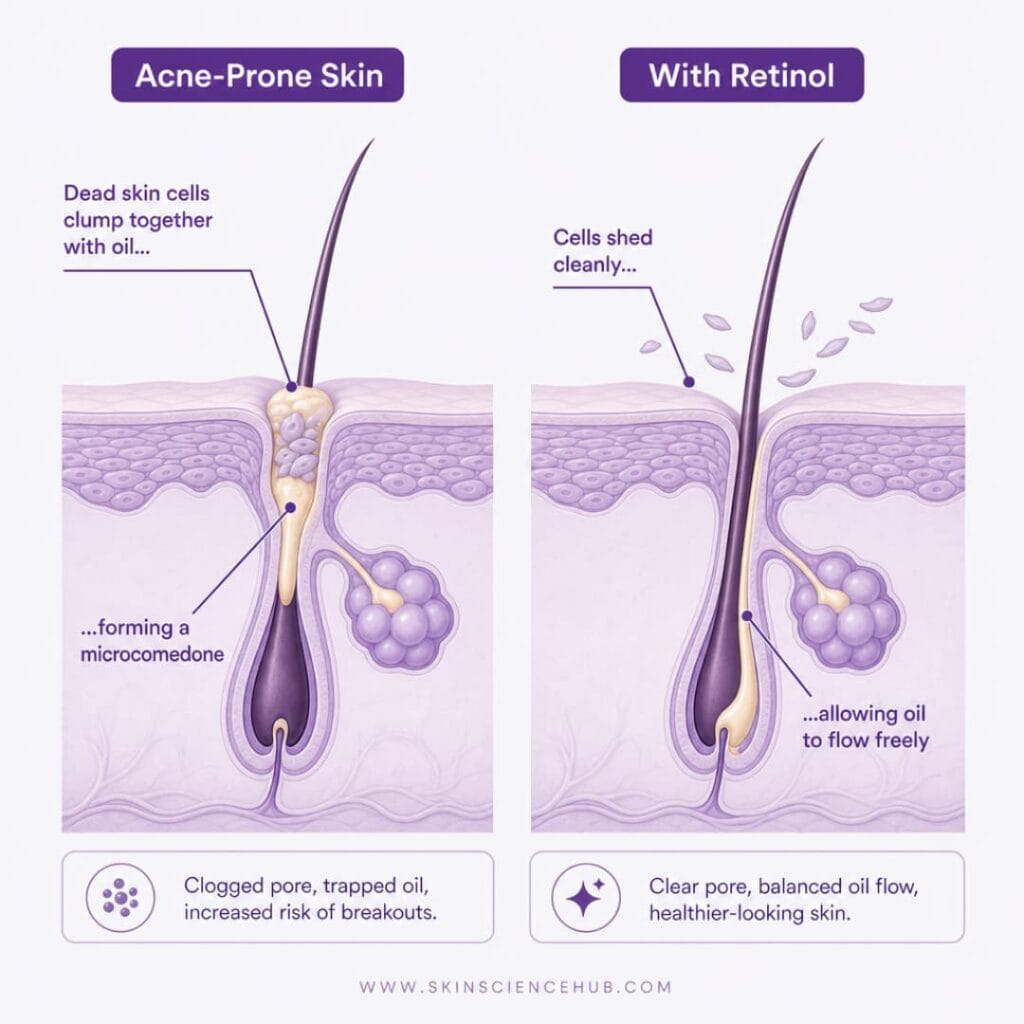
Inside a healthy follicle, dead skin cells shed cleanly. In acne-prone skin, those cells stick together instead, mixing with oil to form a microcomedone. That’s the earliest stage of every breakout, and it happens before anything is visible on the surface.
When you apply retinol, it converts to retinoic acid in your skin and activates the RAR-gamma receptors abundant in skin cells, correcting the abnormal shedding behind the clog. Once that process normalizes, oil moves freely through the follicle again, loosening the microcomedones already there and keeping new ones from forming.
2. It Calms Inflammation
Retinol calms inflammation by making your skin less sensitive to acne bacteria, so it reacts with less swelling and redness when bacteria are present. That bacterial activity starts inside the microcomedone, long before it ever becomes a visible breakout, meaning retinol’s anti-inflammatory effect is already working on skin that looks completely clear.
3. It Fades Post-Acne Marks, Not Acne Scars
A breakout that heals can leave two different things behind, post-acne marks or acne scars. Marks are flat discoloration, and retinol clears them faster through the same cell turnover process.
Scars are different. They come from collagen damage that changes your skin’s texture, not just its color. Retinol may soften very mild cases at best. Microneedling and laser resurfacing treat it directly. Our guide to retinol for hyperpigmentation covers exactly how long marks take to fade
What Types of Acne Retinol Works Best For
Comedonal Acne
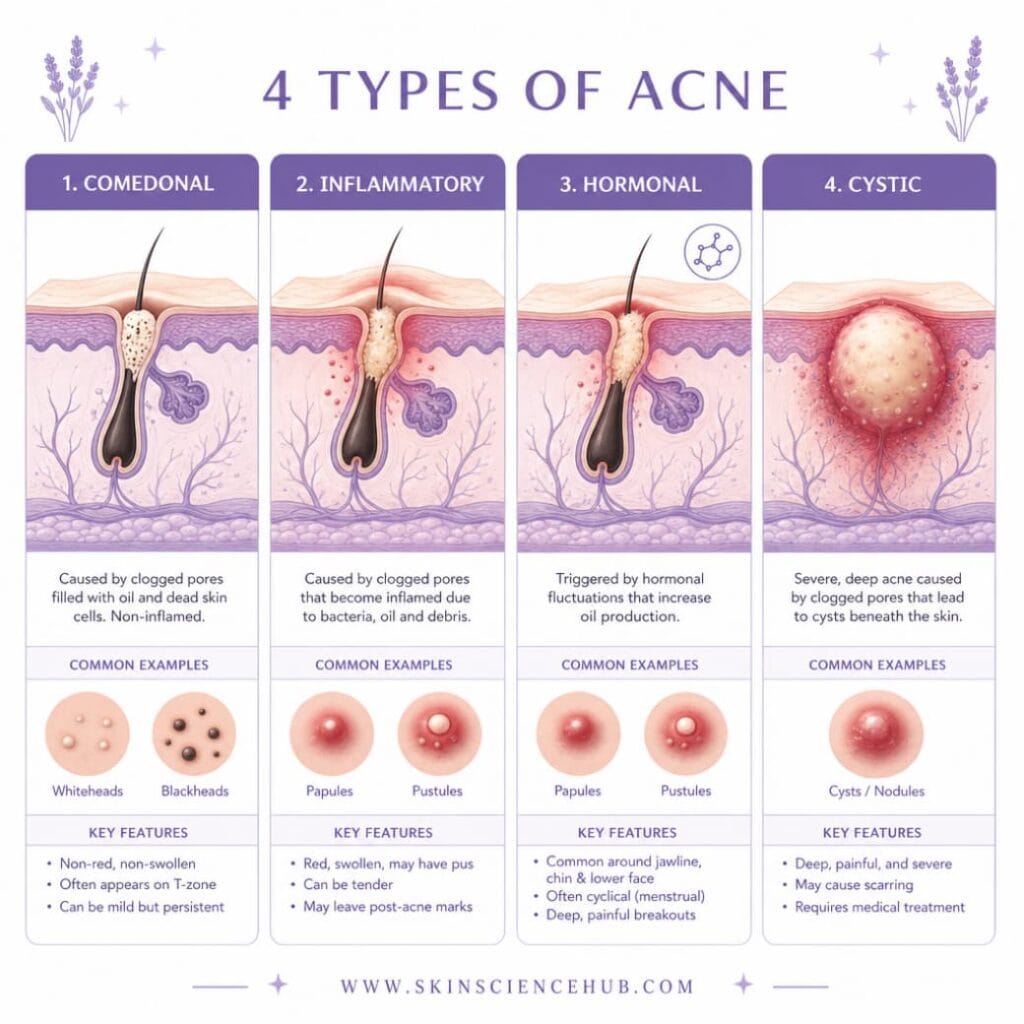
Blackheads and whiteheads are retinol’s strongest use case, since they come directly from the clogged follicles retinol is built to clear.
Inflammatory Acne
Red, swollen papules and pustules respond well too, because they combine a clogged follicle with active inflammation, the two things retinol treats at once.
Hormonal Acne
Hormonal acne shows up as deep breakouts along the jawline and chin, and in women, it tends to flare in the days before menstruation. It happens because androgens push the oil glands to overproduce. Lowering that usually needs a prescription, such as an oral contraceptive or spironolactone, both of which can take a few months to fully work. Retinol won’t lower androgen activity, but it keeps your follicles clear, so new breakouts don’t pile on top before the prescription kicks in.
Cystic and Severe Acne
Retinol isn’t built to handle cystic acne by itself. These deep, painful breakouts sit below where topical treatment can reliably reach, so they typically need a prescription, often isotretinoin. Retinol is usually paused while you’re on it, because combining two retinoids on already-sensitized skin adds irritation without adding benefit. Once that course finishes, retinol comes back in as a maintenance step that keeps follicles clear and reduces the likelihood of new cysts forming.
Retinol vs Other Acne Treatments
If you’re already using benzoyl peroxide, salicylic acid, or azelaic acid for acne, knowing how each one interacts with retinol determines whether to combine them or rotate them.
Retinol vs Benzoyl Peroxide
Benzoyl peroxide kills acne bacteria and has a mild comedolytic effect, and retinol corrects the abnormal shedding pattern that creates the clog.
Benzoyl peroxide can also degrade certain retinoids on contact through oxidation. An older unstabilized tretinoin lost up to 95% of its potency within 24 hours of contact with benzoyl peroxide in one study, while a newer optimized tretinoin gel showed no breakdown under the same conditions. Over-the-counter retinol products haven’t been tested either way, so using benzoyl peroxide in the morning and retinol at night means you don’t have to worry about whether your specific product degrades on contact, and you still get the benefit of both.
Retinol vs Salicylic Acid
Salicylic acid is oil soluble, so it travels into the pore and breaks apart the buildup of dead skin cells trapped there. Retinol works earlier, correcting the shedding pattern that creates that buildup. Both accelerate cell turnover in their own way, so alternating nights gives your skin room to respond to each one without overwhelming it.
Retinol vs Azelaic Acid
Azelaic acid fights acne bacteria, calms inflammation, and fades dark marks. Retinol clears pores and normalizes shedding, and its anti-inflammatory effect overlaps with azelaic acid’s, which means the two complement each other well. Start on alternate nights, because azelaic acid needs time to settle and adding retinol on top before that happens doubles the irritation load. Most people build up to using both more frequently once their skin has adjusted to azelaic acid first.
How to Start Retinol for Acne Without Irritating Your Skin
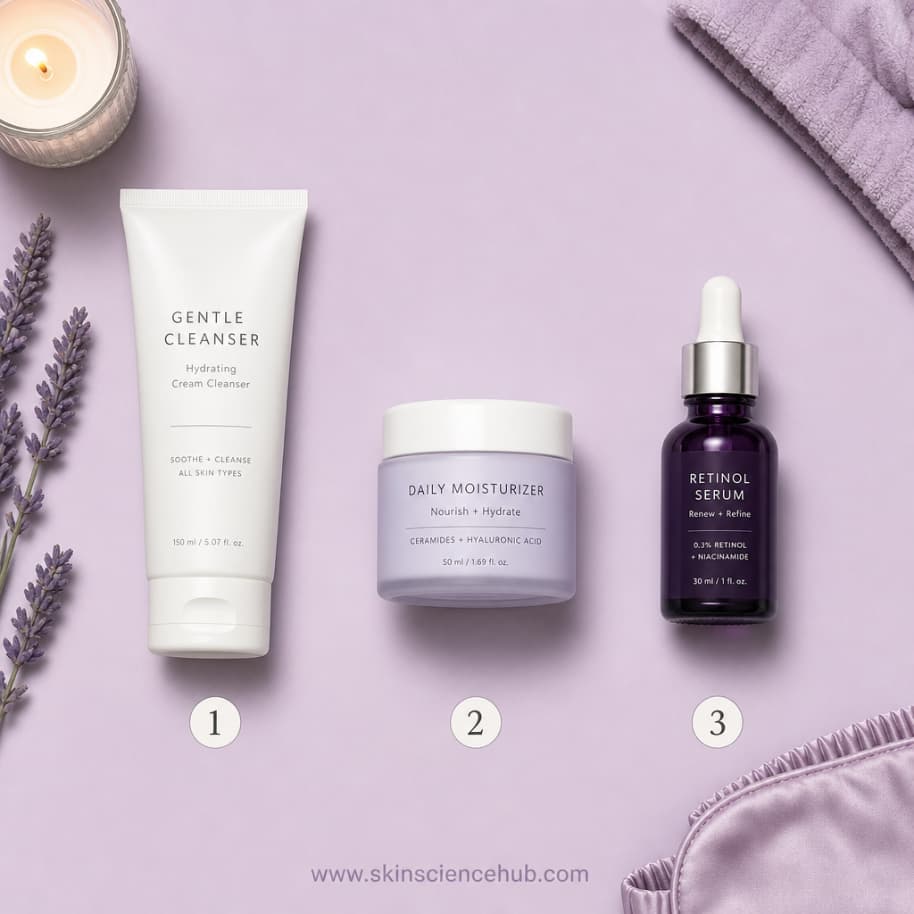
Start with 2 to 3 nights a week, because your skin needs time to adjust before it can tolerate daily use. During those nights, apply a pea-sized amount across your whole acne-prone area, not just on active breakouts. Retinol prevents new breakouts before they form, which is why it needs to reach skin that looks clear too.
Each of those nights, apply a moisturizer first, then the retinol on top, so that buffer cuts down on irritation while your skin is still adjusting. Once you’re tolerating that schedule well, add a night each week until you’re using retinol nightly. Most people get there within a month, though plenty take longer, and that’s fine.
Some irritation along the way is normal. Redness, dryness, and peeling are common during this stretch, and they ease up as your skin adjusts. If your skin stays red, tight, or visibly peeling for more than 2 to 3 days at a time, drop back to every other night for a week before building up again.
If you’re also using other acne treatments alongside retinol, the combining rules in Retinol vs Other Acne Treatments apply to this same schedule.
What Is the Retinol Purge?
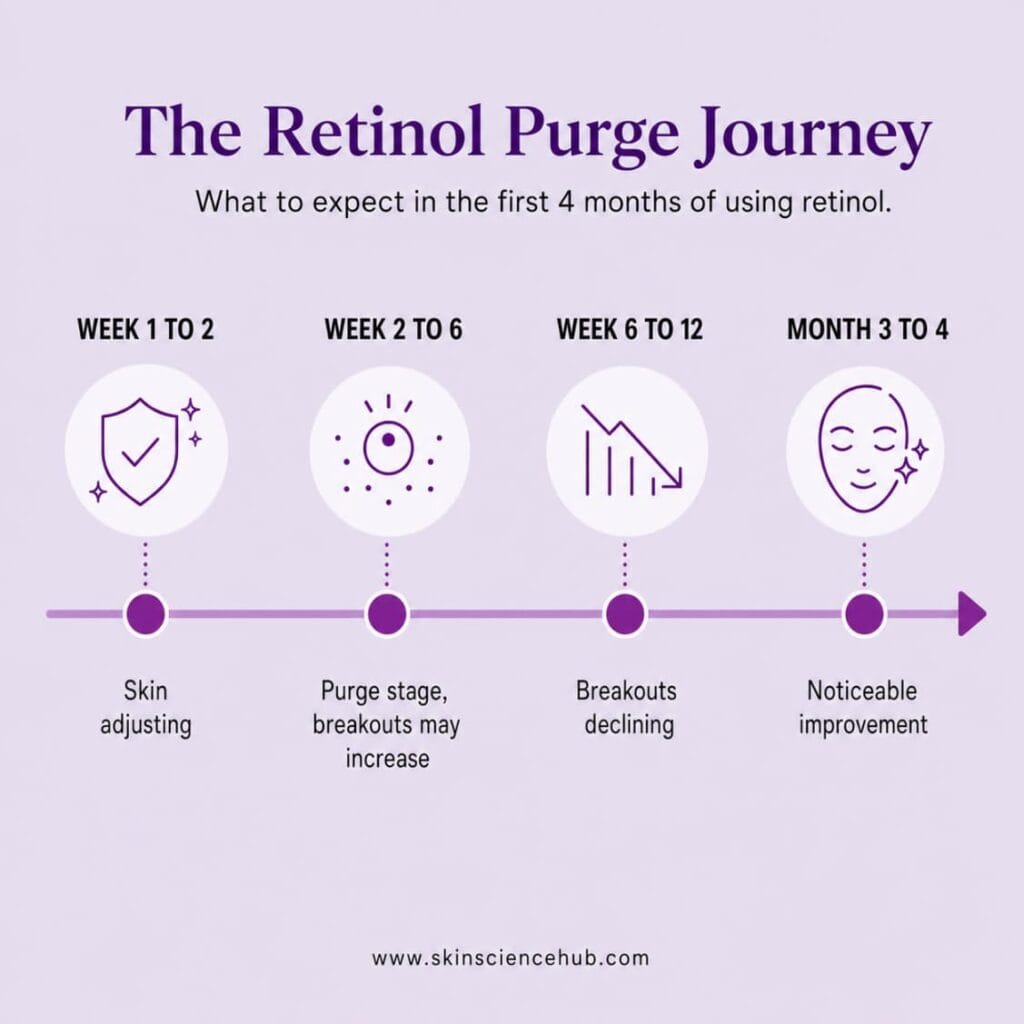
What people call the retinol purge is rarely retinol creating new problems. It’s usually retinol speeding up the surfacing of problems that were already there. Acne starts with inflammation and microcomedones forming under the skin well before anything becomes visible, so when retinol speeds up cell turnover, it pushes that hidden buildup to the surface faster than it would have shown up on its own.
That’s why you might see more breakouts before things improve, even though retinol is doing exactly what it’s supposed to do. Most purging shows up in the areas you already break out in, and it eases up within 2 to 6 weeks as that backlog clears.
A reaction looks different from a purge. New breakouts in spots you don’t normally get them, or breakouts that keep increasing past 8 weeks, point to a reaction. That’s when backing off your frequency and giving your skin more time between applications is the right call.
The hardest part of a purge is psychological, not physical. Quitting in week 3 feels reasonable when your skin looks worse than when you started. That’s usually right before your skin starts improving, not a sign to stop.
To learn more, read:
Common Retinol Mistakes That Make Acne Worse
A few habits work against retinol, even if everything else in your routine is right.
- Going too hard too soon – It’s tempting to jump straight to daily, full-strength use. That just piles fresh irritation onto inflammation that’s already there, and the strain on your skin barrier can set off new breakouts.
- Spot treating instead of covering the whole area – If you’re only treating the pimples you can see, new ones keep forming in the spots you missed. Retinol needs to reach the skin that looks clear too.
- Stacking too many active ingredients into one routine – Throwing exfoliants, a strong vitamin C, and retinol into the same routine all at once overwhelms your skin faster than any one of them would on its own.
- Going without moisturizer – Skin that’s adjusting to retinol needs that buffer, and going without it leaves your barrier exposed right when you need the cushion most.
- Quitting during the purge – This is the one that costs people the most, because restarting later means starting over from the beginning.
- Going without sunscreen – This one works against you twice over. Retinol makes your skin more sun sensitive, and unprotected sun exposure makes any post-acne dark marks darker and slower to fade.
How Long Until Retinol Clears Acne
Retinol takes months to work, so you need to stay consistent.
Breakouts can increase for the first 2 to 6 weeks before things improve. They keep declining through 8 to 12 weeks, and most people see stable, noticeable improvement by 3 to 4 months.
Dark marks left behind by old breakouts take 3 to 6 months to noticeably fade, because pigmentation always clears slower than active acne does.
Given how long this takes, staying consistent works better than reaching for something stronger. A lower-strength retinol used every night clears acne faster than a stronger one used on and off.
Should You Use Retinol or Retinal for Acne
Retinaldehyde, often shortened to retinal, converts to active retinoic acid in one step inside your skin. Retinol needs two. That extra step doesn’t slow retinol down by much, but it does mean retinal gets more active retinoic acid into your skin for the same applied amount, and research backs that up with measurably higher bioavailability and skin penetration.
What that doesn’t prove is that retinal clears acne faster than retinol in practice. Head-to-head studies on acne outcomes are still thin.
Retinal does have one legitimate point of difference for acne. Its aldehyde group also fights Cutibacterium acnes directly, the bacteria most tied to inflammatory breakouts, giving it an antibacterial action retinol doesn’t have.
If you’re new to retinoids, retinol remains the better place to start, as it’s gentler while your skin builds tolerance. Once your skin handles retinol well, retinal is a reasonable next step if you want more from the same ingredient class. Don’t use both together. Pick one and stay consistent.
Aside Retinol, there are other ingredients for acne. My guide shows you how which ones without irritation.
Best Over-the-Counter Retinol Products for Acne
CeraVe Resurfacing Retinol Serum

A strong starting point for acne-prone skin new to retinol. Encapsulated retinol, ceramides, and niacinamide come built in, so barrier support and mark-fading are already covered in one fragrance-free, non-comedogenic formula.
The Ordinary Retinol 0.5% in Squalane

The cleanest budget pick for someone who has already used retinol. The concentration is clearly stated on the label, and squalane keeps the formula from stripping your barrier while the retinol works.
La Roche-Posay Pure Retinol Face Serum

Built for sensitive acne-prone skin that has reacted badly to other retinols. Niacinamide and hyaluronic acid are already in the formula, handling the irritation so you don’t need a separate buffer on top.
Paula’s Choice Clinical 1% Retinol Treatment

The highest retinol concentration available over the counter, for skin that has already built full tolerance and wants to push further. Peptides and licorice extract add barrier support and mark-fading on top of the retinol’s acne work.
For more retinol product options, read
Bottom Line
Retinol works for acne. What determines how well comes down to how you use it.
Start with 2 to 3 nights a week and build from there. Cover your whole acne-prone area, not just the breakouts you can see. Stay with it through the purge.
Do that, and you get clearer skin with fewer post-acne marks.