
Skin Purging vs Breakout: 4 Signs to Tell the Difference
Last updated on September 6th, 2026
If you recently started a new product and your skin suddenly looks worse, you’re probably asking yourself one question. Is this skin purging or a breakout?
It’s a fair question and a tricky one, because both look almost identical. They show up as the same spots and blemishes, feel equally uncomfortable, and have a habit of arriving right when you were hoping for clearer skin. But they have completely different causes and need completely different responses, and 4 signs will help you tell them apart.
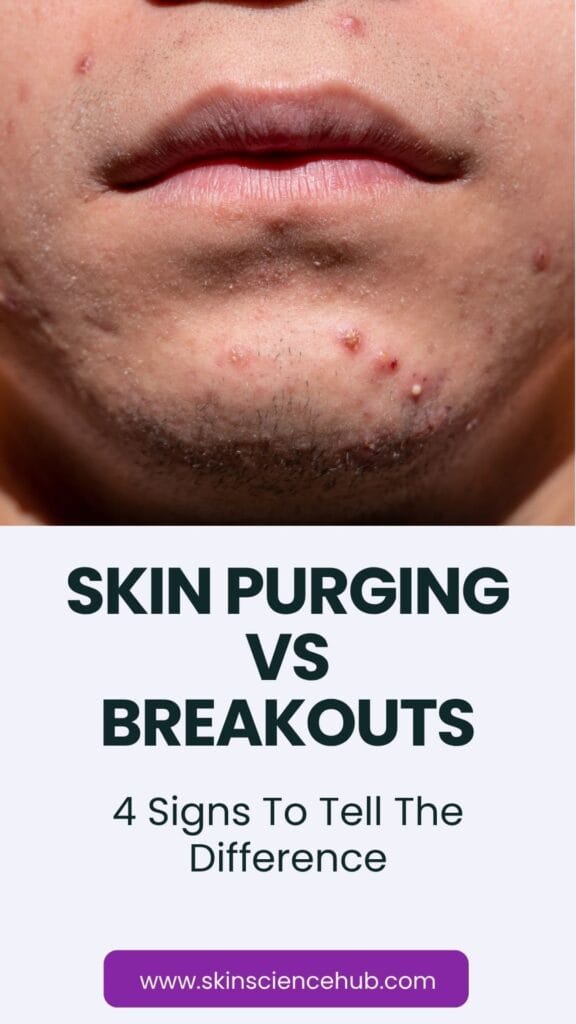
What Is Skin Purging?
Skin purging is a temporary increase in breakouts caused by ingredients that speed up your skin’s cell turnover.
Your skin is always cycling through new cells, pushing older ones toward the surface and shedding them, and that cycle takes around 28 to 40 days. When you introduce an ingredient that speeds it up, like a retinoid or a chemical exfoliant, everything moves through faster, including the tiny clogs that were already forming beneath the surface.
Those clogs are called microcomedones. They sit inside your pores, completely invisible, until the cell cycle pushes them out. Most people assume the product caused the breakouts, but as a pharmacologist, I can tell you that’s not what’s happening. The congestion was already there. Your skin was going to surface it eventually, and a cell-turnover accelerator just gets there first. That’s why you can go from clear-looking skin to a sudden crop of breakouts within days of starting something new.
Think of it like cleaning out a cluttered cupboard. Before you start, everything is packed away and the kitchen looks tidy. The moment you begin pulling things out, it looks like chaos, but you’re not creating new mess. You’re just moving what was already there, and when you’re done, the cupboard is clear. Your skin works exactly the same way, and that’s why purging is a sign the product is doing what it should.
Purging is also far less common than skincare social media makes it seem. Not everyone who starts a retinoid or exfoliating acid will experience a visible purge, and if your skin stays calm after introducing a new active, that’s completely normal. Some people simply have fewer microcomedones building beneath the surface, while others are blessed with naturally clear pores. Either way, the product is still doing its job.
What Is a Breakout?
A breakout is something different entirely. Where purging brings existing congestion to the surface faster, a breakout is your skin building brand new acne from scratch.
It starts inside the pore, where excess oil and dead skin cells build up together, bacteria move in, and your skin responds with inflammation. Everything you see on the surface was created fresh, and none of it was sitting there waiting to come out.
Breakouts have plenty of triggers, and most of them have nothing to do with the new product you just started. Comedogenic ingredients in your skincare or makeup can physically block your pores. Hormonal shifts, especially in the week before your period, push oil production up and make your skin far more reactive. Stress and diet both play a role too, which is why breakouts have this unfortunate talent for showing up at the worst possible moment.
Timing is also where a lot of people get it wrong. A breakout can be well underway before you ever open a new product, and if both happen to coincide, the new product takes all the blame for something it had nothing to do with. That mix-up is one of the most common reasons people quit products that were doing exactly what they should.
Unlike purging, a breakout won’t clear up on its own. You need to find and address the cause, whether that’s a pore-clogging ingredient, a hormonal pattern, or something else in your routine needs a closer look
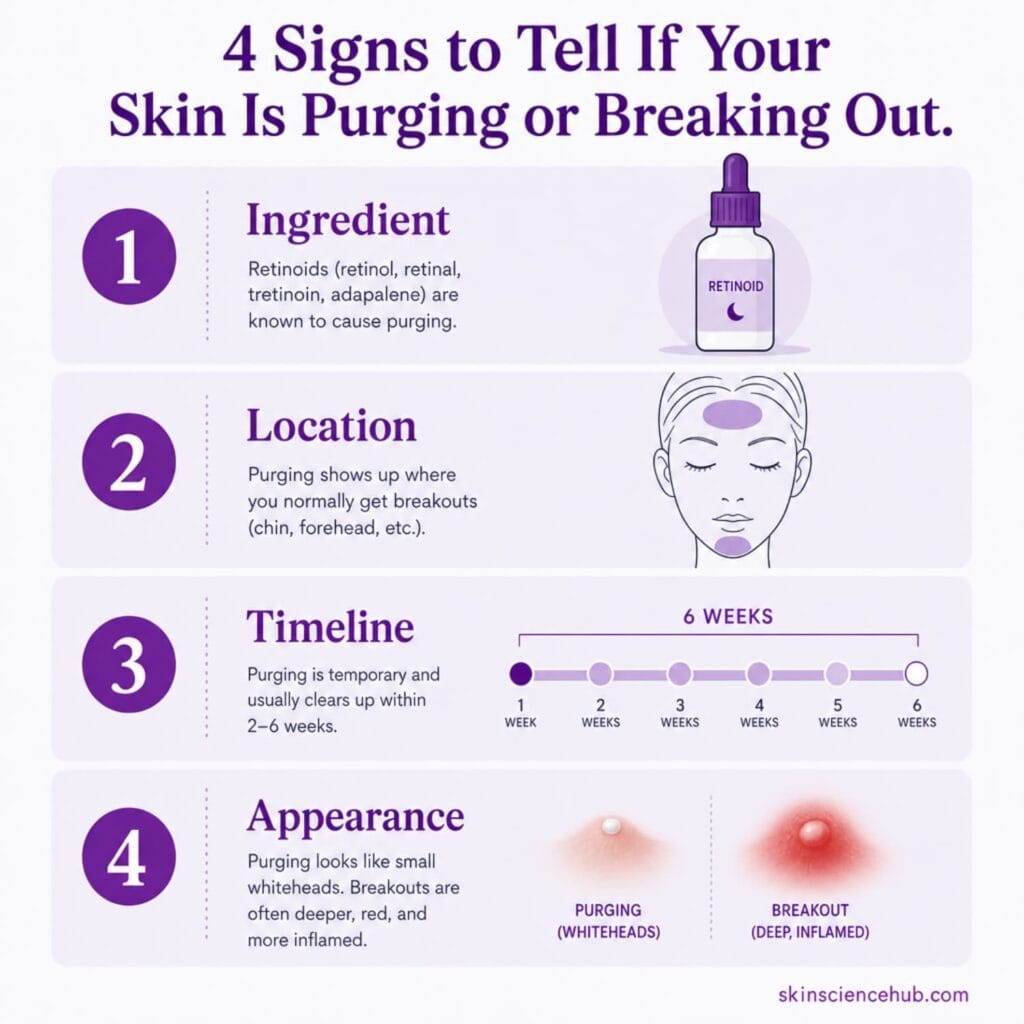
4 Signs to Tell If Your Skin Is Purging or Breaking Out
1. Ingredient
Purging only happens with ingredients that speed up cell turnover, so the first thing to check is what you recently added. Did you start a retinoid or a chemical exfoliant? If yes, a purge is possible and the next 3 signs will help you work it out. If no, what you’re seeing is a breakout, because purging has no other trigger.
2. Location
Check where the new spots are showing up. If they’re in the same places you usually break out, your chin, forehead, or around your nose, that’s a good sign you’re purging. Purging can only bring up congestion that was already forming, and congestion forms where your skin has always been prone. If spots are popping up somewhere that’s normally clear for you, like your cheeks or temples, your skin is reacting to something, and that’s a breakout.
3. Timeline
Purging typically lasts 4 to 6 weeks, and your skin will look worse before it gets better. If you’re within that window and spots are showing up in your usual areas, you’re most likely still purging.
Timing can make this trickier than it sounds though. Starting a new active in the week before your period is bad timing, because hormonal shifts in that window can trigger breakouts that look exactly like a purge. Try introducing new actives in the week after your period ends, because that gives you a much cleaner read on what your skin is doing.
4. Appearance
Purging shows up as blackheads, whiteheads, and pustules, and they tend to clear faster than you might expect because they were already well into their development before they surfaced. The spots are usually smaller and concentrated in your normal acne-prone areas.
Breakout spots are a whole different situation. They sit deeper under the skin, feel more inflamed, and take much longer to resolve, especially when hormones are the culprit.
Skin Purging vs Irritation
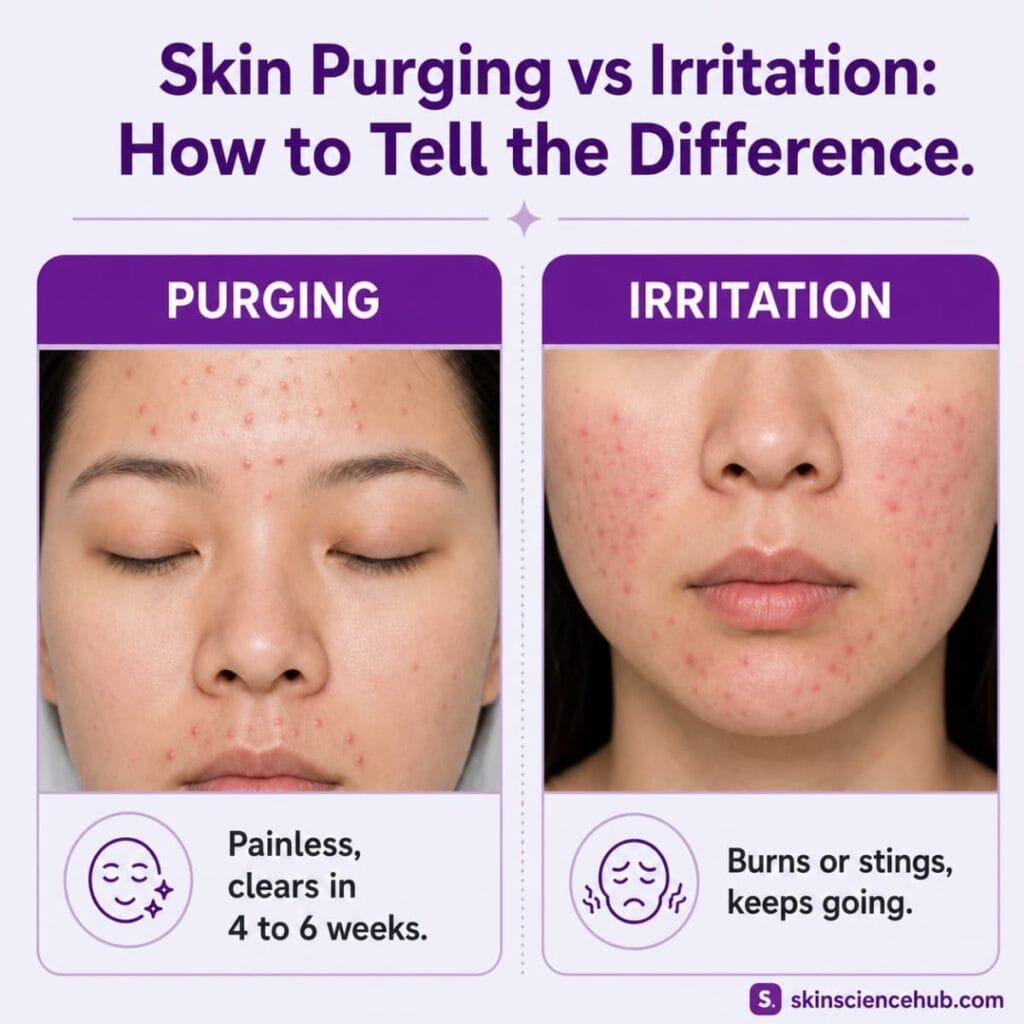
Irritation gets mistaken for purging all the time, and it’s an easy mistake to make. But your skin needs a completely different response for each one, and knowing which you’re dealing with changes what you do next.
When your skin is irritated, it’s simply reacting to something in the product that doesn’t agree with it. Nothing is clearing out and nothing is being surfaced. Your skin just doesn’t like what you put on it.
The most telling sign is how it feels. Irritation makes your skin burn or sting after applying a product, and you may also notice redness and small scattered bumps appearing in areas that don’t normally break out. With purging, none of that happens, and it doesn’t hurt.
Irritation also keeps going every time you apply that same product, because the trigger is still there. Purging works through a backlog of congestion and runs its own course, so it eventually stops on its own.
If your skin is irritated, give your barrier time to recover. Scale the active back to once or twice a week, or pause it completely, and lean on gentle supportive ingredients like ceramides, glycerin, and niacinamide while things settle. Once your skin feels calm again, you can ease the product back in, and applying it over moisturizer makes the reintroduction much more comfortable.
What Ingredients Cause Skin Purging?
Ingredients that cause purging
Retinoids are the most well-known purging triggers, and that’s because they directly accelerate cell turnover. Retinol, retinaldehyde, adapalene, tazarotene, and tretinoin all work this way, so if you’ve recently started any of these and your skin is acting up, purging is likely what’s happening. Tretinoin tends to produce a more noticeable purge than most over-the-counter retinoids though, because it’s prescription-strength and works considerably faster on the cell cycle. So if your purge feels more intense than you expected, that’s probably why.
Chemical exfoliants are the other main group. AHAs like glycolic acid, lactic acid, and mandelic acid speed up dead skin cell shedding at the surface. BHAs like salicylic acid go deeper, working inside the pore to clear congestion, which is why they work so well against blackheads. PHAs like gluconolactone and lactobionic acid are gentler and work the same way as AHAs. Fruit enzymes like papain, ficin, and bromelain also trigger purging because they break down the bonds holding dead skin cells together.
Benzoyl peroxide can produce a purge-like response too, though whether that’s true purging or irritation is still debated. Azelaic acid occasionally triggers mild initial breakouts, but this tends to settle quickly.
Ingredients that do not cause purging
Vitamin C, niacinamide, peptides, growth factors, ceramides, and hyaluronic acid are all popular actives, and none of them speed up cell turnover. So if your skin is breaking out after adding one of these, it’s reacting to something in the product, not purging.
How Long Does Skin Purging Last?
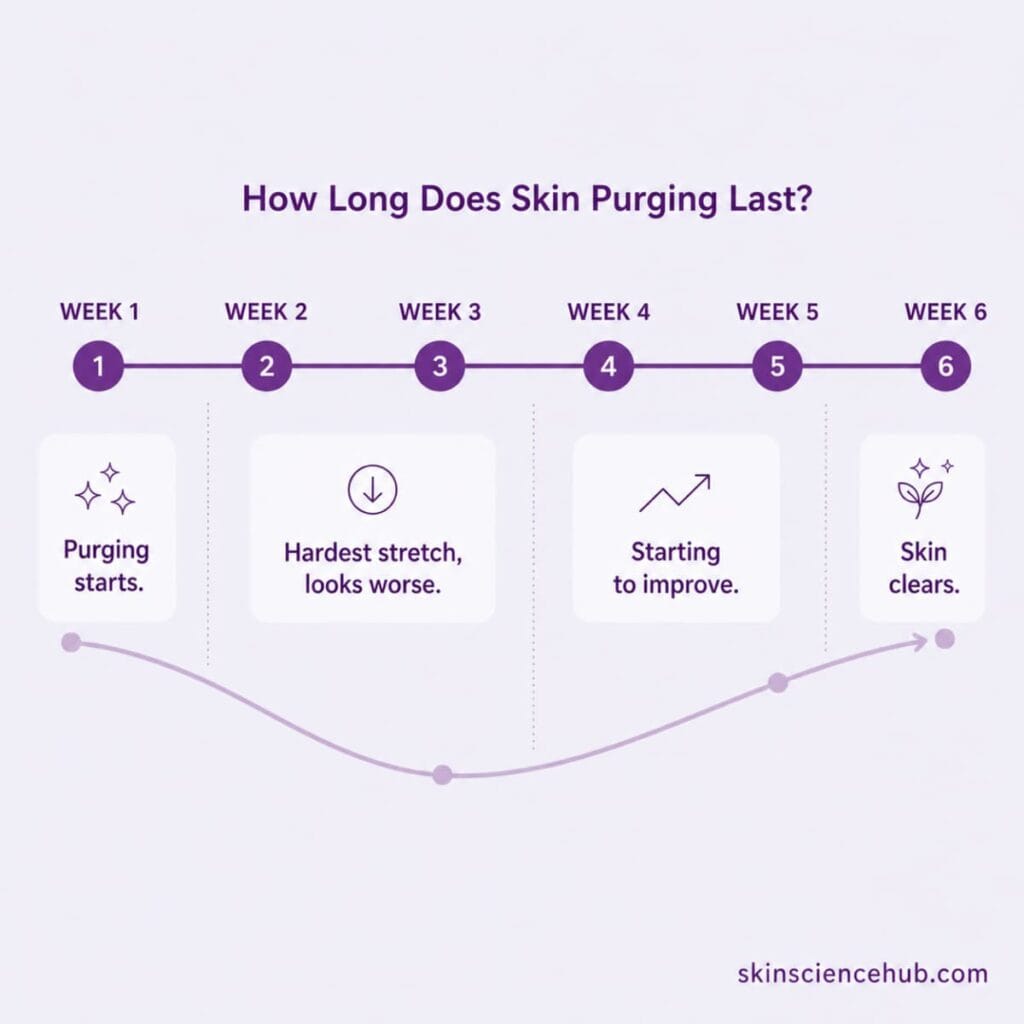
Purging typically lasts 4 to 6 weeks, and your skin will look worse before it looks better. That’s completely normal and not a sign anything has gone wrong.
The hardest part usually hits somewhere in the middle, around weeks 2 and 3, when several microcomedones surface at the same time and your skin can look noticeably worse than when you started. This is the point where most people throw the product out, and if your spots are sitting in your usual areas and matching the 4 signs, this is the moment to keep going.
Past the 6-week mark with no signs of improvement though, purging is no longer the explanation. Your skin has had enough time to work through any backlog, so if breakouts are still coming, something else in your routine needs a closer look.
Once it clears, everything you started the product for begins to show up. Your texture gets smoother, your tone becomes more even, and your skin starts behaving the way you were hoping it would from the beginning.
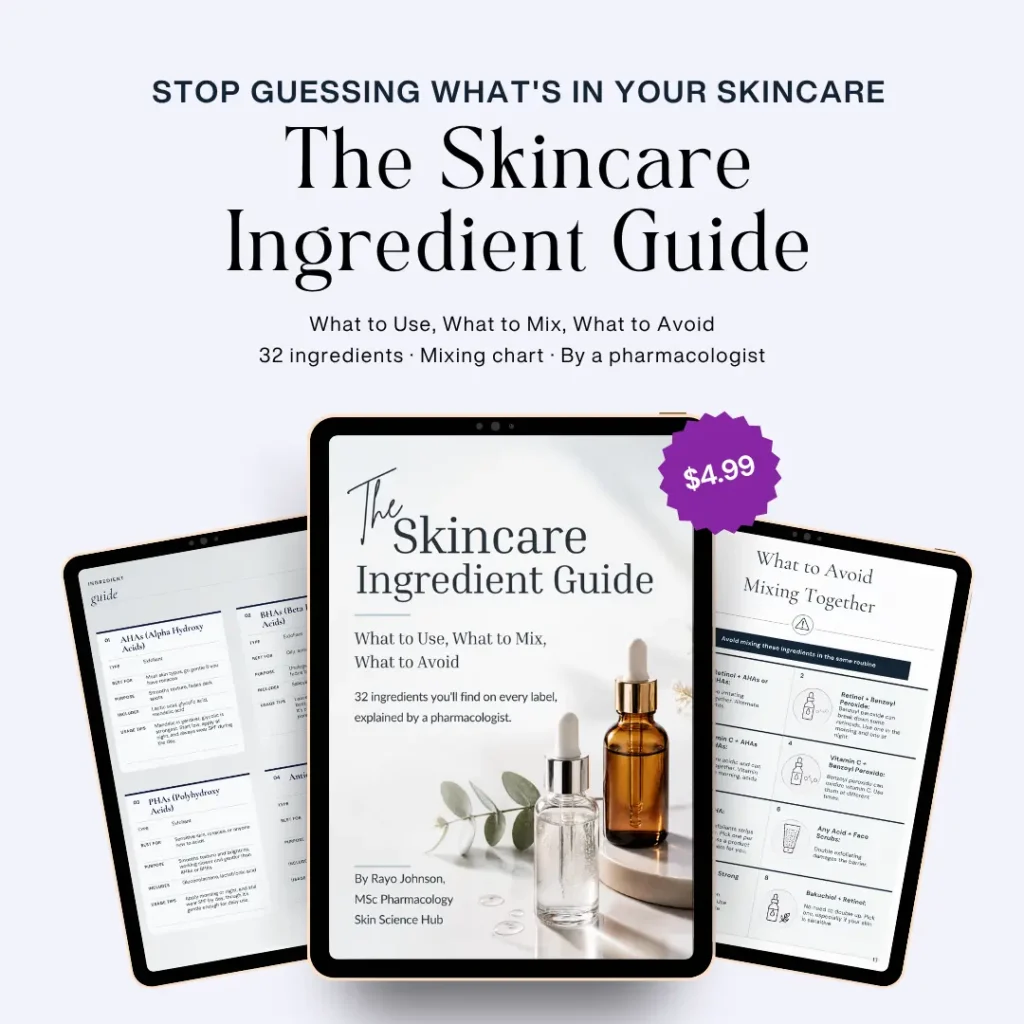
Starting a new active? My guide shows you what to pair it with and what to keep apart while your skin adjusts.
How to Manage Skin Purging
When your skin is purging, the instinct is to do more. More products, more treatments, more intervention. But the most helpful thing you can do is keep things simple and pull back.
1. Slow your active down
Using your active once or twice a week gives your skin time to adjust between applications, and a slower introduction almost always means a milder purge. You can gradually build frequency back up once your skin has settled.
2. Keep your barrier hydrated
Your barrier is working hard right now, so supporting it makes a real difference. Apply a gentle moisturizer before and after your active, and look for ceramides, hyaluronic acid, glycerin, and panthenol because they help your skin stay resilient throughout.
3. Wear SPF every day
Cell-turnover actives make your skin more sensitive to UV damage, so sunscreen is essential during a purge. Every morning, no exceptions.
4. Don’t pick
This is the hardest one. Blemishes that surface during a purge are already on their way out, and picking at them only slows healing down and raises your risk of post-inflammatory hyperpigmentation.
Skin Purging Myths, Debunked
Purging comes with a lot of noise around it, and some of it is actively leading people to quit products that were doing exactly what they should.
Myth: If you don’t purge, the product isn’t working
Not everyone who starts a retinoid or exfoliant will see a visible purge, because purging needs a backlog of microcomedones to work through, and not everyone has one. So if your skin stays completely calm after introducing a new active, that’s a good thing. It means your pores were already in great shape, and the product is still doing its job.
Myth: More purging means the product is working harder
The amount you purge reflects how much congestion was already building beneath your skin before you started, not how powerful the product is. So a heavy purge means there was a lot sitting beneath the surface, and a mild one means there was less. Neither tells you anything about the product’s strength.
Myth: If it burns, it’s working
Burning and stinging are signs of irritation, not purging. Purging is painless, and if your skin is reacting that way on application, your barrier is unhappy with something in the formula, and that needs addressing.
Myth: Purging means your skin is detoxing
Your skin doesn’t detox, because that’s not what skin does. Your liver and kidneys handle detoxification. Purging is a cell turnover response, and the detox framing is a marketing concept with no biological basis behind it.
When to Stop Using a Product and See a Dermatologist
Purging tests your patience, and most of the time that patience pays off. But your skin does send clear signals when something isn’t right, and those are easy to spot.
You’re past 6 weeks with no improvement – Purging has a timeline and 6 weeks is its outer limit. If you’re still seeing consistent new breakouts past that point, purging isn’t the explanation anymore, so it’s time to stop and look more carefully at what else in your routine might be causing them.
You’re developing deep, painful cysts – Purging doesn’t produce cysts. If large, painful bumps are forming deep under your skin after starting a new active, your skin is reacting to it and you need to stop using the product.
Your skin burns or stings on application – That’s irritation, not purging, and it won’t improve if you keep going. Stop, give your barrier time to recover, and come back to the product more slowly once your skin has settled.
New breakouts are showing up somewhere completely new – If spots are appearing in areas that have always been clear for you, that’s not purging. See a dermatologist, because they can tell you exactly what’s happening and point you in the right direction.
Skin Purging and Melanin-Rich Skin
If you have a deeper skin tone, purging comes with an extra layer to think about, and it changes how you should introduce new actives.
When a blemish heals on melanin-rich skin, it often leaves behind a dark spot that can take months to fade. This is post-inflammatory hyperpigmentation, and it happens because your skin produces extra pigment in response to inflammation during healing. So while the breakout clears, the mark it leaves becomes its own separate problem to manage.
Mandelic acid is a much friendlier starting point than glycolic acid for deeper skin tones, because it absorbs more slowly and causes far less irritation. Pairing it with niacinamide helps too, because niacinamide keeps the pigmentation response in check while your skin adjusts. SPF every morning is also essential, because UV exposure deepens existing dark spots and slows fading down.
If retinoids are consistently too much for your skin, bakuchiol is a great alternative. It works on similar mechanisms to retinol and is far better tolerated by reactive skin.
Final Thoughts
Purging can be a frustrating thing to go through, especially when your skin looks worse right after you started something new. But knowing what’s happening underneath makes it a lot easier to handle.
If your spots match the 4 signs, keep going. Your skin is doing exactly what it should, and the results you were hoping for are on the other side of that process.
If your skin stayed completely calm after starting your new active, that’s a good thing too. It just means there wasn’t much congestion sitting beneath the surface to begin with.
And if you’re still unsure after 6 weeks, see a dermatologist. They can tell you exactly what’s going on and point you in the right direction.