
Hormonal Acne: Why It Targets Your Jawline and Chin, and What to Do About It
Hormonal acne is one of the most common and most misunderstood skin conditions in adulthood. Not only does it tend to affect confidence and self-image, but it can also lead to deep scarring and dark marks that linger long after individual breakouts heal. For many adults, it shows up along the jawline and chin, flares on a monthly cycle, and refuses to respond to the products that used to work.
It’s difficult to treat because it’s rooted in androgen activity at the follicle level, not surface oil or bacteria, and that distinction calls for a different approach.
Hormonal acne is one of several distinct acne types, and if you want the broader context first, our full guide to acne types covers all of them. It’s treatable, and with the right approach, most people see clear improvement within 3 to 6 months.
What Is Hormonal Acne?
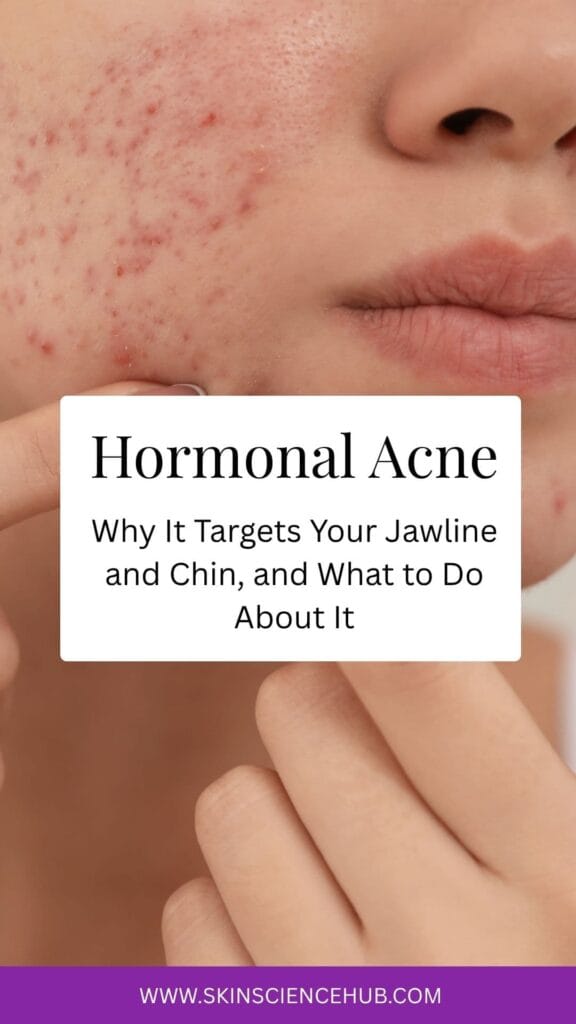
Hormonal acne is a type of acne driven by your skin’s response to androgens, a group of hormones that includes testosterone. Both men and women produce androgens naturally, and when they overstimulate the oil glands in your skin, the result is excess oil, clogged pores, and breakouts.
Hormonal acne doesn’t always point to a hormonal imbalance. Many women who deal with it have perfectly normal blood test results. The issue is often how sensitive your skin is to those hormones at the follicle level, and that sensitivity can exist even when your overall hormone levels are completely fine.
That skin-level sensitivity is also why hormonal acne is most common in adult women, though men can develop it too. For many people it starts or worsens in their 20s, 30s, and 40s, and without treatment, it can persist for years.
How to Tell If Your Acne Is Hormonal
Hormonal acne has a recognizable pattern, and most people who have it share several of the same signs. The more of these apply to you, the stronger the case that hormones are driving your breakouts.
1. Where your acne shows up
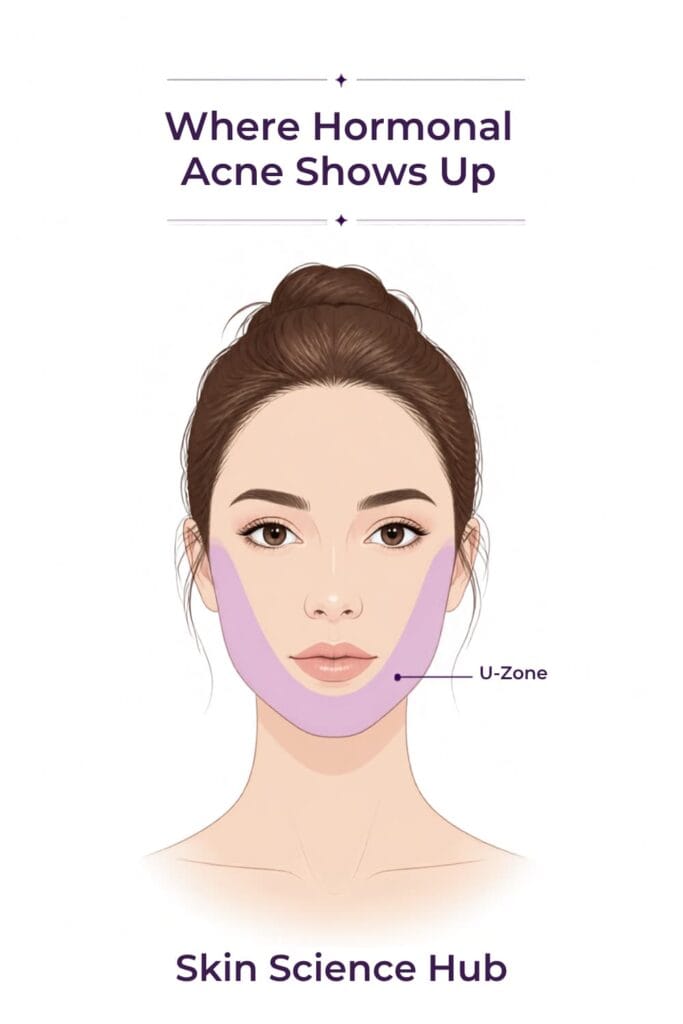
Hormonal breakouts concentrate in what’s known as the U-zone, the chin, jawline, and lower cheeks. If your breakouts consistently land on the lower face while the rest of your skin stays relatively clear, that location pattern is a reliable indicator of hormonal involvement.
2. When it flares
If your breakouts arrive in the week before your period and clear up shortly after, that cyclical timing is one of the strongest signs of hormonal acne. Estrogen levels drop in the 7 to 10 days before menstruation, and as estrogen falls, androgens become relatively more dominant. That shift is what drives the pre-period flare.
3. What the breakouts feel and look like
Hormonal acne tends to produce deep, cystic lesions, the kind that form underneath the skin and feel tender long before they become visible. Cystic hormonal acne like this is often painful and can take weeks to fully resolve.
4. When it started
Hormonal acne is primarily an adult condition. If your acne carried on past your early 20s, appeared for the first time as an adult, or has been gradually getting worse, that persistence points toward a hormonal driver.
5. How it responds to treatment
If benzoyl peroxide and salicylic acid haven’t cleared your breakouts, pay attention to that pattern. Those ingredients work at the surface, targeting bacteria and excess oil, and hormonal acne is driven by activity deeper in the follicle.
The more of these signs apply to you, the more likely hormones are the underlying driver, and that’s where your treatment approach should start.
Why Does Hormonal Acne Appear on the Jawline and Chin?
It appears in those areas because the sebaceous glands along the lower face are significantly more sensitive to androgen stimulation than glands elsewhere on the face, and that sensitivity is what determines where hormonal acne lands. Researchers believe this area has a higher concentration of androgen receptors and 5-alpha reductase activity, which means the glands here convert testosterone to DHT more aggressively than those on the forehead or nose.
There’s also a structural factor. Many people with hormonal acne have particularly large sebaceous glands in the chin and jawline area, paired with relatively small follicle openings. When androgen activity triggers a surge in oil production, those smaller follicle openings fill quickly and become inflamed, which is what makes the lower face the focal point of hormonal acne.
Teen acne and adult hormonal acne tend to hit different parts of the face for this same reason. Teenage acne is driven by an overall surge in sebum production that tends to land on the oiliest areas of the face, typically the forehead and nose. Adult hormonal acne follows a different map, driven by localized androgen sensitivity concentrated in the lower face, and it can develop even in people who had little to no acne during their teenage years.
What Causes Hormonal Acne?
Hormonal acne doesn’t happen all at once. It follows a step-by-step cascade inside the follicle, and each stage makes the next one worse.
1. Excess oil builds up
When DHT overstimulates the sebaceous glands, the follicle fills with more oil than it can release. Dead skin cells that would normally shed through the follicle opening get trapped in that oil, and together they form a plug.
2. Bacteria multiply in the clog
That plug cuts off oxygen inside the follicle, and that oxygen-depleted environment is where C. acnes, the bacteria associated with acne, thrives. In a healthy follicle, C. acnes exists in manageable amounts. Once the follicle is clogged, its population grows rapidly and unchecked.
3. The immune system fights back
As that population grows, your body recognizes the C. acnes overgrowth as a threat and mounts a response, releasing enzymes that begin breaking down the follicle wall and the surrounding tissue. When that wall ruptures, the inflammatory contents spill into the deeper layers of the skin. That’s what produces the deep, painful nodules, and it’s also what creates the conditions for scarring.
4. Where progesterone fits in
Progesterone thickens the texture of sebum during the luteal phase of your cycle, making it more viscous and more likely to form a clog. So even when androgen activity isn’t at its peak, progesterone alone can tip the balance toward a breakout, and that’s why flares tend to worsen in the luteal phase, when progesterone is highest.
Taken together, these steps cover all four main drivers of acne, excess sebum, follicular plugging, bacterial overgrowth, and inflammation, and in hormonal acne, hormones are driving all four simultaneously. That’s why it tends to be deeper and more persistent than other types. Our guide to acne types breaks down how these four factors play out across different forms of acne.
What Triggers Hormonal Acne?
Several factors can trigger hormonal acne flares, and knowing which ones apply to you makes them easier to manage.
1. Your menstrual cycle
The monthly hormonal cycle is the most common trigger, and studies show around 60 to 70 percent of women with hormonal acne experience premenstrual flares. During the first half of your cycle, rising estrogen keeps androgen activity in check and has a natural anti-inflammatory effect on the skin. As you move into the luteal phase, estrogen levels decline and the influence of androgens increases. Progesterone rises at the same time, adding to the hormonal pressure on your oil glands. That combination is what drives the pre-period flare most women experience in the week or two before menstruation.
2. PMOS and other hormonal conditions
For some women, hormonal acne signals something beyond monthly fluctuation. PMOS, formerly known as PCOS, is a hormonal condition that accounts for more than 90 percent of hyperandrogenism cases in women and is one of the most common reasons hormonal acne becomes severe, persistent, and difficult to treat.
If your acne comes with irregular or infrequent periods, excess facial or body hair, or darkened patches of skin around the neck or underarms, those are signs that need a doctor’s evaluation, because they may point to an underlying hormonal condition that requires proper diagnosis and treatment.
3. Hormonal contraceptives
Some hormonal contraceptives can trigger or worsen hormonal acne, and the mechanism comes down to the type of hormone they contain.
Progestin-only methods are the main culprits. Certain implants, specifically those containing levonorgestrel or etonorgestrel, contain a type of progestin that behaves similarly to testosterone in the body. That means they can stimulate your oil glands the same way testosterone does and set off the same breakout cascade. If your acne started or got significantly worse after starting a progestin-only implant, that is the likely reason and is important to discuss with your doctor.
The other culprit is stopping a combined oral contraceptive. Combined pills contain estrogen, which lowers testosterone levels in the blood and keeps oil production in check. When you stop taking them, that protection disappears and testosterone levels can surge temporarily before your body adjusts. The resulting flare often catches people off guard because it feels sudden and unexplained.
4. Stress
When you’re stressed, your body releases a hormone called CRH, which stimulates the sebaceous glands directly and increases the conversion of DHEA to testosterone. That means stress has a direct androgenic effect on your skin, not just an emotional one, and it can trigger breakouts independently of your cycle.
5. Diet
Your diet can also trigger hormonal acne, and a few specific foods are more likely to cause problems than others.
Dairy may also trigger breakouts, though not all dairy carries the same risk. The strongest association is with skim milk specifically, because fat-free dairy has higher IGF-1 bioavailability than full-fat versions, meaning more of it is absorbed and active in the bloodstream. Full-fat dairy and moderate cheese consumption show a much weaker connection in the research.
Also, whey protein and branched-chain amino acid supplements both elevate IGF-1 on their own and can worsen hormonal acne even without a high-glycemic diet.
Topical Treatments for Hormonal Acne
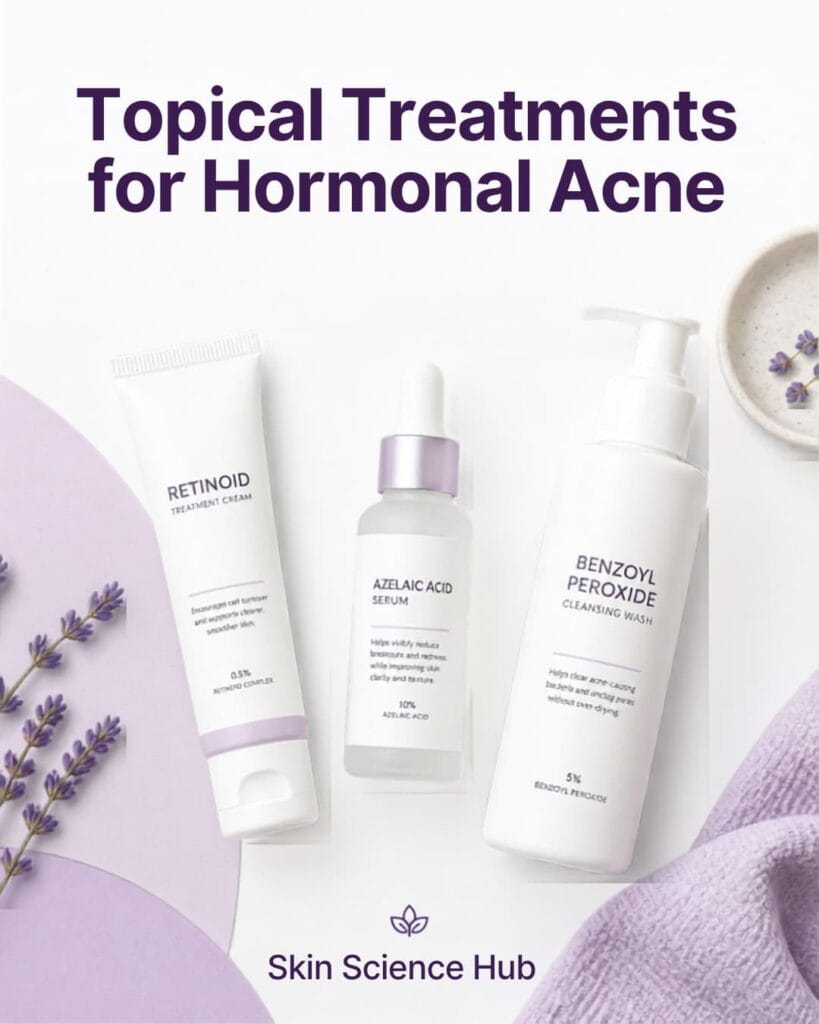
Topical ingredients reduce how often hormonal breakouts happen and how severe they are when they do, and used consistently, they can make a significant difference to your skin
1. Retinoids
Retinoids are the most effective topical option for hormonal acne because they prevent the follicle from clogging before a breakout can form. They normalize the way cells turn over inside the follicle, preventing the buildup of dead skin cells that forms the initial plug. No plug means no clogged, oxygen-depleted environment for C. acnes to thrive in.
Prescription tretinoin and adapalene have the strongest evidence for acne specifically. Our full guide to retinoids covers how to use them, what to expect, and how to introduce them without overwhelming your skin.
2. Azelaic acid
Azelaic acid is particularly well suited to hormonal acne because it works on two things at once. It is anti-inflammatory, so it calms active lesions, and it inhibits tyrosinase, the enzyme responsible for producing the dark pigment that collects at the site of healed breakouts. For someone dealing with active hormonal acne and the marks it leaves behind, azelaic acid addresses both in one step. Our azelaic acid for acne guide covers the concentrations, formats, and what the research supports.
3. Benzoyl peroxide
Benzoyl peroxide targets C. acnes directly, killing the bacteria that drive the inflammatory response. It is most useful for actively inflamed lesions and tends to show results faster than most other topical actives. For adult women, concentrations of 2.5 to 5 percent are as effective as higher concentrations and significantly less irritating.
4. Salicylic acid
Salicylic acid is oil-soluble, which allows it to penetrate inside the follicle and dissolve the bonds between dead skin cells, keeping the follicle clear. It also has mild anti-inflammatory properties that help calm early-stage breakouts.
5. Niacinamide
Used alongside retinoids or azelaic acid, niacinamide reduces sebum production and calms inflammation, making the skin environment less prone to breakouts over time. Our niacinamide guide covers how to layer it with the other ingredients above.
Natural Remedies for Hormonal Acne.
Lifestyle changes can reduce how often hormonal flares happen and how severe they are, and they work well alongside topical or prescription treatment.
Diet
The most evidence-backed dietary adjustments for hormonal acne are shifting toward lower-glycemic carbohydrates, swapping skim milk for full-fat dairy or a plant-based alternative, and cutting whey or branched-chain amino acid supplements if you use them.
Stress management
Actively managing stress can reduce the frequency of flares. Regular exercise and whatever stress reduction works consistently in your life are the most practical tools.
Sleep
Consistently poor sleep elevates stress hormones, which compound the androgenic load on your sebaceous glands. Protecting your sleep is one of the more underrated tools for keeping hormonal acne in check.
Prescription Treatments for Hormonal Acne
For hormonal acne that’s persistent, severe, or driven by an underlying condition like PMOS, prescription treatments are often the most direct and effective approach. A dermatologist can determine which option suits your skin, health history, and treatment goals.
1. Combined oral contraceptives
Combined oral contraceptives can improve hormonal acne by lowering testosterone levels and increasing SHBG, a protein that binds to testosterone and limits how much of it reaches your oil glands. The American Academy of Dermatology conditionally recommends them for acne management. Different formulations show similar efficacy in the research, and the choice between them is based on your individual health profile and medical history. If you’re considering stopping a combined oral contraceptive, it’s important to discuss that timing with your doctor, as stopping can trigger a temporary flare as the testosterone-lowering effect is withdrawn.
2. Clascoterone (Winlevi)
Clascoterone is the only topical prescription that targets the hormonal side of acne directly. It’s an FDA-approved androgen receptor blocker that works by preventing DHT from binding to receptors in the skin, reducing sebum production and inflammation. Because it’s minimally absorbed into the bloodstream, it does this without significantly affecting hormone levels elsewhere in the body, and it’s approved for both men and women aged 12 and over.
In a study assessing its safety and efficacy, participants applied 1% clascoterone cream twice daily for 12 weeks. The results showed that approximately 20 percent of patients achieved treatment success, meaning clear or nearly clear skin, compared to 7.7 percent for those using the base cream without the active ingredient. It also reached 50 percent improvement in lesion count faster than once-daily tretinoin 0.05%, with a median of 43 days compared to 57. The American Academy of Dermatology conditionally recommends it for acne management based on high-certainty evidence.
A one-month supply runs between $300 and $600 in the US, and without insurance coverage, that price puts it out of reach for many people. If cost isn’t a barrier, it’s an option to raise with your dermatologist.
3. Spironolactone
Spironolactone is an oral androgen receptor blocker that prevents testosterone and DHT from binding to receptors in the sebaceous glands, reducing oil production and inflammation. At doses of 50 to 100mg per day, the AAD conditionally recommends it as a first-line treatment option for women with acne.
In a 12-week randomized controlled trial of 410 women with facial acne, spironolactone at 50 to 100mg daily significantly improved acne-related quality of life scores, with lesion counts also showing measurable reductions. Common side effects include increased urination, irregular periods, breast tenderness, and headaches. Men are generally not prescribed it due to the risk of gynecomastia, and it’s contraindicated in pregnancy.
Routine potassium monitoring is not clinically necessary for most healthy young women on spironolactone. As a pharmacologist, I’d point to the JAMA Dermatology study of 974 healthy young women, which found the rate of hyperkalemia on spironolactone was 0.7 percent, almost identical to the baseline population rate of 0.8 percent. Your dermatologist will advise based on your individual situation.
4. Isotretinoin
Isotretinoin is reserved for severe, nodular, or treatment-resistant acne, and it’s the only option in this section that can clear acne long-term. It works by shrinking the sebaceous glands significantly, reducing oil production at the source, and normalizing the follicular environment that allows C. acnes to thrive. Dermatologists consider it when hormonal acne is causing significant scarring, when other treatments haven’t been effective, or when the severity warrants a more intensive course of treatment.
Hormonal Acne Prevention: Your Skincare Routine
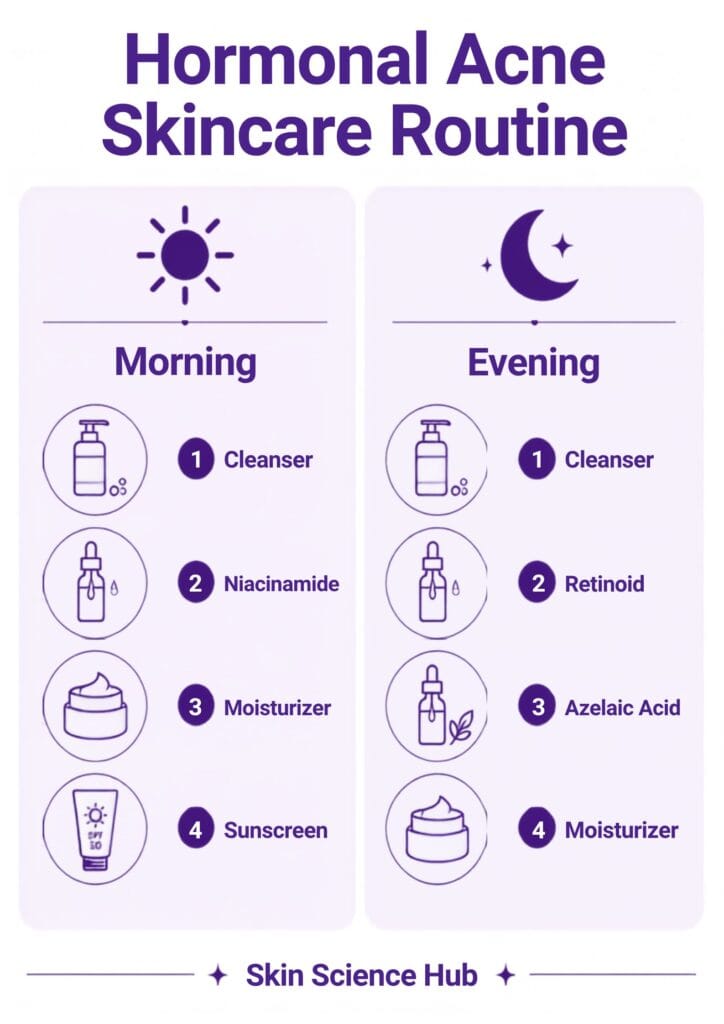
The right ingredients, used consistently and in the right order, reduce how often breakouts form and make them easier to manage when they do.
Morning
Start with a gentle cleanser suited to acne-prone skin. Our guide to the best face wash for oily and acne-prone skin covers options across different budgets and formulations. After cleansing, apply niacinamide, then follow with moisturizer and sunscreen. Sunscreen is essential when using retinoids at night, as they increase sun sensitivity.
If benzoyl peroxide is part of your routine, apply it after cleansing and before moisturizer. Salicylic acid also fits well here, either as your morning cleanser or as a toner after washing.
Evening
Cleanse, then apply your retinoid directly onto a dry face. Start 2 or 3 nights a week and build gradually as your skin adjusts. On nights when you’re resting from the retinoid, apply azelaic acid as your active. Once your skin has built up tolerance, you can layer azelaic acid on top of the retinoid after it absorbs. Finish with moisturizer.
For the full detail on layering, timing, and how to get the most from each ingredient, our guide to layering skincare actives covers all of it.
Hormonal Acne and Dark Spots: How to Treat the Marks It Leaves Behind
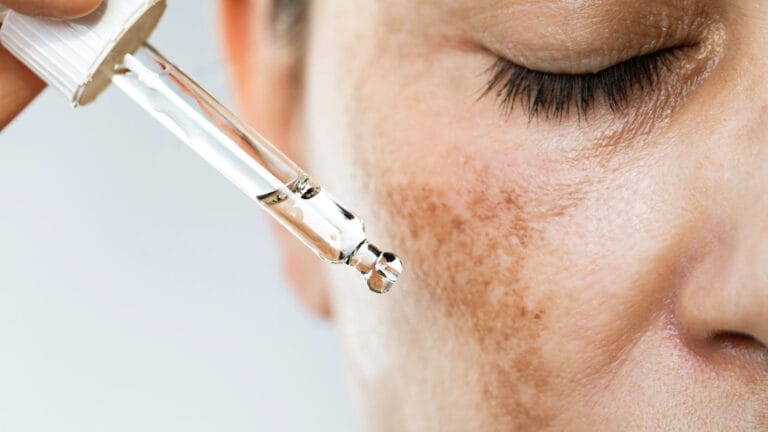
The deep, inflammatory lesions that hormonal acne produces are the primary cause of post-acne dark marks. These marks aren’t permanent, but they do need their own treatment approach. Our guide to hyperpigmentation ingredients covers the options best supported by the research and how to work them into your routine.
The Bottom Line
Hormonal acne can feel relentless, especially when you’ve been trying to get rid of hormonal acne without knowing what’s driving it. Understanding the mechanism is the first step, and the right combination of topical and lifestyle support helps most people get their skin under control. For anything persistent or severe, prescription options are worth discussing with your dermatologist.