

7 Types of Peptides for Skin (And Which One You Need)
Last updated on April 6th, 2026 at 07:55 am
There are several types of peptides for skin, and they all do something different. Serums, moisturizers, eye creams, all promising firmer, younger-looking skin. But most people shopping for peptides don’t realise something important.
Not all peptides work the same way.
Some signal your skin to produce more collagen. Others deliver copper directly to repair tissue and calm inflammation. Some interfere with the muscle contractions that create expression lines over time. These are completely different mechanisms, and matching the wrong type to your concern is the most common reason peptides get written off as overhyped.
As a pharmacologist, I find peptides genuinely interesting because the science is more nuanced than most skincare content lets on. There are real gaps in the evidence worth knowing about, and there are specific peptide types with solid data behind them. Understanding that distinction changes how you shop.
This article breaks down every major type of peptide in skincare, what each one does, who it’s for, what the research shows, and how to use them without wasting money or undermining your routine.

What Are Peptides in Skincare?
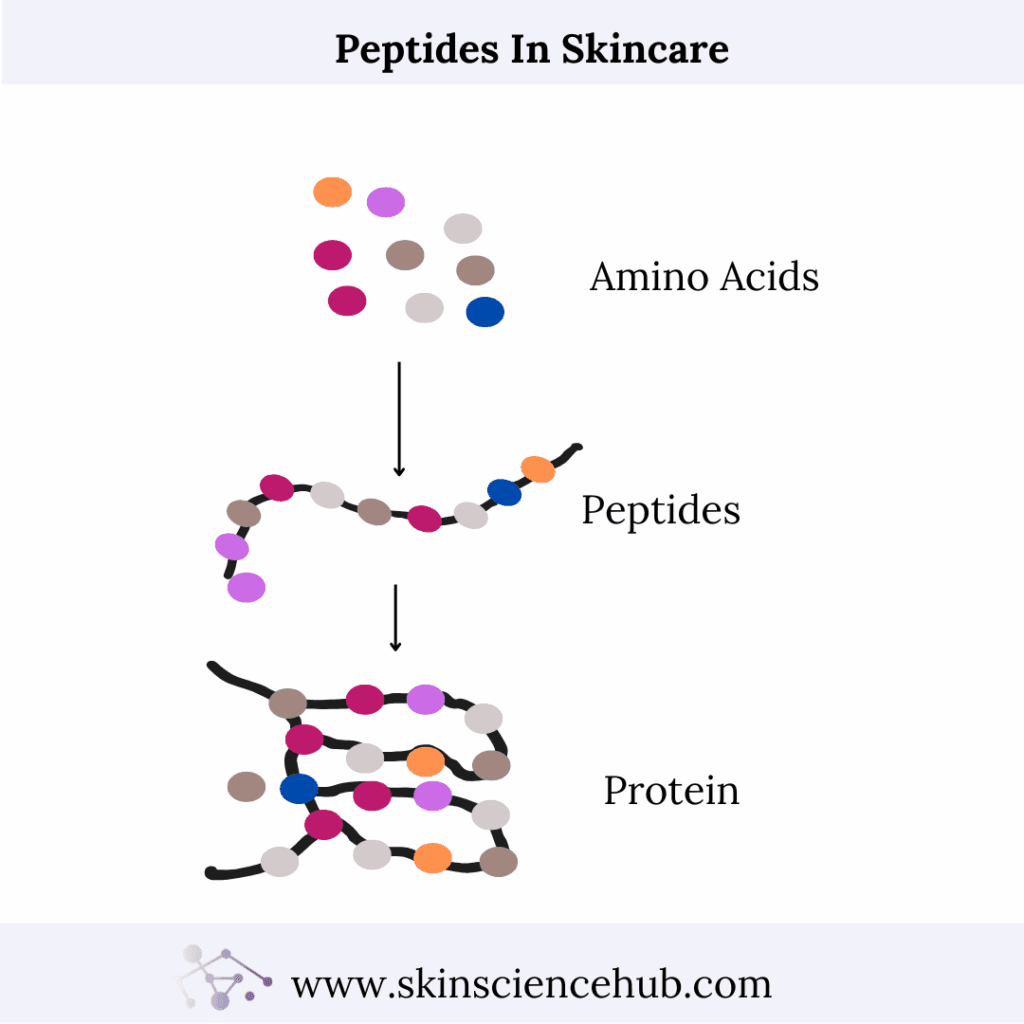
Peptides are short chains of amino acids that tell your skin to produce collagen, repair tissue, and maintain its barrier. They’re the building blocks your skin uses to make proteins.
Think of amino acids as individual letters forming words (peptides), which then link into full sentences (proteins). Collagen, elastin, and keratin are all proteins, and because they’re large molecules, they can’t penetrate your skin’s outer layer.
Peptides can. They’re smaller, so they slip through and trigger responses deeper down, like signaling cells to produce more collagen or delivering minerals directly to repair tissue.
But ‘peptides’ on a label tells you almost nothing useful. The different peptide types in skincare, signal, carrier, neurotransmitter, enzyme inhibitor, and barrier repair, all work through completely different biological pathways. Match the right type to your concern and you’ll actually see results.
Do Peptides Work? What the Research Shows
Before spending money, it helps to know what the research looks like.
Most peptide studies are small, short, around 8 to 12 weeks, and company-funded. Results show modest but measurable improvements in fine lines and wrinkles. Matrixyl has the strongest evidence, with measurable improvements in wrinkle depth across multiple independent studies. Argireline shows measurable reduction in expression line depth. Copper peptides have solid evidence for wound healing and post-procedure recovery. Beyond those three, the data gets thinner for other peptide types.
There’s also a size issue. Most skincare peptides are larger than what skin can easily absorb, so some brands add penetration enhancers to help deliver the ingredient deeper. This is why results build gradually over weeks.
Topical Peptides vs Injectable Peptides
These two are very different, and it’s worth knowing why. Injectable peptides like BPC-157 and PDRN go directly into the bloodstream and produce fast, significant results. The impressive before-and-afters you may have seen online often come from those injectable treatments, not skincare serums. Topical peptides work locally on the skin and build results slowly over time. Both have their place, but they’re not interchangeable, and comparing them sets unrealistic expectations for what a serum can do.
The 7 Types of Peptides in Skincare
1. Signal Peptides for Collagen and Firmness
Signal peptides are the most researched anti-aging peptides in skincare, and for general loss of firmness and fine lines, they’re where to start.
They work by mimicking the tiny fragments that appear when collagen breaks down naturally. Your fibroblasts, the cells responsible for making collagen, detect those fragments and read them as “we need more collagen here.” So they ramp up production.
The most studied example is Matrixyl, listed on labels as palmitoyl pentapeptide-4. You’ll also see it as Matrixyl 3000 and Matrixyl Synthe’6 in more advanced formulations. These are the collagen peptides most worth looking for when reading an ingredient list.
Products to try:
- Medik8 Liquid Peptides – Combines multiple peptide types in one serum, so you get broader coverage without stacking multiple products.
- The Ordinary Matrixyl 10% + HA – A straightforward, affordable peptide serum for testing whether signal peptides work for your skin before committing to anything expensive.

