

Damaged Skin Barrier: Signs, Causes, and How to Repair It
Last updated on August 11th, 2026
Most people think a damaged skin barrier, or broken skin barrier, looks obvious. Redness. Flaking. Burning. The kind you can actually see and feel.
But the real damage starts weeks, maybe even months, before any of that shows up, breaking down quietly while your skin still looks completely normal on the surface.
So if you’ve felt even slight tightness after cleansing, pay attention, and if products that never used to sting suddenly start to burn, take that seriously too. If your skin just feels off in a way you can’t quite explain, trust that feeling, because you’re not being paranoid. Your barrier may already be damaged, and the longer you wait to address it, the harder the repair becomes.
In this article, you will learn the signs, causes, and how to repair a damaged skin barrier.

How Your Skin Barrier Works

Think of your skin barrier as a brick wall. Skin cells are the bricks, and lipids like ceramides, cholesterol, and fatty acids are the mortar. Water stays in, and irritants stay out.
Try this simple test, and you’ll see exactly how it works. Get lemon juice on healthy hands and you feel nothing. But if your hands are chapped and rough, that same lemon juice stings badly. A healthy barrier stops the lemon juice from penetrating, so it just sits on the surface, while a damaged one lets it seep between cells where the low pH irritates nerve endings. And if enough gets through, you’ll see redness as your immune system responds.
That brick-and-mortar structure also depends on staying acidic. Your skin keeps an acidic pH between 4 and 6 called the acid mantle, and this acidity helps your skin produce the lipids it needs while keeping your microbiome balanced.
When harsh cleansers with high pH strip your skin, they don’t just remove oils. They shift your skin’s pH into alkaline territory and set off a cascade of problems. Your skin starts breaking down its own lipids faster, dead skin cells stop shedding properly, and it can’t fight bacteria as well. Inflammation kicks in, and all of this adds up to barrier damage that compounds over time.
That’s why catching a damaged skin barrier early counts. Once that protective structure starts breaking down, everything that touches your skin can become an irritant. Your gentle cleanser, your hydrating serum, even plain water can cause stinging, tightness, and inflammation, given that nothing properly blocks it anymore.
Signs of Skin Barrier Damage
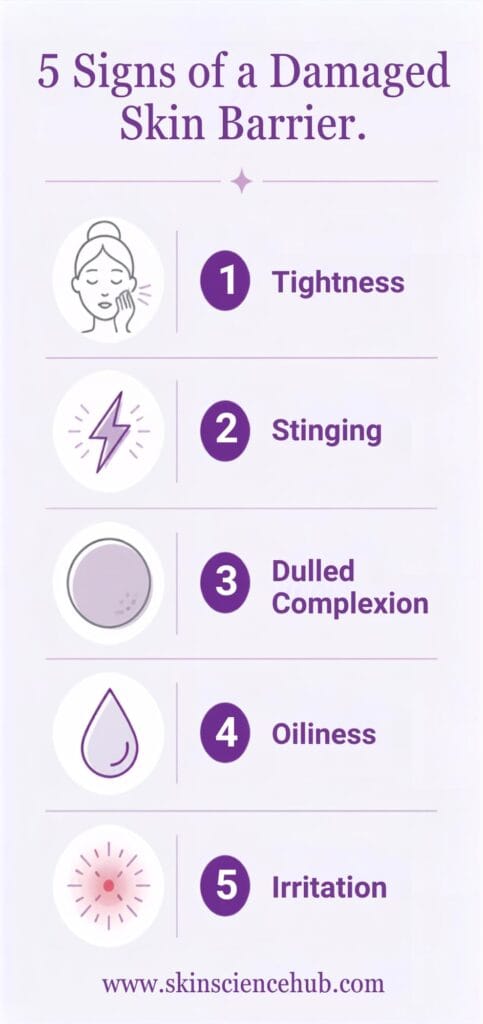
Most people think a damaged skin barrier always shows visible signs like redness and flaking, but that’s not true, and this misconception is especially common for people with darker skin tones, where redness doesn’t show up the same way.
Subtle symptoms signal early skin barrier damage, and you might dismiss them since they seem minor. But these early signs deserve your attention most, because they show up weeks before the visible damage does.
- Your skin feels tight after cleansing, even with gentle products. It feels uncomfortable or stretched in a way that doesn’t seem right.
- Products that never stung before suddenly burn or tingle when you apply them, even though you haven’t changed your routine. This catches you off guard, because everything was fine before.
- Your complexion looks dull and flat no matter what you use. Moisturizers take forever to absorb, or they leave a tacky residue that lingers for hours.
- Your skin gets oilier than usual. When your barrier can’t hold water, your skin overproduces oil to compensate, and you might also notice breakouts showing up in places where you don’t typically break out.
- Your skin feels generally uncomfortable in ways that are hard to pinpoint. Persistent itching happens, mild stinging appears randomly, and your skin just feels angry for no clear reason.
What Causes a Damaged Skin Barrier
1. Over-Exfoliation and Harsh Actives
Over-exfoliation causes more damaged skin barriers than anything else on this list. AHAs like glycolic and lactic acid, BHAs like salicylic acid, retinoids, and physical scrubs all strip away your protective lipid layer when you use them faster than your skin can rebuild it. Even a mild lactic acid toner does damage if you use it daily, because frequency counts more than strength.
Your skin doesn’t need daily acids to stay healthy. Stacking two or three exfoliating steps into one routine, an acid toner, a retinoid, a physical scrub, adds up faster than any one of them would alone.
2. Harsh Cleansing
Cleansers with high pH levels, sulfates like sodium lauryl sulfate, or denatured alcohol don’t just strip your natural oils. They shift your skin into alkaline territory, and your skin responds by breaking down its own lipids faster, losing its ability to fight bacteria, and triggering inflammation. That’s why some foaming cleansers and makeup wipes leave your face feeling tight.
If your skin feels tight after cleansing, that’s not clean. That’s a damaged skin barrier.
3. Sun and Weather
Sun and weather cause a damaged skin barrier through two different mechanisms. UV exposure degrades the lipids holding it together, breaking it down directly. Cold weather and low humidity work the other way, pulling moisture out of your skin faster than your barrier can replace it. Indoor heating and air conditioning create that same low-humidity effect indoors, which is why office workers deal with this year-round.
4. Water Exposure and Friction
Water and friction together wear down your skin barrier faster than either does alone. Water softens and swells your outer skin layer, and when you combine that with friction, you get rapid breakdown.
Diaper rash shows this mechanism clearly. Moisture trapped under a diaper, plus friction against delicate skin, breaks down the barrier, so Candida yeast grows on the damaged skin and causes a rash. Adults get the same thing in body fold areas, like under the breasts, abdominal folds, or under the arms, a condition called intertrigo.
Your hands are the easiest target for a damaged skin barrier because you often expose them to water and friction. Pro tip. Take off your rings when you wash your hands. They trap water and soap under the band, keeping skin damp while creating constant friction, a common trigger for hand eczema. The same risk applies to washing dishes or cleaning without protection, so reach for gloves at the sink.
5. Product Mismatch
Layering multiple actives when your skin doesn’t need them creates problems, and so does constantly switching products before your skin has time to adjust, since the damage compounds the longer it continues. Using treatments meant for oily skin when yours is naturally dry works against what your skin needs.
Misreading your symptoms causes the same mismatch. Mistake a damaged skin barrier for acne, and you strip away more protection with harsh treatments. Mistake it for dry skin, and you pile on heavy moisturizers your compromised skin can’t process. Either way, you keep the damage going, not fixing it.

How to Repair a Damaged Skin Barrier
Repairing a damaged skin barrier only works in order. Stop first, then rebuild, adjust if it isn’t working, and protect it once it’s healed.
1. Stop Damaging Your Skin Barrier
This takes about a week. Find what’s damaging your barrier, and stop it.
Switch to gentle cleansing. Cream or lotion formulas work well because they don’t strip, and you want low pH options that maintain your acid mantle. If you wear makeup or sunscreen, oil cleanse first, then follow with a gentle water-based cleanser.
Stop all exfoliation. Acids damage healing skin, and so do retinoids, scrubs, and brushes, because your barrier can’t repair itself while you’re removing skin cells.
Pause high concentration actives. Vitamin C and benzoyl peroxide both interfere with healing, and fragrance irritates during repair, even the natural versions.
2. Rebuild Your Damaged Skin Barrier
Start with water, because your skin can’t rebuild without it. Pick one lightweight hydrating step, a toner, essence, or serum, whichever you already have, with glycerin, panthenol, or hyaluronic acid, and apply it to damp skin for better absorption.
Follow with niacinamide at 2 to 5 percent. It strengthens barrier function while calming inflammation, though the trendy 10 percent formulas are too strong for damaged skin.
Then bring in lipids. Skin is built from ceramides, cholesterol, and fatty acids working together, so use a moisturizer that contains all three. Products with only one or two won’t do the job.
Seal everything at night with an occlusive. Face oils and petroleum products trap moisture while you sleep, and sunflower, safflower, borage, and shea butter all work well if petroleum feels too heavy.
3. If Your Repair Routine Isn’t Working
Give a damaged skin barrier two weeks of consistent care, and you should see it improving. If you don’t, something needs to change.
Watch for sensitivity that keeps building, redness that spreads or intensifies, and products that used to feel fine suddenly starting to burn. On darker skin tones, that worsening tends to show up as darkening, not redness. If your skin looks worse after three weeks of consistent gentle care, your routine still contains something too harsh, or you’re dealing with an underlying condition.
Left untreated, a damaged skin barrier raises your risk of infection, keeps your skin reactive for longer, and can trigger flares in conditions like eczema or rosacea.
If it’s your routine, stopping actives and exfoliation may not be enough. Strip down further, to just a cleanser and one basic moisturizer, and remove everything else for a week. If your skin improves, reintroduce products one at a time, with a week between each addition, checking labels for denatured alcohol and preservatives as you go, because either one can irritate compromised skin even at low concentrations. Stop immediately if anything stings, no matter how gentle it’s labeled, that’s your barrier signaling it’s still compromised, not the product working.
See a dermatologist if your skin doesn’t improve after six weeks of stripping your routine down and reintroducing products slowly. Go sooner if you experience severe burning or pain, if persistent redness spreads, if you notice signs of infection, or if you suspect an underlying skin condition is driving the damage rather than your routine.
4. After Repairing a Damaged Skin Barrier
Around week four to six, your barrier may be healed enough to reintroduce actives. Start with the lowest concentration, use it once or twice a week, and always follow with your barrier routine.
Keep using your gentle cleanser, ceramide moisturizer, niacinamide, and sunscreen, because they protect and support the barrier you just rebuilt. But the most important thing is to listen to your skin and take it one step at a time.
Rebuilding your barrier? My guide shows you the gentle ingredients to lean on and the combinations to avoid while you heal.
Bottom Line
Weeks pass before a damaged skin barrier ever shows visible symptoms. Tightness, sudden stinging, and oiliness are all early signs.
Therefore, acting on those signs means simplifying your routine. Stop what’s damaging it, use gentle cleansers, and include moisturizers that contain lipids, ceramides, cholesterol, and fatty acids.
Once you start these steps, you should notice improvement within a couple of weeks.


Thank you very much for clearly explaining how to repair skin barrier damage. Super valuable.
Love this! As someone with sensitive, dry skin who has also suffered from a damaged skin barrier, I can say that less is often more.
Plus, finding the right products for your skin helps a lot, even if it can be a process of trial and error.
Thanks for sharing!
Very interesting article! I felt my skin irritated and itchy when the weather is getting colder, but it seems to have regulated by itself after a while. I walk to go to work and I wonder if I should use richer products to protect my skin from the cold and wind during winter.
Such a clear and eye opening breakdown. It’s wild how the skin can be struggling long before you see the big signs. This is a great reminder to pay attention to those little changes and take care of the barrier early.
I really enjoyed your article! It was filled with such great information!
Thanks for this! I’ve always hated that tightness I would get in my skin after washing my face sometimes. All this time I thought it was just what happens after washing my face. I never once thought about anything being damaged. This helps a whole lot!
This guide is super informative! I appreciate how you break down the steps to repair a damaged skin barrier—it can feel so overwhelming otherwise. The tips about gentle cleansing, moisturizing, and avoiding harsh products are spot on.
I didn’t realize how much I needed to read this! I am not the best with skincare. I try, but I need all the help I can get. Thank you for this information!
I’ve experienced a few of these signs and never connected them to my skin barrier. This post explained everything in such a simple, straightforward way. I’m definitely rethinking parts of my routine now.
This is amazing. Thank you for the useful information. Over the years, I have figured out what works and what doesn’t for my skin, but not without trial and error.