
Retinal vs Retinol: Which Is Better for Your Skin?
Last updated on July 16th, 2026 at 10:46 am
Retinal and retinol sound nearly identical, and they’re both vitamin A derivatives, so assuming they work the same way makes sense. They don’t, though.
The difference between them comes down to one conversion step. Retinal goes directly to retinoic acid inside your skin, while retinol has to convert twice. That’s why retinal works faster, causes less irritation, and shows stronger results in clinical studies.
If retinol is working for you, there’s no reason to switch. If you’ve hit a plateau, struggled with irritation, or want faster results, retinal is worth understanding.
New to vitamin A? Start with retinoids vs retinol and what is retinaldehyde first.
Retinal vs Retinol at a Glance
| Retinal | Retinol | |
|---|---|---|
| Conversion steps to activate | One | Two |
| Adjustment period | 2 to 4 weeks, generally mild | 4 to 6 weeks, often noticeable |
| Research behind it | Growing, with strong 2025 clinical evidence | Decades of clinical data |
| Irritation risk | Lower | Higher |
| Cost | Higher | Lower |
How Retinal and Retinol Work
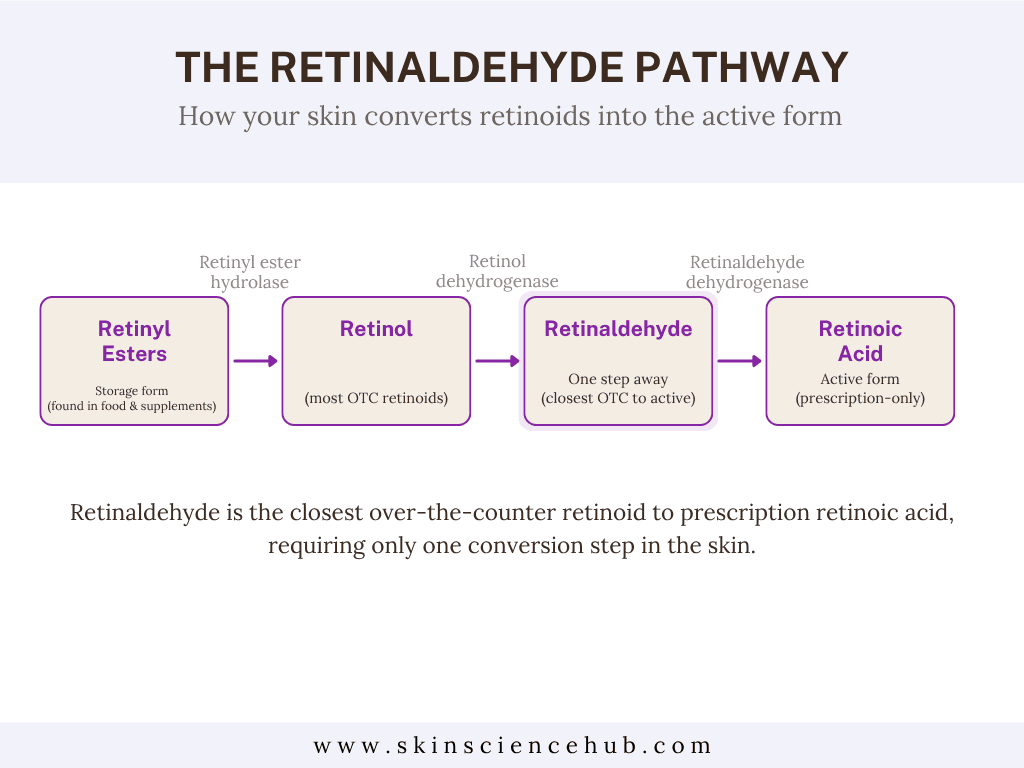
Both retinol and retinal are retinoids, and retinoid is simply the umbrella term for the whole vitamin A family, from retinol and retinal to prescription-strength tretinoin. They all convert to the same active compound inside your skin, but each starts at a different point in the process.
That compound is retinoic acid.
As a pharmacologist, what matters to me is how efficiently each ingredient gets there, because conversion efficiency is what determines how much active ingredient your skin cells receive.
Retinol takes two steps. It converts to retinal first, then retinal converts to retinoic acid. Each step loses potency along the way, so less of what you apply reaches retinoic acid.
Retinal takes one. It converts directly, so more of what you apply becomes active in your skin, and faster. A 2025 clinical study confirmed this, finding retinal achieves approximately 25 percent higher skin penetration than retinol.
What is retinaldehyde covers the full conversion ladder in detail.
How Long Retinal and Retinol Take to Work
Retinol works gradually. Most people see smoother skin and improved texture between 8 and 12 weeks, while fine lines start to fade around 12 to 16 weeks. Collagen-building effects take 4 to 6 months. It keeps building as long as you use it consistently.
Retinal moves faster, and you feel it early. Skin hydration and barrier function improve around 4 to 8 weeks in. By 12 weeks, texture and fine wrinkles improve noticeably. In a clinical study, 95% of participants showed overall skin improvement at 3 months.
If you’ve stopped using retinoids before because you weren’t seeing anything, retinal’s faster timeline is a genuine reason to try it. Most people quit in the first few months, before the ingredient has had enough time to work, and seeing results earlier makes it much easier to stay consistent.
Your timeline depends on a few variables. Skin type, concentration, how often you apply it, and consistent sunscreen use all play a role. Getting those factors right puts you at the faster end of those timelines.
Retinal vs Retinol Research
A 2025 head-to-head study put both ingredients to the test. Retinal reduced wrinkle depth by 35% more than retinol. Skin elasticity improved by 22% more. Retinal also showed 29% greater pore size reduction than retinol.
Dark spots are the one exception. The same study found no significant difference between retinal and retinol for pigmentation. Both work for dark spots and uneven tone.
Retinal vs Retinol Side Effects and Irritation
Starting retinol often means getting through a rough few weeks. Dryness, flaking, redness, and tingling are common as your skin adjusts, and for most people, that early phase is where they give up.
Retinal is gentler, which surprises most people given that it’s the more potent ingredient. But the data backs it up. In a 2025 clinical study, 12.5% of retinal users reported mild irritation, compared to 17.5% of retinol users. Some dryness and tingling can still happen early on. The peeling and flaking that come with retinol are much less common with retinal, and your skin adjusts faster.
Is Retinal Worth the Higher Price
Retinol is affordable across the board. Inexpensive formulations work well, and even premium versions rarely stretch the budget. The technology has been around for decades, and the ingredient is straightforward to formulate.
Retinal costs more. Part of that is justified. Retinal degrades faster when exposed to air, light, and heat. Formulators need specialized packaging and stabilization technology to keep it potent until it reaches your skin.
Price alone doesn’t tell you whether a retinal product will stay active. A 2020 stability study found that most retinoid products lost significant potency before their expiry dates, and expensive products degraded just as quickly as mid-range ones. Knowing what to look for is a more reliable guide than price.
Retinal vs Retinol for Acne, Wrinkles, and Hyperpigmentation
For acne
Both retinol and retinal help with acne by normalizing the skin cell buildup that clogs pores. Retinal also has documented antimicrobial activity against acne-causing bacteria, giving it an additional mechanism that retinol doesn’t have. For acne-prone skin, retinal is the better choice.
For wrinkles
The research gives retinal a clear edge for wrinkles. It outperforms retinol for wrinkle depth, skin elasticity, and pore size reduction. For anti-aging results, retinal is the more effective choice.
For hyperpigmentation
For hyperpigmentation, consistency and daily sun protection will do more for your dark spots than which ingredient you choose. Both work through cell turnover, and neither has a clear advantage over the other here.
When to Choose Retinal Over Retinol
Your skin reacted badly to retinol – You get the same results with less irritation. For sensitive or rosacea-prone skin, retinal is the gentler path.
Retinol hasn’t shown visible results after 3 to 4 months – Retinal is more potent at equivalent concentrations. If retinol hasn’t been enough, retinal is the logical next step.
Your retinol results have plateaued – If you saw improvement early but feel like your skin has stopped responding, retinal’s more efficient conversion gives your skin a stronger dose of active retinoic acid and can push past that plateau.
When to Choose Retinol Over Retinal
Retinol is already working for you – If you’re seeing results without irritation, there’s no reason to switch. You’re exactly where you need to be.
Your budget is the priority – Retinol is significantly more affordable than retinal, and its results are backed by decades of research. Good formulations work well without the higher price tag.
You prefer a longer track record – Retinol has more clinical history than any other over-the-counter vitamin A form. If you want the most established ingredient, retinol is it.
How to Read Retinal and Retinol Percentages
The percentages on retinal and retinol labels look like they should be comparable. They aren’t.
Because retinal is one conversion step closer to retinoic acid, a lower percentage goes much further. The table below shows approximate equivalents.
| Retinal | Approximately equivalent to Retinol |
|---|---|
| 0.01 to 0.05% | 0.1 to 0.25% |
| 0.05 to 0.1% | 0.25 to 0.5% |
| 0.1 to 0.3% | 0.5 to 1% |
A 0.05% retinal is potent enough to outperform a 0.5% retinol, so don’t let a low number put you off. If you’re starting out, begin at 0.01% to 0.05% and build up from there.
If you see a retinal at 0.3%, treat it the way you would a 1% retinol. That’s high-strength territory, and your skin will need time to adjust.
Retinal and Retinol Products
Not all retinal products are worth the price. Before you buy, check the ingredient list for retinal or retinaldehyde, look for airless pump or opaque packaging, and check whether the brand mentions encapsulation technology like cyclodextrin or calcium encapsulation. When they do, the formula is designed to keep retinal stable. When they don’t, reviews from people who’ve used it for several months tell you more than the packaging will.
Retinal
Medik8 Crystal Retinal 3
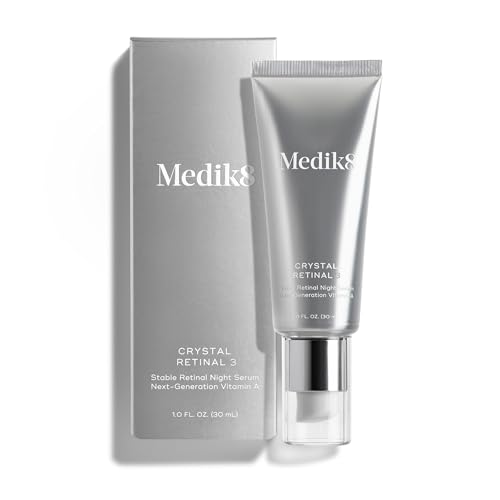
Medik8 Crystal Retinal 3 uses cyclodextrin encapsulation and comes in an airless pump. At 0.03% retinaldehyde, it’s a practical starting point for anyone new to retinal, and because Medik8 makes higher strength versions of the same formula, you can step up gradually without switching products.
Geek and Gorgeous A-Game 5

Geek and Gorgeous A-Game 5 is a 0.05% retinal serum with opaque packaging. At 0.05%, it’s roughly comparable to 0.25% retinol, so it works well for beginners and anyone stepping up from retinol for the first time.
The Ordinary Retinal 0.2% Emulsion

The Ordinary Retinal 0.2% Emulsion sits at 0.2% retinaldehyde, which puts it in strong retinol territory. It’s not a starting point, but for experienced retinoid users it offers high-strength retinal at a low price. The opaque pump bottle offers good protection from light and air, and it’s worth using within a few months of opening to keep the formula active.
Retinol
The Ordinary Retinol 0.5% in Squalane

The Ordinary Retinol 0.5% in Squalane puts 0.5% retinol in a squalane base. Squalane stabilizes the formula and reduces dryness during the adjustment period, so your skin barrier holds up as it adapts.
CeraVe Resurfacing Retinol Serum

CeraVe Resurfacing Retinol Serum combines retinol with ceramides and niacinamide. The ceramides support your skin barrier and the niacinamide reduces irritation, so if your skin is reactive or sensitive, this combination makes the adjustment period noticeably easier.
La Roche-Posay Retinol B3 Serum

La Roche-Posay Retinol B3 Serum has 0.3% retinol alongside niacinamide. For retinol, 0.3% is a moderate starting strength, and the niacinamide reduces irritation from the start, making it a good choice if you have sensitive skin and haven’t used retinol before.
For more retinol and retinal product options, read
How to Switch From Retinol to Retinal
Switching is straightforward, but where you start depends on where you are with retinol right now.
You’re currently using retinol without irritation – Switch directly to retinal at 0.05% or below. Your skin is already used to retinoids, so you can start the next day.
You’ve been using retinol at 0.5% or higher – Start with retinal at 0.05% to 0.1%. That puts you at roughly the same potency as your current retinol.
You stopped retinol because of irritation – Let your skin settle for 2 to 4 weeks before starting retinal, then begin at 0.03% or below.