
NAD+ Benefits for Skin: Does It Really Work?
Last updated on August 6th, 2026 at 09:07 am
NAD+ sounds like something pulled from a chemistry lab. Its full name is nicotinamide adenine dinucleotide, and it exists inside every cell in your body, powering energy production, repairing DNA, and holding oxidative stress in check. That work started before you were born, yet the amount of NAD+ available to do it declines as you age.
That decline is exactly why NAD+ in skincare has become such a selling point, with serums and moisturizers now promising to replenish what your skin has lost, often at a steep price tag.
So in this article, you will learn what NAD+ promises for skin, whether the science backs those promises up, and if it belongs in your routine.
What Is NAD+, and What Are Its Benefits for Skin?
NAD+, short for nicotinamide adenine dinucleotide, is a coenzyme found in every cell in your body. People call it a cellular battery because it carries energy your cells capture from food to wherever it’s needed, the way a battery holds a charge until something draws power from it.
In skin, that energy translates into a few concrete benefits:
- Cellular energy – NAD+ fuels the repair processes that keep skin looking youthful and resilient.
- Collagen protection – It also switches on sirtuins, proteins that produce collagen and slow the enzyme that breaks it down, so skin holds onto its firmness for longer.
NAD+ has circulated for years in oral supplements and IV drips aimed at longevity, but putting it directly into a skincare formula is a much newer idea. Bottling NAD+ is easy. Getting it to penetrate skin is where things get complicated.
Why NAD+ Struggles in Skincare
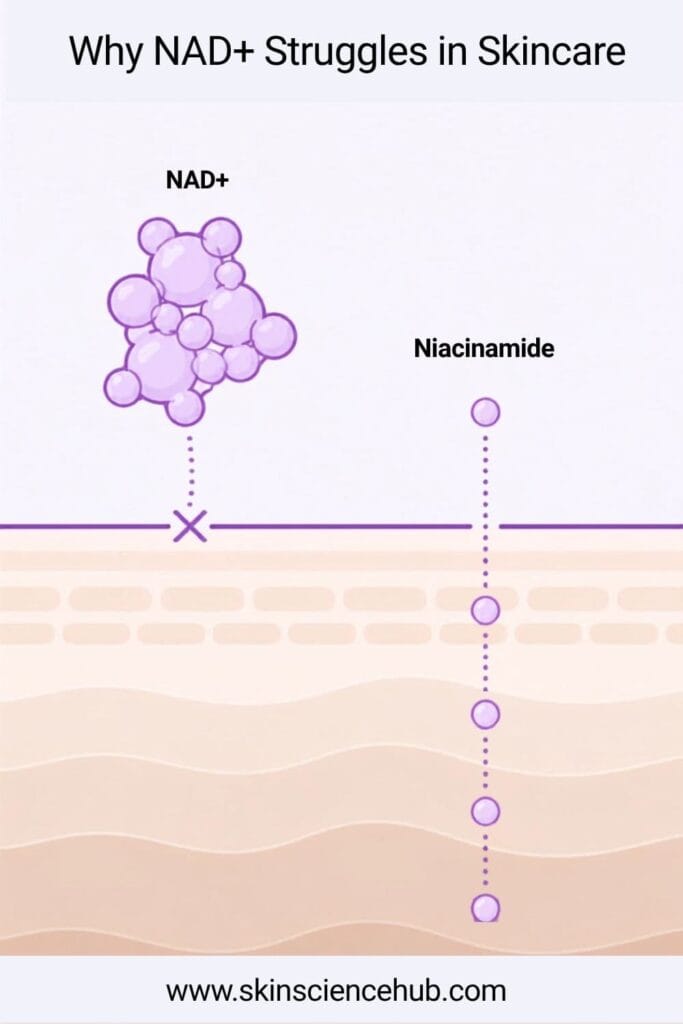
NAD+ is a large molecule that also carries an electrical charge, and both properties work against it, since skin is built to keep large, charged molecules out. As a pharmacologist, I’d point out this is the same size-and-charge calculation that determines whether any topical drug gets absorbed, not just NAD+.
On top of that, NAD+ is unstable, breaking down when exposed to light, heat, or shifts in pH, even before you open the bottle.
Because of these challenges, most formulas rely on smaller precursor molecules instead of NAD+ on its own, ones your skin can absorb and convert into NAD+ more readily. Other brands try encapsulation instead, wrapping NAD+ in a lipid layer meant to help it cross the barrier intact.
The Precursors in Your NAD+ Product
Niacinamide, NMN, and NR are the three precursors you’ll see named on a label. But they don’t all work the same way.
Niacinamide has the longest track record of the three. It’s small enough to penetrate easily, stable enough to survive sitting on a shelf, and studied enough that dermatologists don’t need to guess at what it does. Decades of research show it strengthening the skin barrier, fading hyperpigmentation, calming inflammation, and protecting against sun damage. Our niacinamide guide and serum roundup cover this in full, because most of what people hope to get from NAD+ is already sitting in a niacinamide bottle.
NMN converts into NAD+ in one step, which looks like a shorter path to raising NAD+ in your skin. Research hasn’t confirmed that advantage on living skin, only on lab models built to mimic it.
NR works well as an oral supplement, raising blood NAD+ levels more reliably than niacinamide. Its topical application has not been tested for skincare.
Of the three, niacinamide is the only one that works without question, with decades of research behind it. NMN and NR remain promising. Learn more on NAD vs Niacinamide in skincare.
Does NAD+ Skincare Really Work?
Right now, NAD+ on its own is unproven.
Most of what exists on it comes from cells in a dish or lab models built to mimic skin, and none of that rises to the kind of evidence niacinamide already has.
Researchers delivered NAD+ beneath the skin using a microneedling device, creating tiny channels for it to reach living cells directly. In a study of 36 women with melasma, severity dropped by 59% over 21 weeks, and the only side effects were redness and swelling that faded on their own within 48 hours. But the study has one clear limitation, because there was no group tested with microneedling alone, and microneedling by itself is already known to improve melasma. So this result can’t tell you whether NAD+ did anything at all.
That thin evidence puts NAD+ in a different category than the actives dermatologists already trust.
How NAD+ Compares to Retinoids, Vitamin C, and Collagen
NAD+ doesn’t outperform retinoids or vitamin C, but it does hold up better than a topical collagen cream.
Retinoids
Retinoids remain the strongest ingredient for stimulating collagen, backed by decades of trials tracking changes in wrinkles and skin texture over months of use. NAD+ works on collagen through a different route, switching on the same sirtuin pathway mentioned earlier, but that mechanism has only been studied at the cellular level, so it doesn’t carry the same weight as a retinoid’s track record yet.
Vitamin C
Vitamin C protects skin from oxidative damage caused by sun exposure and pollution, confirmed in published trials over years of use. NAD+ plays a role in managing oxidative stress too, since that’s part of its job inside a cell. But that role comes from general cell biology, not a skin-specific trial, so it isn’t backed by the same kind of proof vitamin C has.
Collagen
Topical collagen shares NAD+’s penetration problem, only its version is worse. Collagen molecules are massive, far too large to cross the skin barrier and reach the dermis, where your skin produces its own collagen, so a collagen cream mostly sits on the surface, holding water there without rebuilding anything underneath. NAD+ has something collagen doesn’t though, a working answer to that same problem. Niacinamide crosses the barrier, converts into NAD+ on its own, and has the clinical track record to back it up. Collagen has no equivalent yet.
What to Look For in a NAD+ Product
Check the ingredient list – A product that names niacinamide, NMN, or NR tells you exactly what you’re getting. One that lists only “NAD+” is vague, as that single word could mean NAD+ on its own, or a precursor marketed under the trendier name.
Check the packaging – Because NAD+ breaks down easily, opaque airless packaging, like a pump or a squeeze tube, keeps the active ingredient intact through repeated use. A clear jar or bottle offers no such protection, so light and air break the ingredient down before you get the chance to use it.
Check for a delivery system – If a brand uses NAD+ directly, look for any mention of encapsulation or a stabilized delivery method. That’s a better sign than a plain, unencapsulated formula.
Consider niacinamide instead – If NAD+’s benefits are what drew you here, a niacinamide serum gives you the proven version of those same benefits for a fraction of the price.
How to Use NAD+ in Your Skincare Routine
Just like niacinamide, NAD+ layers well with antioxidants, peptides, and hyaluronic acid, whether you use it morning or night. It doesn’t need a slow introduction, but like any new product, patch test it first. Combining it with retinol, vitamin C, or AHAs works fine too, provided you get the layering order right.
Bottom Line
NAD+ on its own remains unproven, not disproven, just not there yet. Niacinamide already does what NAD+ skincare promises, backed by decades of research, at a fraction of the price.