Can You Use Retinol with Vitamin C, Niacinamide, and AHAs?
Last updated on July 16th, 2026
Retinol has decades of clinical evidence behind it. It increases cellular turnover, stimulates collagen production, and fades pigmentation. Vitamin C for brightness, niacinamide for barrier support, AHAs for exfoliation. All of them work with retinol, and all of them come with warnings about using them together.
As a pharmacologist, what I am concerned about is not whether these ingredients conflict chemically, but whether your skin can handle them all at once. Most of the contradictory advice online comes from mixing up those two questions.
In this article, you will know how to use retinol with vitamin C, niacinamide, AHAs, and salicylic acid, in the right order, on the right nights, without overwhelming your skin.

Can You Mix Retinol with Other Active Ingredients?
Yes, you can mix retinol with most active ingredients. The concern traces back to a single 1999 study that raised questions about skin pH affecting how retinol converts to its active form, and it is still widely cited today, but it does not hold up.
The study used a blend of animal and human proteins, not intact human skin, and it looked at how skin naturally processes vitamin A, not how topical retinol works. The pH issue only appeared when a fatty acid byproduct was added, and without it, the study found no clear pH pattern. No research since has reproduced the effect on real skin.
Retinol’s own chemistry explains why. Retinol is oil soluble, which means it works in oil, not in water. Vitamin C, glycolic acid, and AHA toners are all water based. Oil and water do not mix, even on your skin, so an acidic product simply cannot reach retinol or change how it works.
The one combination worth keeping separate is other retinoids. Retinal, tretinoin, and adapalene all work the same way once absorbed, so layering them adds irritation without any additional benefit.
Can You Use Niacinamide with Retinol?
Yes, and it is one of the most recommended pairings in dermatology. Retinol drives cell turnover and collagen production, and niacinamide keeps your barrier strong, fades hyperpigmentation, and reduces enlarged pore appearance. Because the 2 work on different things, neither gets in the way of the other.
Niacinamide supports your barrier by prompting more ceramide production. Ceramides are the fats that hold your skin barrier together, and more of them means your skin tolerates retinol better. Better tolerance leads to longer use, and longer use leads to better results. In the early weeks, you may notice some dryness or redness as your skin adjusts to retinol, and niacinamide helps reduce both.
Apply niacinamide first, followed by retinol, or use niacinamide in the morning and retinol at night.
Can You Use Vitamin C with Retinol?
Yes. Vitamin C brightens skin and stimulates collagen production. Retinol increases cell turnover and smooths wrinkles. Seité et al. (2005), published in Skin Pharmacology and Physiology, confirmed that combining the two reversed more signs of photoaging than either ingredient could achieve on its own.
How you layer them depends on which form of vitamin C you use. L-ascorbic acid, the most common form, can increase irritation when used with retinol at night because both are potent actives. For most people, vitamin C in the morning and retinol at night is the simpler approach, and vitamin C’s antioxidant protection works well alongside sunscreen during the day. If you want to use both at night, vitamin C derivatives are a gentler option and layer with retinol more comfortably.
Can You Use AHAs with Retinol?
Yes, but this pairing needs more care than niacinamide or vitamin C. The concern is not that they cancel each other out, but that using both on the same night can overwhelm your skin barrier.
Retinol increases cell turnover from deeper layers upward, while AHAs like glycolic and lactic acid dissolve dead skin cells on the surface. Because they work on different layers, they complement each other. The pairing works best when each ingredient has its own night.
When you use both too close together, you may notice flaking. Flaking is when your skin starts to peel and shed in small dry pieces. This is not exfoliation. It is a sign your barrier has been pushed past its limit, and adding more actives at that point makes it worse.
The standard approach is to alternate nights. AHAs one night and retinol the next, with a rest night in between. Kafi et al. (2007), published in Archives of Dermatology, showed that retinol applied up to 3 times a week produced significant improvements in fine wrinkles and collagen production over 24 weeks. You do not need to use it every night. Skin cycling follows the same logic.
If your skin is well adjusted to both, an AHA in the morning and retinol at night is also an option. If you have sensitive skin, keep them on separate nights, and if your routine already includes multiple acids, retinol should wait for a different night altogether.
Can You Use Retinol with Salicylic Acid (BHA)?
Yes, and if you have acne, this combination makes a lot of sense. Salicylic acid, also called BHA, is oil soluble, which means it gets into pores and clears them out. Retinol regulates cell turnover and reduces the conditions that lead to breakouts in the first place. Together they address acne from 2 different directions.
Using both on the same night increases irritation risk, so alternating nights is the cleaner option. Salicylic acid one night, retinol the next. If you prefer to use both on the same day, salicylic acid in the morning and retinol at night keeps the two separate without losing either benefit.
Both ingredients can be drying, so a moisturiser on both nights is important. If you are new to actives, start with one before adding the other. Give your skin a few weeks with each, and it will handle both far better.
How to Layer Retinol in Your Skincare Routine
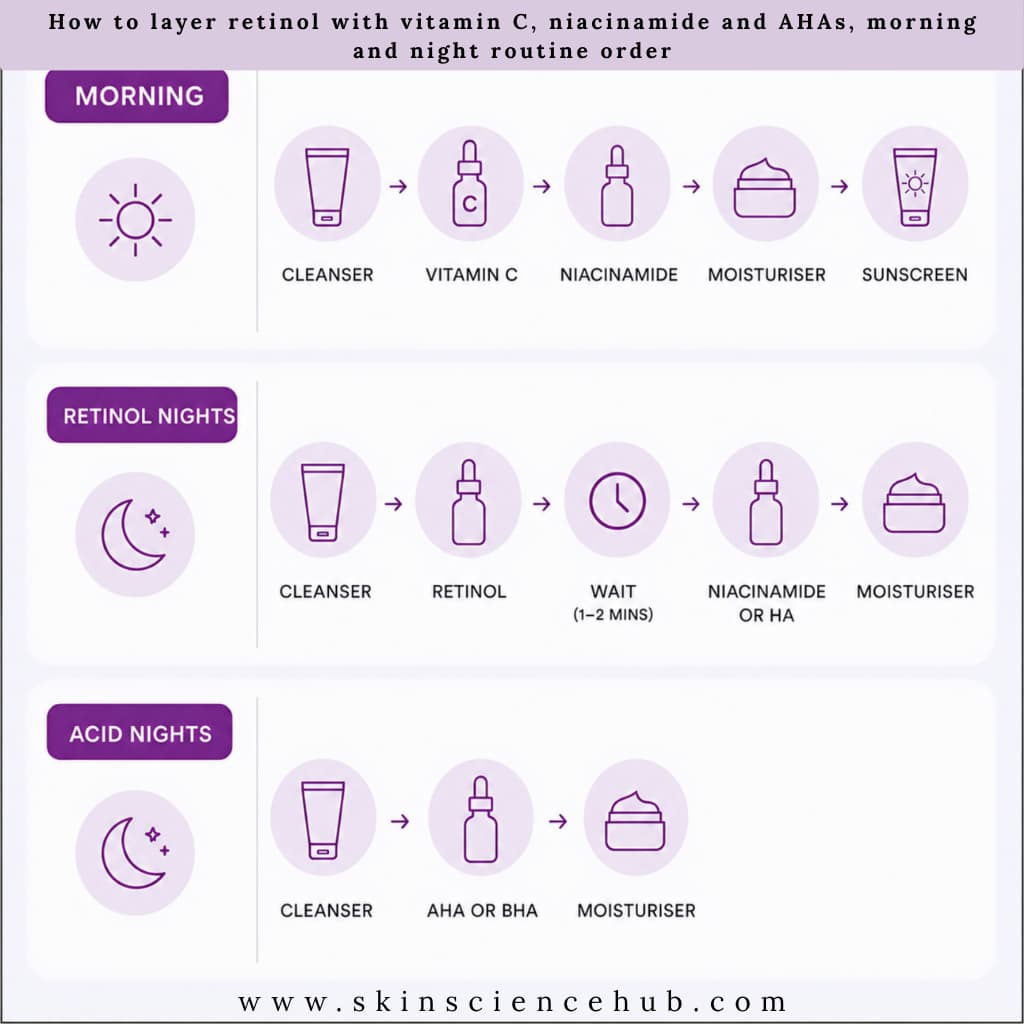
Morning Skincare Routine
In the morning, cleanse first, then apply vitamin C. Add niacinamide if you use it and give both a minute to absorb. Follow with moisturiser, then sunscreen.
Retinol Night Routine
On retinol nights, cleanse first and apply retinol to dry skin. Wait a few minutes before adding anything else. Both steps reduce irritation. Follow with niacinamide or hyaluronic acid, then moisturiser.
AHA and BHA Nights
On acid nights, leave retinol out entirely. Cleanser, AHA or BHA, moisturiser. Keep it simple and let the exfoliant do its work.
Sensitive Skin
If your skin is sensitive, try the moisturiser sandwich. Apply a thin layer of moisturiser first, then retinol, then another layer on top. This creates a buffer so retinol absorbs more gently. Start once or twice a week and build up before layering other actives.
Want the full picture beyond these three? My Skincare Ingredient Guide covers what to mix and what to avoid for 32 ingredients, all in one chart.
Signs You Are Overloading Your Skin with Actives
Some redness and flaking in the first few weeks of using retinol are normal. What is not normal is redness that persists past that period, stinging when you apply a basic moisturiser, or new sensitivity to products you have used for a long time. Those are signs you have pushed your skin too hard.
The fix is to strip back to cleanser, moisturiser, and sunscreen until your skin settles. No actives, no exfoliants. Most people need a week or 2 before their skin feels normal again. After that, reintroduce one ingredient at a time and give each a few weeks before adding the next.
Products for a Retinol Routine
For anyone building or rebuilding the routine, these are the products worth starting with.
1. The Ordinary Retinol 0.5% in Squalane

The Ordinary retinol in Squalene is for anyone already using retinol who wants a higher concentration. It has 0.5% retinol in squalane, a skin-compatible carrier that keeps the formula gentle while retinol does its work.
2. CeraVe Skin Renewing Retinol Serum

CeraVe Skin Renewing Retinol Serum is good for beginners. It has 0.3% retinol and niacinamide in one product, so you get both in a single step. Hyaluronic acid and ceramides are also in there to keep skin hydrated.
3. The Ordinary Niacinamide 10% + Zinc 1%

A niacinamide serum to use alongside your retinol. It has 10% niacinamide, which helps your skin barrier handle retinol more comfortably, and 1% zinc to help keep redness in check during the early weeks.
4. The Ordinary Ascorbyl Tetraisopalmitate Solution 20% in Vitamin F

This is a vitamin C derivative. It is oil based and layers comfortably with retinol at night. With 20% ascorbyl tetraisopalmitate, it supports the brightening and collagen work your retinol is already doing.
5. Paula’s Choice Skin Perfecting 8% AHA Gel Exfoliant

The AHA to use on nights when you are not using retinol. It has 8% glycolic acid in a leave on gel, is fragrance free, and exfoliates the skin surface to keep texture smooth.
6. Paula’s Choice Skin Perfecting 2% BHA Liquid Exfoliant
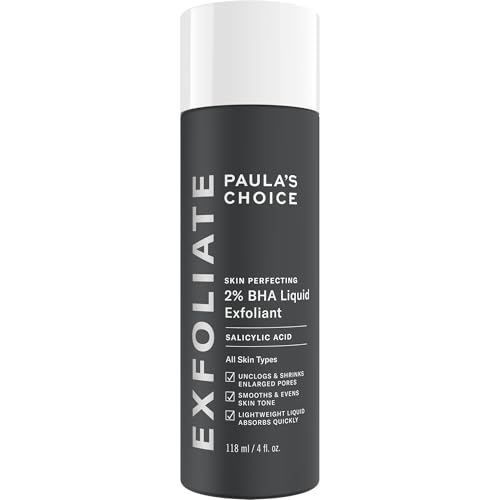
A leave on BHA formula for acne prone skin. It has 2% salicylic acid, and because salicylic acid is oil soluble, it gets into pores and clears them out.
For more product options, read
The Bottom Line
Retinol works alongside all of these ingredients. Niacinamide and vitamin C are the easiest to start with. AHAs and salicylic acid just need alternating nights. From there, your barrier tells you when to push on and when to ease back.