What Sleep Deprivation Does to Your Skin and How to Recover
Last updated on April 25th, 2026
You can tell when someone hasn’t slept enough. It shows on their face. Puffy eyes, dark circles, dull skin, a gray undertone where there’s usually a glow.
Beauty sleep is a real biological process, not just a saying. While you sleep, your skin repairs damaged cells, produces collagen, and clears out the inflammatory signals that built up during the day. It also rebuilds its barrier and regulates the immune activity that drives inflammation. Poor sleep damages your skin in ways that go well beyond how you look in the morning.
Aging speeds up, your barrier weakens, and conditions like eczema, psoriasis, and acne become harder to control. But your skin can recover, often faster than you’d expect.
In this post, you’ll learn exactly what sleep deprivation does to your skin, why it worsens certain conditions, and what reverses the damage.
What Happens to Your Skin at Night
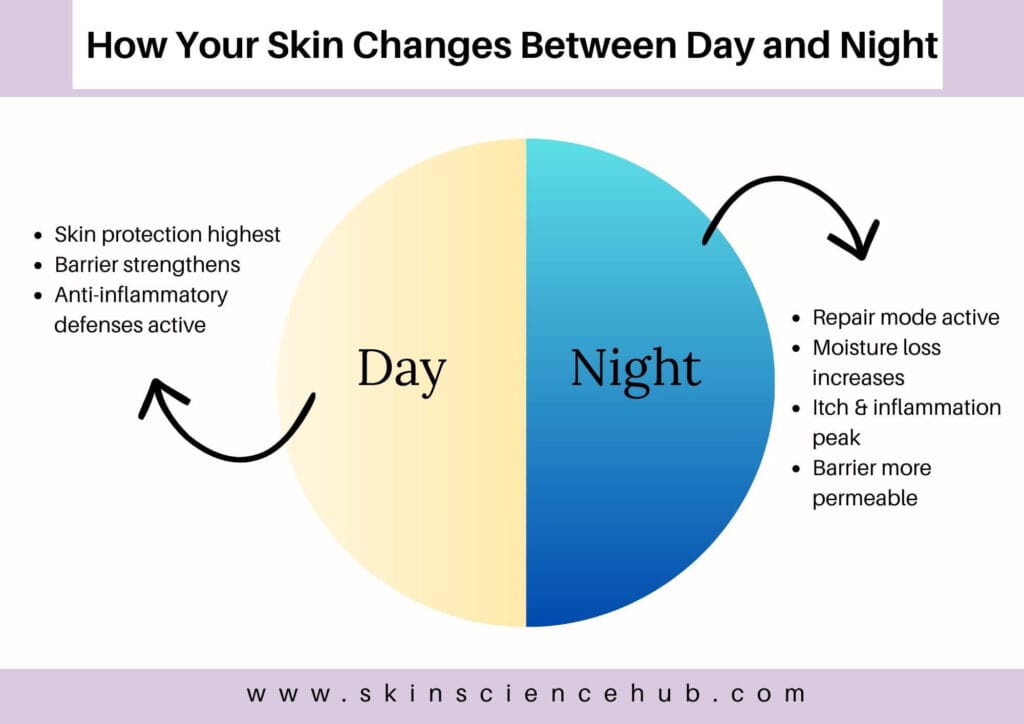
Your skin runs on a 24-hour cycle with two distinct phases. During the day, it focuses on protection. Your barrier strengthens, sebum production peaks, and your skin thickens slightly to defend against environmental damage.
At night, it switches into repair mode. Blood flow increases, cell turnover accelerates, and collagen production ramps up. This is when your skin does its most important work.
Repair mode also makes your skin more vulnerable. Your barrier becomes more permeable, so moisture escapes faster.
Cortisol, your body’s main anti-inflammatory hormone, also drops significantly at night. Without it keeping inflammation in check, inflammatory signals that were suppressed during the day start to rise.
For healthy skin, the body manages this well. For anyone with eczema, psoriasis, or other inflammatory conditions, this is when itch intensifies and flares become more likely. If your skin tends to flare at bedtime and calm down by morning, your skin’s nighttime biology is driving that pattern.
How Sleep Deprivation Ages Your Face
Dark circles and puffy eyes are the most immediate signs. Blood vessels under the thin skin around your eyes dilate and become more visible, and fluid builds up because your lymphatic system doesn’t drain efficiently without adequate sleep.
During deep sleep, your body releases growth hormone, which your skin needs to repair itself and produce collagen. Less sleep means less of it, so wrinkles form faster, elasticity drops, and your skin struggles to keep up.
Beyond the normal nighttime vulnerability, chronic sleep deprivation causes deeper barrier damage.
As a pharmacologist, this is the part I find most significant. Your stratum corneum depends on a precise arrangement of ceramides, fatty acids, and cholesterol to hold moisture in and keep irritants out. Poor sleep disrupts that arrangement over time.
The result is skin that’s more sensitive, more reactive, and less able to hold moisture. Dead cells build up on the surface rather than shedding normally, which dulls your skin tone. Breakouts and minor cuts that would normally heal quickly take much longer, raising your risk of scarring and ongoing inflammation.
How Poor Sleep Worsens Skin Conditions
Sleep problems and chronic skin conditions feed off each other. Poor sleep makes your skin worse, and worse skin makes sleep harder to get.

Eczema and atopic dermatitis
According to a study published in Acta Dermato-Venereologica, 87% of adults with eczema struggle to sleep well. That’s almost 9 out of 10 people caught in the same exhausting cycle. And it’s not just because itch keeps you awake, although that’s a big part of it.
Itch gets significantly worse at night because of those same nighttime shifts your skin goes through. Transepidermal water loss increases, blood flow to your skin rises, and cytokine activity peaks. All of it amplifies the itch sensation right when you’re trying to fall asleep.
When you’re drowsy and half asleep, your ability to stop yourself scratching disappears. You scratch without realising it. Scratching triggers more inflammation, which produces more itch signals, which leads to more scratching. This loop keeps you locked in light sleep rather than the deep, restorative stages your body needs.
Your melatonin levels also drop during active eczema flares. Melatonin doesn’t just regulate your sleep cycle, it also supports your skin barrier through antioxidant protection. So when it dips during a flare, both your sleep and your skin suffer at the same time.
Psoriasis
The same research found that over 60% of people with psoriasis experience insomnia. Many also deal with excessive daytime sleepiness because nighttime sleep gets so disrupted. You’re exhausted all day, yet sleep won’t come at night.
The worse your psoriasis, the worse you sleep. And the worse you sleep, the worse your psoriasis becomes. Each side keeps driving the other.
Psoriasis also carries a significantly higher risk of obstructive sleep apnea. A study published in the Journal of the European Academy of Dermatology and Venereology found that 82% of adults with psoriasis develop sleep apnea, which means you stop breathing repeatedly during the night, sometimes dozens of times. Your body gets intermittent oxygen deprivation, which triggers inflammation throughout your system and worsens your psoriasis directly.
If you wake up gasping for air, feel like you’re choking, or your partner says you stop breathing at night, talk to your doctor about sleep apnea testing. Untreated sleep apnea raises your risk for heart disease, stroke, and high blood pressure on top of what it does to your skin. Treatment is available and it significantly improves both sleep quality and psoriasis control.
Acne
Poor sleep disrupts your hormonal balance and impairs immune function, which leads to increased sebum production and inflammation. Stress from sleep deprivation also elevates proinflammatory cytokines and substance P, a chemical that directly triggers skin inflammation. Your body creates perfect conditions for breakouts right when you’re already exhausted.
If you’ve noticed more breakouts during periods when you’re not sleeping well, you’re observing a real physiological process. Improving your sleep helps clear your skin because it addresses the hormonal and inflammatory drivers directly.
Rosacea
The facial redness, flushing, and burning that characterise rosacea all intensify when you don’t sleep well. Sleep deprivation promotes inflammation throughout your skin and disrupts blood flow to your face. Flares become more frequent and more intense, and the unpredictability of that adds its own layer of stress on top of the physical discomfort.
Controlling your sleep won’t eliminate rosacea, but it reduces how often flares happen and how severe they are when they do.
Chronic urticaria and sleep deprivation rashes
Can lack of sleep cause hives and rashes? Yes, and it happens even in people with no prior skin history.
When you’re sleep deprived, your immune system becomes dysregulated. Mast cells, which are responsible for releasing histamine during allergic reactions, become more reactive. Your body releases more histamine even without an obvious trigger, and histamine is what causes hives, itching, and skin redness. A sleep deprivation rash can develop during periods of chronic poor sleep because of this histamine response.
For people who already have chronic urticaria, a lack of sleep rash response is more frequent and more intense. Inflammatory markers rise, flares happen more often, and the itching intensifies. That itch then disrupts sleep further, which drives inflammation higher, and the cycle becomes increasingly difficult to break.
If you’re developing unexplained hives or rashes and your sleep has been consistently poor, sleep deprivation is a contributing factor worth discussing with your doctor.
Can Your Skin Recover from Sleep Deprivation?
Yes, and the timeline depends on which type of damage you’re dealing with. Most people need at least 7 to 9 hours of sleep for skin repair to happen properly. Below 6 hours consistently, damage accumulates faster than your skin can address it.
Some improvements come quickly. Puffiness and dark circles often reduce within a night or two because your lymphatic system starts draining efficiently again and dilated blood vessels settle down. Dullness improves too, as blood flow normalises and your skin’s exfoliation process gets back on track.
Barrier repair takes longer. Your stratum corneum needs several weeks of consistent sleep to rebuild its lipid structure. If your skin has been reactive, dry, or sensitive for a while, expect gradual improvement over two to four weeks rather than immediate results.
Collagen recovery is the slowest. Collagen synthesis depends on sustained growth hormone release during deep sleep, so rebuilding takes months of consistently good sleep. Fine lines and elasticity loss won’t reverse quickly, but they do improve over time.
For inflammatory conditions like eczema, psoriasis, and acne, you may notice improvements sooner because better sleep directly reduces the hormonal and inflammatory drivers behind flares. Most people see calmer, less reactive skin within a few weeks of consistently better sleep.
How to Sleep Better for Healthier Skin
If you have eczema, psoriasis, acne, or any chronic skin condition, see a dermatologist before focusing on anything else. Getting your condition under control often improves sleep immediately because you’re removing the root cause of the nighttime discomfort and itch.
Once your skin is being treated, your sleep environment is the next thing to look at.
1. Set up your bedroom for sleep
Use blackout curtains and cover any devices that emit light. Even a small glow from a phone charger disrupts melatonin production and fragments your sleep. If you can’t eliminate every light source, a good eye mask does the job.
Temperature matters just as much. Keep your bedroom between 60 and 67 degrees Fahrenheit. Your core body temperature needs to drop for deep sleep to happen, and a cool room makes that easier. For anyone dealing with inflamed, itchy skin that already feels hot at night, a cooler room also provides real physical relief.
Noise disrupts sleep even when it doesn’t fully wake you. Intermittent sounds keep pulling you out of deep sleep stages without you realising it. Eliminate noise where possible or use consistent white noise to mask it.
2. Build a consistent sleep schedule
Go to bed and wake up at the same time every day, including weekends. Your circadian rhythm runs on consistency, and when it’s stable, your skin’s inflammatory response at night becomes more manageable. Out of everything in this section, this one change makes the biggest difference.
3. Manage your light exposure through the day
Stop looking at screens at least an hour before bed, preferably two. Blue light from phones, tablets, and computers suppresses melatonin and signals to your brain that it’s still daytime, pushing your sleep window later.
In the morning, get natural light within the first hour of waking. This anchors your circadian rhythm for the day. If you wake before sunrise or live somewhere with limited morning light, a light therapy box used for 15 to 30 minutes after waking works well.
4. Watch caffeine and food timing
Caffeine has a half-life of around 5 to 6 hours, so coffee at 3pm means significant caffeine is still in your system at 9pm. Cut it off after early afternoon. Large meals close to bedtime can cause reflux and discomfort that fragments sleep, so keep evening eating light and give yourself time to digest before you lie down.
5. Optimise your nighttime skincare routine
Shower or bathe before bed to remove dust, pollen, and pollutants that accumulate on your skin throughout the day. These particles trigger inflammation and itch that disrupt sleep. After bathing, apply a moisturiser while your skin is still slightly damp, which counteracts the moisture loss that happens during sleep and reduces the likelihood of nighttime itch.
If your doctor has prescribed topical medications, apply them at night. Blood flow to your skin increases during sleep, which improves how well active ingredients absorb. For inflammatory conditions, nighttime application also helps control the immune response that intensifies after dark.
Wash your bedding weekly in hot water and keep your bedroom free of dust and clutter. Dust mites, mould, and pet dander trigger both skin inflammation and respiratory irritation, and a clean sleep environment makes a noticeable difference.
When to get professional help
If you’ve addressed your sleep environment, treated your skin condition, and still struggle to sleep consistently, talk to your doctor about a referral to a sleep specialist. You may have an underlying condition like sleep apnea that needs specific treatment.
Cognitive behavioral therapy for insomnia, known as CBT-I, has shown real effectiveness in improving both sleep quality and skin symptoms in people with chronic skin conditions. It targets the thoughts and behaviors that interfere with sleep and produces lasting improvements. If anxiety or psychological distress related to your skin is affecting your sleep, a mental health professional can help address that directly.
The Bottom Line
Poor sleep damages your skin in ways that go well beyond tired eyes and a dull skin tone. It accelerates aging, weakens your barrier, drives inflammation, and makes conditions like eczema, psoriasis, and acne significantly harder to manage.
Your skin repairs itself every single night. How well it does that depends on how much quality sleep you get.