
Benzoyl Peroxide: How It Works and How to Use It Without Drying Out Your Skin
Benzoyl peroxide has treated acne for more than six decades, and it still holds up as one of the most reliable options out there. It works by killing the bacteria behind breakouts and calming inflammation at the same time, and unlike antibiotics, bacteria haven’t built up resistance to it.
You’ll find it in washes, leave-on gels and creams, and spot treatments. It works just as well on bacne as it does on your face.
In this article, you’ll learn how to use benzoyl peroxide without the dryness and irritation that puts so many people off it, along with what it pairs well with and what to keep separate.
What Is Benzoyl Peroxide?
Benzoyl peroxide treats acne. You can get it over the counter or by prescription.
It’s bactericidal, meaning it kills the bacteria behind acne, Cutibacterium acnes (C. acnes). That bacteria lives both on the surface of your skin and down inside the hair follicles, which is where breakouts actually start.
Recent studies suggest benzoyl peroxide in skin care products can break down into benzene, a known carcinogen, though we’ll cover that in detail later in this guide.
How Benzoyl Peroxide Works
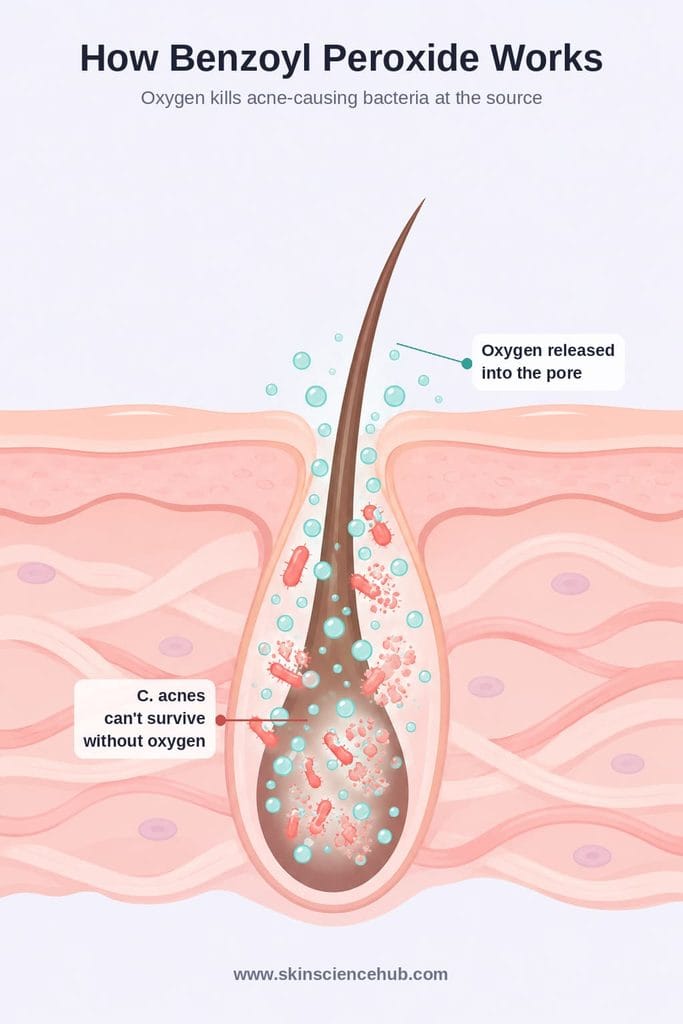
Benzoyl peroxide is a strong antibacterial. Once it’s on skin, it breaks down and releases oxygen into the pore. That process kills C. acnes, because it’s anaerobic and can’t survive in that oxygen-rich environment. A 10% formula can cut C. acnes counts by about 98% within two weeks, matching the reduction seen after four weeks of oral antibiotics.
That broad, oxygen-based kill is also why bacteria haven’t built up resistance to benzoyl peroxide. Antibiotics work by blocking a specific process bacteria use to build proteins, and bacteria can eventually mutate around that block. That’s why benzoyl peroxide so often gets paired with a topical antibiotic like clindamycin. Clinical trials show that this combination wipes out both susceptible and resistant strains of C. acnes within a week, cutting overall counts by 99.7%.
It also has a mild keratolytic effect, meaning it speeds up how fast your skin sheds dead cells. That helps with some of the buildup behind blackheads and whiteheads, though a dedicated exfoliant still does more of that work.
On top of the bacterial kill, benzoyl peroxide reduces inflammation directly in the lesion, cutting down on redness and swelling. Less inflammation may also lower the risk of the dark marks that can follow a breakout, a bigger concern for people with darker skin tones.
Acne comes down to four things: excess sebum, clogged pores, C. acnes bacteria, and inflammation. Benzoyl peroxide targets the bacteria and the inflammation directly, while leaving excess sebum and clogged pores mostly untouched.
What Benzoyl Peroxide Is Good For
1. Benzoyl Peroxide for Inflammatory Acne
Benzoyl peroxide works best on inflammatory acne: the papules and pustules that show up as red, swollen blemishes. It’s usually recommended for mild to moderate cases. A review comparing Western and Japanese acne trials found it reduces inflammatory lesion counts by 15 to 34 percent.
2. Benzoyl Peroxide for Cystic and Hormonal Acne
Benzoyl peroxide reduces bacteria and swelling in a cystic or hormonal breakout. But it can’t reach the hormones driving the excess sebum. Treating either type usually needs a hormonal or sebum-targeting approach alongside it.
3. Benzoyl Peroxide for Bacne (Body and Back Acne)
Body and back acne responds the same way facial acne does, just across more surface area. Body wash works better here than a leave-on gel because it’s easier to cover your whole back and chest evenly in the shower. One four-week trial found that an 8% wash cut inflammatory lesions by 37 percent.
4. Benzoyl Peroxide for Blackheads and Whiteheads
Benzoyl peroxide isn’t at its strongest against blackheads and whiteheads, though it still helps. A review of Western and Japanese acne trials found it cuts non-inflammatory lesions by 13 to 41 percent, close to the 15 to 34 percent reduction it found for inflammatory acne. Since blackheads and whiteheads form mainly from trapped debris, not bacteria, an ingredient built to clear that debris directly, like salicylic acid or a retinoid, generally does better.
Where Else Benzoyl Peroxide Helps
1. Benzoyl Peroxide for Folliculitis and Ingrown Hairs
Doctors use benzoyl peroxide off-label for two related hair-follicle conditions. The first is folliculitis, which is inflammation around the follicle, usually caused by bacteria. Benzoyl peroxide clears it by killing that bacteria directly.
The second is pseudofolliculitis barbae, which isn’t true folliculitis despite the name. It happens when a shaved hair curls back into the skin and triggers inflammation. Benzoyl peroxide helps in two ways: its keratolytic effect keeps hairs from getting trapped under the skin, while its antibacterial action calms the bumps that flare up.
2. Benzoyl Peroxide for Rosacea
Rosacea isn’t the same condition as acne. Rosacea-prone skin is more sensitive to irritation than most, so standard benzoyl peroxide usually makes it worse. Epsolay, a 5% encapsulated formulation, gets around this by releasing the ingredient slowly, so your skin takes it in gradually. Two FDA approval trials found it cut inflammatory rosacea lesions by nearly 70 percent over 12 weeks, versus 38 to 46 percent with a vehicle cream alone. Results showed up as early as two weeks
3. Benzoyl Peroxide for Hidradenitis Suppurativa
Hidradenitis suppurativa is a chronic inflammatory condition that causes painful lumps under the skin, usually in the armpits, groin, or under the breasts. It isn’t caused by bacteria, but bacterial biofilms often form in those areas and drive more inflammation. Benzoyl peroxide targets those biofilms directly. Clinical guidance lists benzoyl peroxide wash as a maintenance option, alongside other antiseptic washes like chlorhexidine and povidone-iodine. It’s never used as a standalone treatment, just one part of a broader care plan.
4. Benzoyl Peroxide for Pitted Keratolysis and Body Odor
Pitted keratolysis is a bacterial skin infection on the feet that eats into the top layer of skin, leaving small pits and a strong odor. It’s most common in people who sweat heavily inside closed shoes. The bacteria behind it produce the compounds responsible for that smell, so eliminating them is what clears the odor. A randomized trial found that both 2.5% and 5% benzoyl peroxide significantly reduced the odor and improved the pitted lesions, with no significant difference between the two strengths.
Body odor, or bromhidrosis, follows the same basic logic: bacteria break down sweat on your skin, and washing your underarms with benzoyl peroxide reduces that bacteria. Clinical references treat this as a conservative option, not a primary one.
What Benzoyl Peroxide Won’t Do
Benzoyl Peroxide Won’t Fade Dark Spots
Benzoyl peroxide doesn’t fade the dark or red marks a breakout leaves behind. It kills bacteria and calms active inflammation. It does nothing for pigment or blood vessels once a pimple has healed. Fading an existing dark spot needs an ingredient built for that job, like azelaic acid or vitamin C. If you have a lingering red mark that won’t fade, check the PIE vs PIH breakdown for a different approach.
Benzoyl Peroxide Won’t Replace a Retinoid
Retinoids speed up cell turnover directly, which helps keep new clogged pores from forming. Benzoyl peroxide only speeds up turnover as a side effect of killing bacteria, not through a dedicated mechanism of its own.
Benzoyl Peroxide Won’t Treat Fungal Acne
Fungal acne isn’t true acne, despite the name. It’s a yeast overgrowth in the hair follicles, not bacteria, so benzoyl peroxide can’t treat it. It can even make things worse: killing off bacteria disrupts the skin’s microbiome, giving the yeast more room to grow.
Building a Benzoyl Peroxide Routine
1. Which Strength Should You Use?
Benzoyl peroxide is available over the counter from 2.5% to 10%. A review of Western and Japanese trials found no difference in how well these concentrations work. Higher percentages aren’t more effective, and they raise the risk of irritation. Most dermatologists recommend starting at 2.5% to 5%.
2. Benzoyl Peroxide Wash vs Leave-On: Which Should You Use?
Benzoyl peroxide comes in two basic formats: washes and leave-on products.
A benzoyl peroxide face wash or body wash stays on your skin for only a minute or two before you rinse it off, but that short contact still works. One brand, Panoxyl, claims its formula kills bacteria in 15 seconds, though that figure comes from the company’s own study, not an independent one.
Leave-on products, gels, creams, and spot treatments, stay on the skin for hours. That longer contact time means more of the active ingredient absorbs, and it also gives irritation more time to build.
Dermatologists report that washes work about as well as leave-on formulas, though well-controlled head-to-head trials between the two are still rare. If you’re new to benzoyl peroxide or have sensitive skin, a wash is usually the gentler place to start.
3. Starting Low and Building Up
Start at 2.5% to 5%, and use it every other day at first. This gives your skin time to adjust before you increase how often or how strong you go. Leave-on products can borrow the wash’s short-contact technique too: apply it, then rinse it off after five minutes. As your skin tolerates it, slowly stretch that time out.
4. Moisturizer for Benzoyl Peroxide
Benzoyl peroxide dries skin out, so you need a moisturizer alongside it. Look for one with ceramides and niacinamide. Ceramides help rebuild the skin barrier, while niacinamide calms inflammation and strengthens it further.
5. Where It Fits in Your Layering Order
If you’re using a benzoyl peroxide wash, it replaces your regular cleanser, so apply it directly to your face. If you’re using a leave-on gel or cream, cleanse first, then apply it before your moisturizer. Either way, finish with sunscreen in the morning, since benzoyl peroxide makes your skin more sensitive to the sun.
Benzoyl Peroxide Side Effects and Safety
Dryness, redness, and peeling are the most common reactions, especially at higher concentrations or if you start too strong. A smaller number of people develop contact dermatitis, which is a stronger allergic reaction than irritation. If you develop contact dermatitis, stop using it.
Benzoyl peroxide can also cause purging: a short-term flare of existing breakouts as it speeds up cell turnover. That’s a sign it’s working. Purging is different from the irritation described above, though the two can look similar enough to confuse. To tell them apart, check the skin purging vs breakout guide.
Is Benzoyl Peroxide Safe During Pregnancy?
Benzoyl peroxide is generally considered safe during pregnancy at concentrations up to 5%, used twice daily, unlike retinoids, which aren’t recommended during pregnancy at all. The FDA puts benzoyl peroxide in pregnancy category C, meaning its effects on fetal development haven’t been directly studied, though only a small amount absorbs into the bloodstream. As with any product you use during pregnancy, check with your obstetrician or dermatologist first.
Who Shouldn’t Use Benzoyl Peroxide
If you have a known sensitivity to benzoyl peroxide, avoid it. A less obvious risk factor is worth knowing too: benzoyl peroxide breaks down in skin into benzoic acid, and cinnamon belongs to the same chemical family, so someone sensitive to cinnamon can sometimes react to benzoyl peroxide as well. That’s a reason to introduce it cautiously, not necessarily a reason to avoid it altogether.
If your skin is rosacea-prone, standard benzoyl peroxide usually makes it worse. Epsolay, an encapsulated 5% version built specifically for rosacea-prone skin, is designed to avoid that problem.
Does Benzoyl Peroxide Bleach Clothes and Hair?
Yes. Left on skin, benzoyl peroxide can bleach any fabric it touches, including towels, pillowcases, and clothing, and it can lighten hair too. This shows up mostly on dark or colored fabric. A wash format lowers the risk, since less time on your skin means less time to bleach whatever it touches.
Is Benzoyl Peroxide Still Safe? The Benzene Question
In 2024, independent lab testing found that benzoyl peroxide can break down into benzene, a known carcinogen, when exposed to heat and sunlight. Some products showed benzene levels far above the FDA’s limit after being heated. This mirrors what happens when a bottle sits in a hot car or on a sunlit shelf.
The FDA opened an investigation, and the American Academy of Dermatology followed with official guidance in March 2025, telling people to store these products carefully and replace them regularly. A small number of products were recalled, though no broad industry-wide recall has happened.
A 2025 multicenter retrospective study found no significant link between benzoyl peroxide use and benzene-related cancers. The FDA has also said that even with decades of daily use, the added cancer risk is low.
Research is ongoing.
How to Store Benzoyl Peroxide
Keep it at room temperature or cooler and away from direct sun, since heat and sunlight are what break it down into benzene. Replace it every ten to twelve weeks.
Benzoyl Peroxide vs Other Acne Actives (and How to Combine Them)
1. vs Salicylic Acid
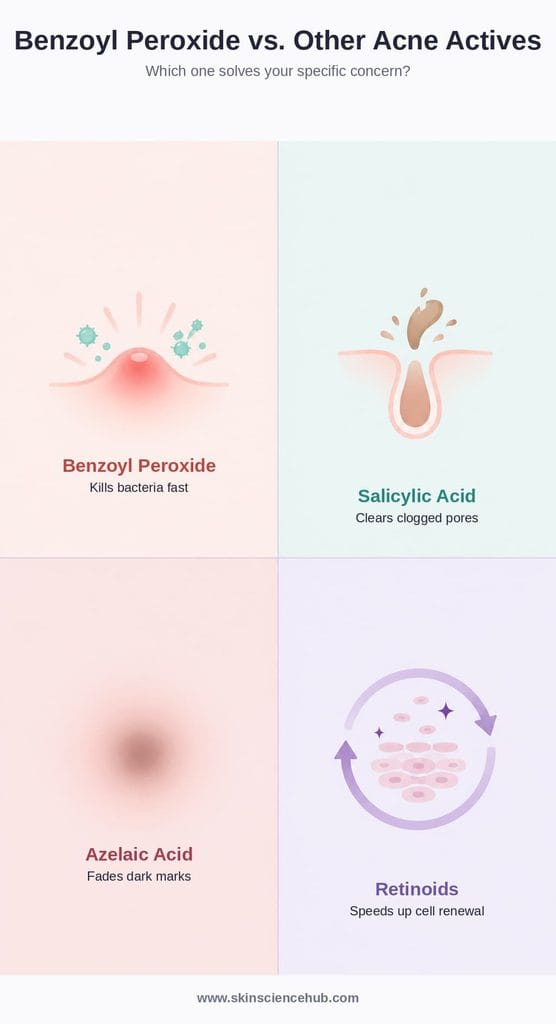
If your main problem is red, inflamed bumps, benzoyl peroxide is the better place to start. For blackheads and clogged pores, salicylic acid works better. You don’t have to pick one, though, since many routines use both and the two don’t break each other down chemically. The concern is irritation. Using both on the same area at once can cause more dryness and peeling than your skin can handle. Alternating them, one in the morning and one at night, or on different days, is the safer approach.
2. vs Azelaic Acid
If you have active, inflamed breakouts, benzoyl peroxide works faster. But for dark marks left behind, azelaic acid can fade them, while benzoyl peroxide can’t. The two layer well together, so this isn’t an either-or. See the azelaic acid for acne guide for more.
3. vs Adapalene and Retinoids
Benzoyl peroxide kills bacteria fast and fights inflammation, which makes it the better fit for active, inflamed breakouts. A retinoid takes a different route, speeding up cell renewal so a pore never gets the chance to clog.
Whether you can combine them directly depends on which retinoid you’re using. Benzoyl peroxide oxidizes tretinoin, retinol, and retinaldehyde, making them less effective when layered together. Adapalene is the one exception, since it resists that breakdown. That’s why Epiduo, an approved combination product, pairs adapalene with benzoyl peroxide.
If you’re using one of the other retinoids, separating them by time of day still works. One study found that using a benzoyl peroxide wash in the morning and tretinoin microsphere gel at night nearly doubled the reduction in acne lesions compared to tretinoin microsphere gel alone, with no added irritation.
3. Vitamin C
Benzoyl peroxide is a strong oxidizer, while vitamin C is an antioxidant that donates electrons to neutralize free radicals. That electron-donating property also makes vitamin C easy to oxidize. No study has tested benzoyl peroxide and vitamin C together directly, though the underlying chemistry is well established. Applying the two together lets benzoyl peroxide break down the vitamin C before it can do its job. Use vitamin C in the morning and benzoyl peroxide at night to keep them apart.
4. A Few More Interactions
Topical anesthetics don’t work as well with benzoyl peroxide on the skin, so wash the treatment area before applying one. Topical dapsone paired with benzoyl peroxide can turn your skin and facial hair yellow. Combined with hydroquinone, benzoyl peroxide can increase irritation and cause temporary skin staining. Oral isotretinoin adds to the dryness and irritation benzoyl peroxide causes on its own.