What Does Salicylic Acid Do for Your Skin?
Last updated on September 17th, 2026
Salicylic acid is a beta hydroxy acid that clears dead cell buildup deep inside the follicle and calms skin. That makes it a go-to for milder acne. It also helps with warts, corns, dandruff, seborrheic dermatitis, and psoriasis.
Salicylic acid impresses me as a pharmacologist because it effectively clears dead skin cells wherever it’s applied, whether that’s your face, feet, or scalp.
You’ll spot it in cleansers, toners, serums, spot treatments, and peels. Each one is made at a different strength for a different job. This article covers what salicylic acid does, which skin concerns it handles best, how to use it without overdoing it, and what not to combine it with.
What Is Salicylic Acid?
Salicylic acid is an organic compound that chemists and doctors have used for decades. It occurs naturally in plants like white willow bark, wintergreen leaves, sweet birch bark, and meadowsweet flowers, though most of what ends up in your skincare today is made synthetically.
Salicylic acid is a beta hydroxy acid. That is why it behaves so differently from alpha hydroxy acids like glycolic acid and lactic acid. AHAs dissolve in water. Salicylic acid dissolves in oil, so it can travel to places those acids simply can’t reach.
Salicylic acid is also chemically related to aspirin. Both belong to a family of compounds called salicylates. They share that lineage, but they behave quite differently once they’re in your body.
How Salicylic Acid Works
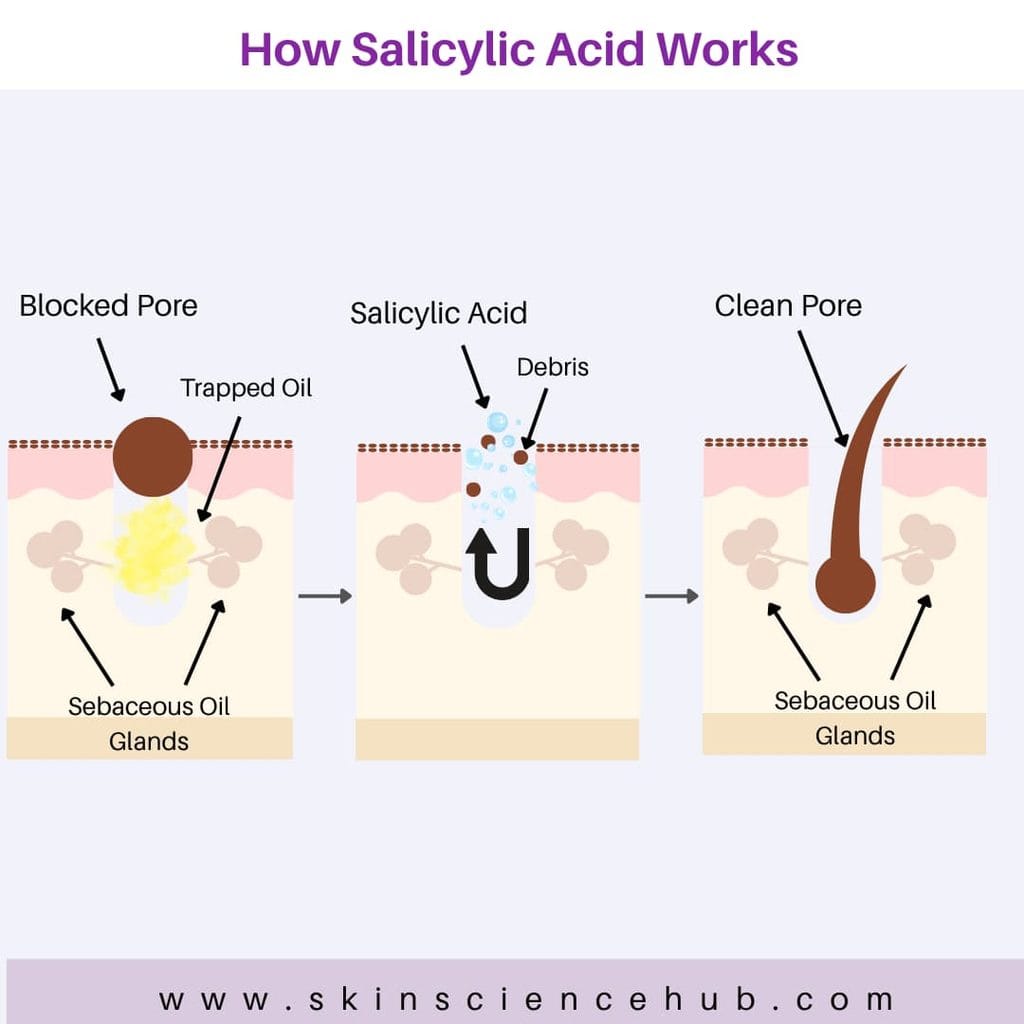
1. Oil Solubility
Salicylic acid is oil soluble, whereas AHAs are water soluble. Because it dissolves in oil, it can slip into the follicle and clear out clogged pores. That’s exactly why it works so well for acne-prone and oily skin. It also reaches the cells that produce sebum, so it mildly regulates how much oil your skin makes.
2. Desmolytic (Keratolytic) Action
Salicylic acid also has desmolytic, or keratolytic, properties, which means it loosens the bonds that hold skin cells together. As those bonds loosen, your outermost skin layer sheds more easily. That shedding is what gives you smoother texture and a more even skin tone.
3. Comedolytic Effect
Salicylic acid is also comedolytic, which means it dissolves clogged pores, or comedones. That’s why it treats blackheads and whiteheads so effectively, since both are forms of non-inflammatory acne.
4. Anti-Inflammatory Activity
Salicylic acid also has anti-inflammatory properties, so it cuts down on the inflammatory compounds your skin produces. That’s why it calms the redness and swelling that come with a breakout so well. It shares this exact mechanism with aspirin, since aspirin converts into salicylic acid once it’s inside your body.
Salicylic acid targets two things: keratinization and inflammation. These are the main drivers behind blackheads, congestion, and breakout redness. It also has a mild antibacterial effect. This comes from clearing out the buildup that acne-causing bacteria feed on.
What Is Salicylic Acid Good For?
1. Blackheads and Closed Comedones
Blackheads and closed comedones both start the same way. Sebum and dead skin get trapped inside a pore. A blackhead’s pore stays open to air, so the trapped plug oxidizes and turns dark. A closed comedone stays sealed beneath a thin layer of skin. This keeps the plug pale and shows up as a small bump instead. This is exactly where salicylic acid does its best work. It reaches deep into the follicle and clears the plug whether the pore is open or closed. That’s why so many people reach for it first when blackheads or that bumpy, congested texture won’t budge. Learn more on these acne skin types and how to treat them.
2. Sebaceous Filaments
Those small, uniform dots across your nose and T-zone are often mistaken for blackheads, but they’re something else entirely. A sebaceous filament is a normal, permanent structure that lines every pore, and its job is to guide sebum from the gland underneath up to your skin’s surface. A blackhead is a plug blocking that same opening. One is working exactly as it should. The other is a clog.
Salicylic acid can make sebaceous filaments less visible by controlling oil buildup inside the pore. But it can’t clear them out for good the way it clears an actual blackhead, since there’s no plug to remove. Sebaceous filaments always come back, because they’re a normal part of your skin.
3. Oily and Congested Skin
Oily skin produces more sebum than it needs, and that extra oil builds up inside pores throughout the day. Left alone, that buildup leads to congestion, rough texture, and stretched-looking pores.
Salicylic acid suits this skin type well, and it keeps working long after you’ve applied it. It reaches into the follicle to keep pores clear as sebum builds. It also mildly regulates how much sebum your skin produces, so less accumulates over time. Use it consistently and you’ll see smoother texture and smaller-looking pores.
4. Inflammatory Acne
Inflammatory acne is what most people call pimples, showing up as red, swollen papules and pustules. These can progress into deeper nodules and cysts. Salicylic acid cuts that swelling and clears follicle buildup. This means it reduces how often new lesions form. Deep cystic lesions need more than a topical exfoliant to clear. Learn how to treat deep cystic acne in our hormonal acne article.
5. Fungal Acne
Fungal acne isn’t caused by bacteria at all. It’s an overgrowth of a yeast called Malassezia inside the hair follicle. This is often mistaken for regular acne because the two look so similar. Malassezia feeds on certain fatty oils, and salicylic acid isn’t one of them. Salicylic acid won’t kill the yeast on its own. However, it’s safe to use without feeding the overgrowth further. Clearing an actual overgrowth needs an antifungal, such as zinc pyrithione or an azole. Learn how to treat fungal acne properly in our fungal acne safe products guide.
6. Keratosis Pilaris and Body Acne
Keratosis pilaris shows up as small, rough bumps, usually on the upper arms, thighs, or cheeks. It happens when keratin builds up and plugs the hair follicle, rather than sebum. Salicylic acid still works on it. It breaks down the cell bonds holding the keratin buildup in place. This frees the trapped hair underneath. Body acne follows the same drivers as facial acne: sebum and follicular buildup. However, the skin on your body is naturally thicker. This often means it needs a stronger routine than your face does.
7. Warts and Corns
Warts and corns also respond to salicylic acid, but at far higher concentrations than those used for acne. Over-the-counter wart and corn removers range between 12% and 40%, compared with the 0.5% to 2% used for breakouts. It works by loosening the same bonds that hold skin cells together.
A corn or callus is built-up skin responding to friction or pressure. Dissolving that thickened layer clears it at the source. A wart, on the other hand, is caused by HPV, and salicylic acid isn’t treating the virus itself. It’s dissolving the thickened, infected surface skin layer by layer. This takes several weeks.
Wart and corn removers aren’t for every spot on your body, though. Avoid them on the face, genitals, moles, birthmarks, and any wart with hair growing from it. Salicylic acid at these strengths can cause severe irritation on sensitive skin.
8. Scalp, Seborrheic Dermatitis, and Psoriasis
Dandruff and seborrheic dermatitis both cause flaking and scale buildup on the scalp. Both also involve an overgrowth of Malassezia yeast, the same yeast that drives fungal acne. Salicylic acid’s keratolytic action lifts those flakes away and calms the scaling. It also has a mild anti-inflammatory effect that helps with the itching and redness that come with it. But it isn’t an antifungal, so it won’t clear the yeast overgrowth itself. That’s why many scalp treatments pair it with an antifungal like zinc pyrithione or selenium sulfide.
Salicylic acid can’t treat psoriasis directly because psoriasis is driven by immune activity, which salicylic acid doesn’t reach. What it does well is soften and break down the thick, scaly patches psoriasis causes. This helps any treatment you layer on top, like a corticosteroid or medicated shampoo, reach the skin and work.
What It Won’t Do
Salicylic acid won’t clear post-inflammatory erythema or hyperpigmentation on its own. Those marks come from vascular changes deep within the skin or excess melanin left behind. Salicylic acid, however, only exfoliates the surface, not deep within the skin. Learn what does in our PIE vs PIH guide.
It also won’t reach deep, cystic breakouts. Once a clogged follicle ruptures beneath the skin, it triggers a deeper immune reaction that no topical exfoliant can calm.
Nor is it a substitute for a retinoid when it comes to cell turnover.
Salicylic Acid Concentrations and Product Types
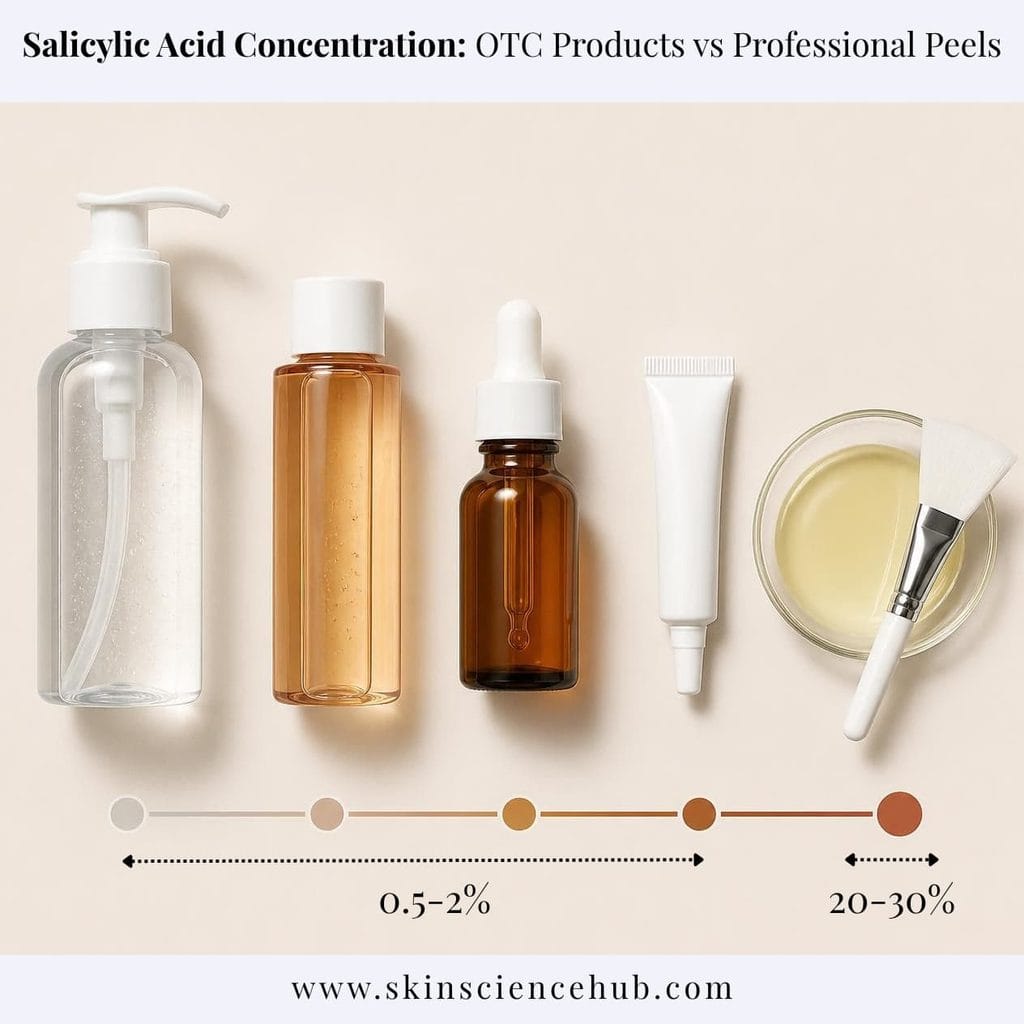
The FDA’s OTC monograph caps salicylic acid at 0.5% to 2% for acne treatment. That’s why CeraVe, Neutrogena, and PanOxyl all stop at 2%, whether you pick a cleanser, toner, or spot treatment. Professional peels, however, range between 20% and 30%, performed under a dermatologist’s supervision.
A salicylic acid cleanser only touches your skin for the time it takes to wash your face, so under a minute. That brief contact limits how much sinks into your skin before it rinses away. This makes it best for light daily maintenance.
Toners, serums, and spot treatments all remain on your skin much longer. The longer they linger, the stronger the effect gets. A toner stays on just briefly before the rest of your routine. A serum lasts for hours. A spot treatment often gets left on overnight, which gives it the longest contact time of the three.
How to Use Salicylic Acid in Your Routine
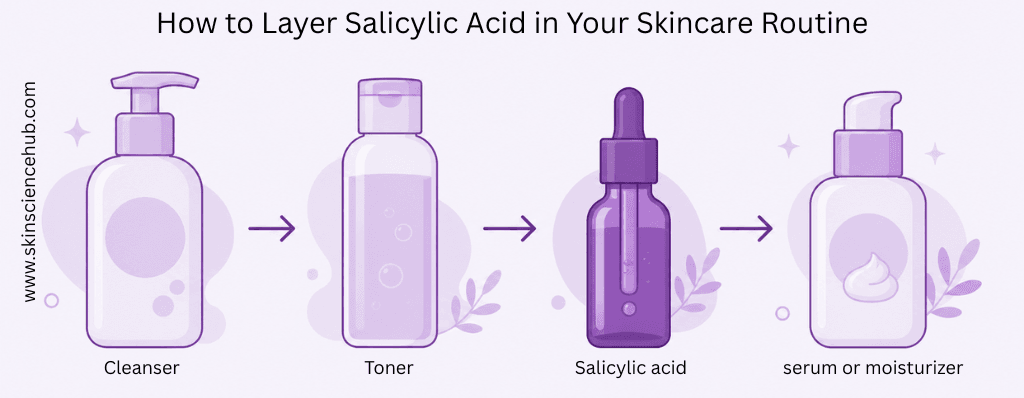
If you’re new to salicylic acid, ease in slowly. Use it two or three times a week. Once your skin adjusts, you can move to daily use.
Apply it to clean, dry skin, after toner. Layer heavier serums or moisturizer on top of it afterward. Check our layering skincare guide to see how it fits with other actives.
For sensitive skin, buffering helps a lot. Apply a light moisturizer first, then layer the salicylic acid on top. This dilutes the acid slightly, making it gentler on your skin.
If you’re using other actives, try skin cycling. Salicylic acid gets its own night. A retinoid gets its own night. Two recovery nights follow. This gives your skin time to reset before the next active comes in. Check our skin cycling guide to see how the full rotation works.
BHA is powerful, but it doesn’t work with everything. My guide shows you what to pair it with and what to keep apart.
What Not to Combine Salicylic Acid With
Don’t apply salicylic acid and benzoyl peroxide to the same area at the same time. Both are drying, so using them together can cause redness, peeling, and a damaged barrier. Alternate them instead: a benzoyl peroxide wash in the morning and salicylic acid at night. Or swap which one you use each day.
Retinoids carry the same risk. They speed up cell turnover and make your skin more sensitive. Salicylic acid also strips away the surface layer faster, so using both together raises your irritation risk. Give your skin a night off between them, salicylic acid one night and a retinoid the next.
Adding another exfoliant on top of salicylic acid is the fastest way to over-exfoliate. That goes for a physical scrub, a different acid, or a second BHA product. Check our damaged skin barrier and over-exfoliated skin guides to spot and recover from over-exfoliation.
Salicylic Acid Side Effects and Who Should Avoid It
Dryness, redness, and mild peeling are the most common side effects, especially if you’re new to it or using a higher concentration than your skin is ready for. Some new breakouts in the first few weeks are usually purging, not a reaction, and they tend to clear on their own. Check our purging vs breakout guide to see the difference.
If you have a salicylate or aspirin allergy, avoid salicylic acid entirely. Reactions can include hives, swelling, or trouble breathing.
Don’t use it on children under two, because their skin absorbs more of it and irritates more easily. Also avoid it for kids and teens recovering from the flu or chickenpox, due to a rare but serious risk called Reye’s syndrome.
If you’re pregnant, current dermatology guidance says you can generally use it at typical skincare concentrations, though it’s a good idea to confirm with your doctor first. You can also see which skincare ingredients to avoid during pregnancy in my pregnancy guide.
It also leaves your skin more sensitive to sun, so daily SPF isn’t optional while you’re using it.
Salicylic Acid vs Other Actives
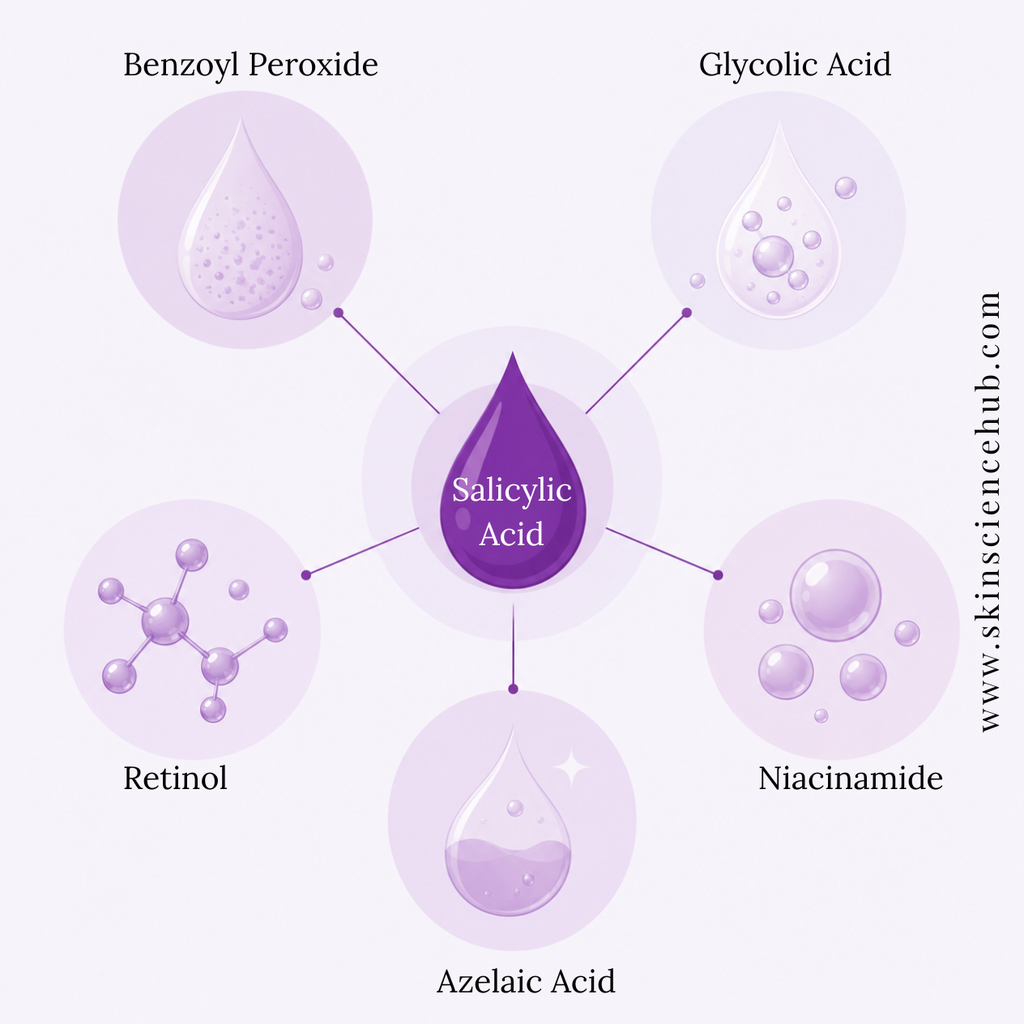
1. Salicylic Acid vs Azelaic Acid
Salicylic acid and azelaic acid both calm inflammation. Salicylic acid is oil-soluble and works inside the follicle, so it’s the stronger pick for blackheads, oily skin, and congestion. Azelaic acid, on the other hand, targets pigmentation and redness, which makes it the better choice for melasma, rosacea, and post-inflammatory marks. It’s also considered safe throughout pregnancy at every concentration, while salicylic acid comes with more concentration-dependent guidance. Check our azelaic acid vs salicylic acid guide for more.
2. Salicylic Acid vs Benzoyl Peroxide
Salicylic acid clears buildup inside the follicle, and its mild antibacterial effect comes as a byproduct of that process. Benzoyl peroxide, however, kills acne-causing bacteria directly, which makes it the stronger pick for inflammatory, bacteria-driven breakouts. Salicylic acid also tends to be gentler on the skin barrier, whereas benzoyl peroxide can bleach fabric and hair on contact. For a full breakdown, read our salicylic acid vs benzoyl peroxide guide.
3. Salicylic Acid vs Glycolic Acid
Salicylic acid is oil-soluble, while glycolic acid is water-soluble. Glycolic acid works on the surface, so it’s a strong pick for texture, dullness, and sun damage. Salicylic acid, though, reaches into the follicle, which makes it the better choice for blackheads and oily, congested skin.
4. Salicylic Acid vs Niacinamide
Salicylic acid and niacinamide aren’t competing for the same job. Salicylic acid is an acid that clears buildup inside the follicle, while niacinamide isn’t an acid at all. It supports the skin barrier and calms inflammation through a completely different pathway. That’s why the two get paired together so often, rather than used as alternatives.
5. Salicylic Acid vs Retinol
Salicylic acid and retinol get used for a lot of the same concerns. Salicylic acid works by breaking down the bonds that hold dead skin cells in place. Retinol binds to retinoic acid receptors instead, speeding up new cell turnover rather than clearing out old ones. That cell turnover boost is also why retinol gets credited with softening fine lines over time, a benefit salicylic acid doesn’t share.
Bottom Line
Salicylic acid is the right pick for blackheads, oily skin, and congestion, and it also works well for keratosis pilaris and body acne. It calms milder inflammatory acne, papules and pustules, though the deeper cystic kind stays out of its reach. At higher concentrations, it also clears warts and corns, and it helps manage dandruff, seborrheic dermatitis, and scalp psoriasis. If you’re dealing with fungal acne, it won’t clear the yeast itself, but it’s safe to use and won’t make things worse.
It’s not the right choice for deep cystic acne or hyperpigmentation, as those conditions need a different treatment entirely.
Start slow, keep sunscreen in your routine, and give it twelve weeks before deciding if it’s working.