

How to Treat Keratosis Pilaris on Your Face (Without Irritation)
Last updated on September 6th, 2026
Keratosis pilaris on your face looks like acne but doesn’t behave like acne. No whiteheads form. Benzoyl peroxide does nothing. The bumps stay rough and persistent no matter what acne treatment you try, because KP isn’t an acne problem. It’s a keratin buildup problem, and it needs a completely different approach.
The outer layer of your facial skin is thinner than on your arms or thighs, so it soaks up some skincare ingredients faster and irritation develops more quickly. The 12% lactic acid that works well for body KP is too strong for most faces and is likely to leave your skin redder and more irritated.
In this guide, you’ll know how to treat keratosis pilaris on face and which ingredients the research supports and the concentrations your face can tolerate.

How to Identify Keratosis Pilaris on Your Face
If your bumps are on your arms, thighs, or buttocks instead, read my guide to treating keratosis pilaris on the body.
What KP Feels and Looks Like
Run your fingers across your cheeks. Keratosis pilaris feels like fine sandpaper, rough and textured even when your skin looks relatively smooth. The bumps are small and uniform, they don’t hurt when you press them, and they never contain pus or develop into whiteheads.
They appear most commonly on your cheeks, jawline, and near your eyebrows. They tend to worsen in winter when humidity drops and improve in summer when moisture levels rise, which is one of the clearest ways to distinguish them from acne that doesn’t follow seasonal patterns.
How KP Differs from Acne and Other Conditions
Acne responds to benzoyl peroxide and salicylic acid within days to weeks. KP doesn’t respond at all. If you’ve been treating your bumps as acne for three months with no improvement, you may have KP rather than acne.
If your bumps itch intensely and cluster around your hairline, you might have fungal acne instead. If your face flushes red with heat, alcohol, or spicy food, see a dermatologist about rosacea, because rosacea and KP can coexist and require different management.
Keratosis Pilaris Rubra Faceii
Keratosis pilaris rubra faceii is the variant that affects the face, showing up on the cheeks, near the eyebrows, chin, and neck. The texture is usually there, but sometimes the skin is completely smooth and redness is the only visible sign, which is why it gets mistaken for rosacea so often.
That redness is your skin’s response to repeated follicular blockage. When keratin keeps plugging the same follicles, low-grade inflammation builds around them, and the result is that persistent flushed appearance that moisturizer alone won’t fix.
Some people with rubra faceii also notice heightened sensitivity to sun and certain cosmetics, which reflects the underlying barrier dysfunction driving the condition. If you’re not sure whether you have rubra faceii or rosacea, a dermatologist can tell you, because the two conditions look similar but need different treatment.
What Causes Keratosis Pilaris on Your Face
Why You Get Keratosis Pilaris
KP is genetic, which means you didn’t cause it and you can’t eliminate it permanently. In some people, part of the cause is a mutation in the gene that makes filaggrin, a protein your skin relies on to maintain its barrier and regulate how skin cells shed. However, not everyone with KP has this mutation, and other genes that influence how your skin makes and sheds keratin also come into play.
When this process doesn’t work properly, keratin builds up inside hair follicles instead of shedding normally.
Your skin keeps trying to shed those plugged cells, but new keratin fills the follicle faster than the old keratin clears. The cycle repeats, the plug persists, and the texture stays.
This is also why KP tends to run in families. If one of your parents has it, your chances of having it are significantly higher.

What Makes Facial KP Worse
Dry skin is the biggest trigger. When your barrier is compromised, keratin plugs form faster and the surrounding skin becomes more inflamed. Cold weather and low humidity accelerate this, which is why facial KP almost always worsens in winter.
Harsh cleansers and over-exfoliation damage your barrier the same way, stripping the lipids your skin needs to regulate cell shedding. More exfoliation is not more effective with KP. It deepens the problem.
Picking the bumps creates post-inflammatory hyperpigmentation, dark spots that outlast the bumps themselves and are significantly harder to treat than the original texture.
For rubra faceii specifically, sun exposure worsens redness over time even without a visible burn. UV radiation breaks down the collagen and elastin supporting your blood vessels, and that structural damage makes flushing more persistent and harder to reverse.
Treatments for Keratosis Pilaris on the Face
Chemical exfoliants are the core of facial KP treatment. They dissolve the keratin plugs blocking your follicles and break apart the bonds holding dead skin cells together, so those cells shed properly. As a pharmacologist, the concentrations I recommend here are deliberately lower than what you’d use on your body, because facial skin absorbs ingredients faster and the margin between effective and irritating is much narrower. Studies show noticeable improvement at 8 to 12 weeks with consistent use.
Lactic Acid and Glycolic Acid: 5 to 8 Percent
These are alpha hydroxy acids that work on the skin’s surface, loosening dead cells so they shed normally. They also pull moisture into your skin while they exfoliate, keeping your barrier supported.
CeraVe Skin Renewing Nightly Exfoliating Treatment combines 5% lactic and glycolic acid with ceramides that repair your barrier while the acids dissolve keratin buildup. It also contains licorice root extract, which blocks inflammatory signals and reduces the redness that often accompanies facial KP.
Start with twice-weekly application and increase gradually as your skin adjusts. Most people tolerate it three to four times weekly after the first month.

Salicylic Acid for Sensitive Skin
Salicylic acid is a beta hydroxy acid that dissolves in oil, which lets it work deep inside the follicle. Choose this if you have occasional breakouts alongside your KP, or if alpha hydroxy acids sting too much.
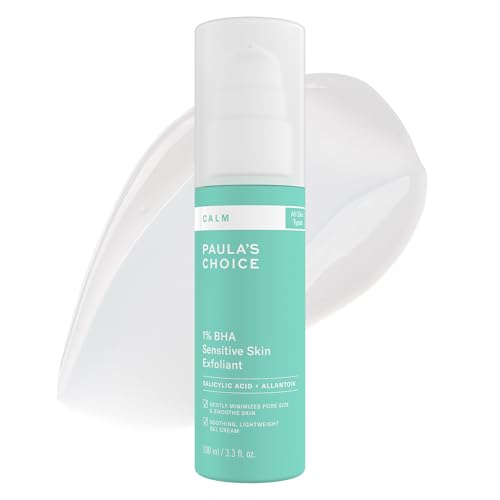
Paula’s Choice CALM 1% BHA Lotion Exfoliant combines salicylic acid with soothing ingredients formulated for sensitive, reactive skin. The 1% concentration works for daily use without the dryness that higher percentages cause.
If sensitivity is your main concern, this is your best option. If rough texture and dark spots are the bigger issue, lactic acid addresses those more directly.
Polyhydroxy Acids for Very Sensitive Skin
If AHAs and BHAs have burned or irritated your skin, use this. Polyhydroxy acids have a larger molecular size than AHAs, so they penetrate more slowly and cause significantly less irritation.
Aveeno Calm and Restore Nourishing PHA Exfoliator uses gluconolactone as its active ingredient. Massage it onto your skin for 30 to 60 seconds and rinse it off. You’re not leaving the acid on long enough to cause irritation, but you still get meaningful exfoliation. The oat kernel oil contains compounds that reduce inflammatory signals in your skin.
Results take longer because you rinse it away, but texture improves steadily over weeks without the stinging or peeling that stronger products cause.

Urea at 5 Percent
Urea breaks down the keratin plugs blocking your follicles and pulls water into your skin at the same time, so you get exfoliation and hydration in one step.
Eucerin 5% Urea Face Cream and Zeroid Rechenic Cream Urea 5% are both appropriate for twice-daily use without irritation. Higher percentages exist for body KP but are too strong for facial skin.
Unlike AHAs, urea doesn’t increase sun sensitivity, which makes it a useful option if daily sunscreen use is inconsistent for you. If you use retinoids, introduce urea gradually, since the combination can increase irritation in some people.

