Retinol for Hyperpigmentation and Fading Dark Spots
Last updated on September 26th, 2026
Most people think of retinol as a wrinkle treatment, not something for hyperpigmentation or dark spots. Yet dermatologists have used it for pigmentary disorders for decades.
Retinol works on dark spots the same way it works on fine lines, by changing how quickly your skin renews itself. Some types of pigmentation respond quicker than others, and using retinol correctly from the start clears dark spots faster and evens out your skin tone.
This post covers how retinol fades pigmentation and dark spots, which types respond fastest, the right way to start using it, and what a realistic timeline looks like before you see results.
How Retinol Fades Pigmentation and Dark Spots
1. Retinol speeds up skin cell turnover
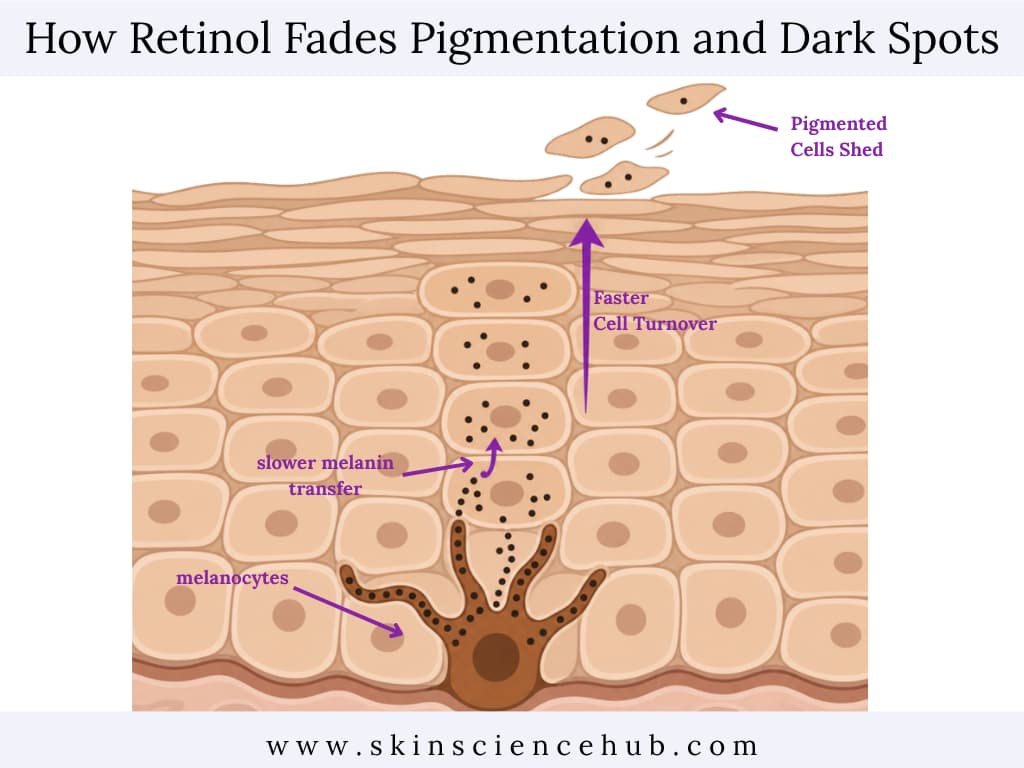
Retinol works by speeding up your skin’s natural turnover, the process where old cells shed and new ones take their place. That cycle normally takes around 28 to 40 days. Retinol speeds it up, so pigmented cells shed from the surface faster than they would on their own, and dark spots fade quicker as a result.
2. Retinol slows down melanin transfer
Retinol also slows melanosome transfer, the process that moves melanin from your melanocytes into the surrounding skin cells. So while pigmented cells clear out faster, the new cells replacing them start off with less melanin too. Together, these two effects even out your skin tone over time. A 2006 review by Ortonne in Dermatologic Therapy described this effect, though the exact mechanism behind it still isn’t fully worked out.
As a pharmacologist, I think this is the detail that gets missed most often. Retinol isn’t just clearing out old pigment. It’s also reducing how much new pigment gets deposited to begin with.
3. Retinol calms the inflammation behind acne marks
Acne breakouts trigger inflammation, and that inflammation signals melanocytes to produce more pigment. That’s part of why a healed pimple so often leaves a dark spot behind. Retinol’s anti inflammatory effect calms that signal during a breakout, so your skin can heal without a mark left behind.
Which Types of Pigmentation Respond Best to Retinol
Post inflammatory marks fade fastest, since they sit closest to the surface. Sun spots and age spots sit deeper, so they take longer to clear. Hormones keep driving new pigment in melasma, which makes it the most stubborn of the three.
1. Post inflammatory marks from acne
Retinol also keeps pores clearer, so you’re less likely to get new breakouts and new dark spots while the old ones fade.
2. Sun spots and age spots
Most of the supporting evidence for this type comes from tretinoin and tazarotene, both prescription strength retinoids, while the over the counter retinol most people use hasn’t been studied as closely for it.
3. Melasma
Pairing retinol with an ingredient built for melasma specifically, like hydroquinone, works better. Azelaic acid is another option worth a closer look if melasma is your main concern. It targets pigment formation at a point retinol doesn’t reach.
How to Use Retinol for Dark Spots
Retinol isn’t safe during pregnancy or while breastfeeding, because retinoids can affect fetal development. Talk to your doctor about switching to Azelaic acid. It treats many of the same dark spots and is considered safe during this time.
Start around 0.1% if you’re new to retinol, and build up as your skin adjusts. Most people do well in the 0.3% to 0.5% range once they’re past that stage.
Apply it across the whole affected area, not just the darkest spot. The skin around a dark spot usually carries some of the same uneven tone.
Use it at night only. Retinol increases your skin’s sensitivity to the sun, so sunscreen the next morning isn’t optional. Day vs Night Routine covers how to fit it into a full routine.
Why Retinol Needs Sunscreen to Fade Dark Spots
UV exposure triggers new pigment within days, whether or not you’re using retinol. Retinol’s clearing process moves on a slower cycle, and unprotected sun exposure can create new dark spots faster than it clears old ones. Wear broad spectrum sunscreen daily. It protects the progress retinol is already making.
If you have melasma or a darker skin tone, visible light drives pigmentation too, not just UV. Tinted mineral sunscreens with iron oxide block visible light, so look for one when choosing a sunscreen. Sunscreens for Dark Skin covers your options in more depth.
Realistic Timeline for Fading Dark Spots
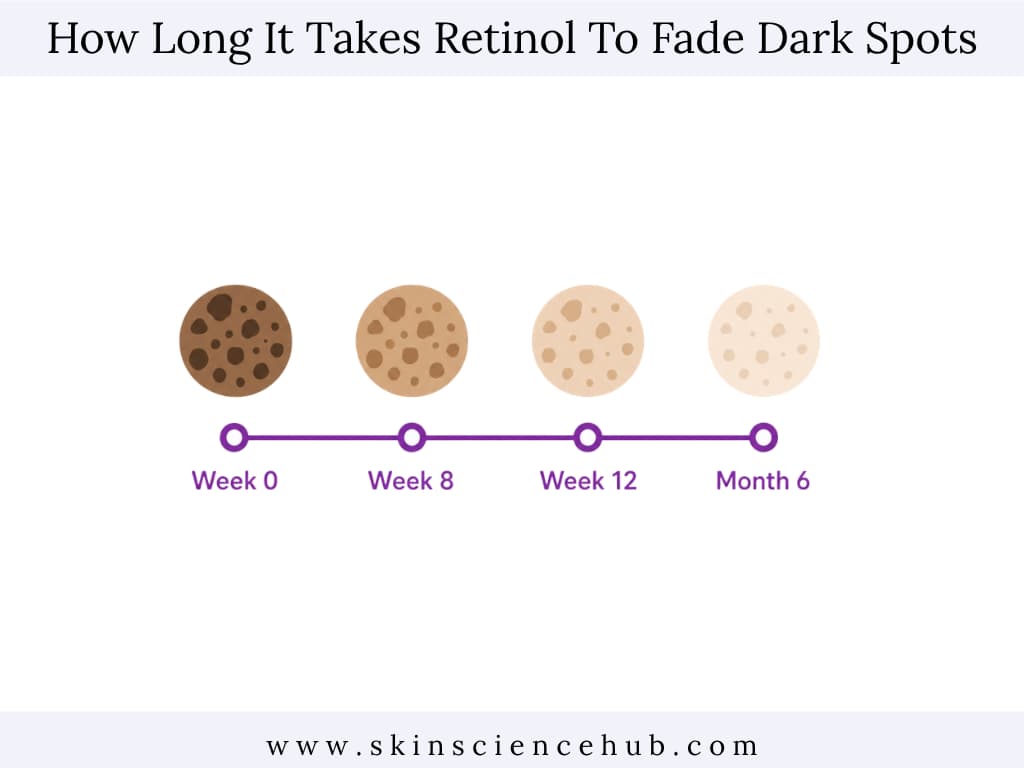
Post acne marks usually start fading within 8 to 12 weeks of consistent use.
Sun spots and other signs of sun damage take longer to clear, because that pigment sits deeper and has often built up over years. A 2020 trial in Skin Pharmacology and Physiology followed 37 women using 0.3% or 0.5% retinol serum and found measurably less hyperpigmentation by week 8, continuing through week 12. The trial only ran 12 weeks, so it can’t confirm what happens past that point, but pigment this deep often takes up to 6 months of consistent treatment to clear fully.
Melasma responds differently, since hormones drive it and it can return even after fading. A multicenter open-label trial of 37 women pairing 0.05% tretinoin with 4% hydroquinone found measurable improvement in melasma by week 4, with 100% of participants showing continued improvement from week 8 onward. Other open-label studies combining retinoids with hydroquinone show a similar pattern, typically landing somewhere between week 4 and week 12.
The biggest reason people give up on retinol too soon comes down to consistency. Skipping nights here and there, or stopping after a few weeks because nothing seems to be happening yet, resets a process that needs steady, repeated cycles to show results.
Why Retinol Can Make Dark Spots Look Worse Before They Fade
Purging
Retinol speeds up cell turnover, and that can push clogged pores to the surface faster than usual. This leads to a few temporary breakouts before things settle down. To learn more, see the difference between skin purging and breakouts
Irritation-triggered pigmentation
Significant irritation from retinol triggers the same inflammation that activates melanocytes, the same pathway that causes a dark spot to form after a breakout. Used too aggressively, retinol can end up triggering the very pigmentation it’s meant to clear, especially on darker skin tones, where inflammation is more likely to leave a spot behind.
Starting low and slow keeps this risk low. Back off at the first sign of irritation that doesn’t settle down. Over Exfoliated Skin is worth a look if you’re not sure whether your skin is just adjusting or signaling something to dial back from.
Retinol vs Other Brightening Ingredients for Dark Spots
Retinol clears pigment that already exists by speeding up turnover and slowing pigment transfer. Azelaic acid and vitamin C take a different route, blocking the enzyme tyrosinase directly, which stops new melanin from forming. Tranexamic acid blocks plasmin activity instead, keeping melanocytes from activating after sun exposure or inflammation.
Retinol blocks tyrosinase too, the same enzyme azelaic acid and vitamin C target. A 2008 lab study in Bioscience, Biotechnology, and Biochemistry tested this directly on melanoma cells and found retinol blocked tyrosinase alone, while tretinoin blocked tyrosinase along with a second pigment producing protein, TRP-1. The study used melanoma cells, not human skin, so the exact effect in your skin may differ, but it’s a reasonable explanation for why tretinoin tends to work faster than retinol.
Retinol works even better on dark spots with the right partners. My guide lists the best dark spot ingredients and shows you when to use each one, morning or night.
How to Combine Retinol with Other Pigmentation Ingredients
Retinol and azelaic acid for dark spots
Azelaic acid pairs well with retinol in plenty of routines. Azelaic acid for hyperpigmentation covers how to build that pairing in.
Retinol and vitamin C for dark spots
Vitamin C suits mornings, while retinol stays at night, so the two never compete for the same application. For the full breakdown on layering these together, see Can You Use Retinol with Vitamin C, Niacinamide, and AHAs.
Retinol and tranexamic acid for dark spots
Tranexamic acid pairs well with retinol too. Topical tranexamic acid usually comes as a serum applied to clean skin, and it doesn’t need a specific morning or night slot, so it fits wherever it’s easiest for you to stay consistent with. Oral tranexamic acid is prescription only, because it affects blood clotting.
For a broader look at every ingredient that fades hyperpigmentation, not just these three, see best ingredients to fade hyperpigmentation.
For product options, read
Should You Use Retinol or Retinal for Pigmentation
Retinal converts to active tretinoin in 1 step, while retinol needs 2 steps, so retinal tends to work faster overall.
Most existing research comparing the two measures wrinkles, texture, and hydration, not pigmentation specifically. So the case for switching from retinol to retinal for dark spots isn’t as settled as the conversion chemistry alone suggests.
If you’re drawn to retinal for other reasons, like faster results on texture or fine lines, that’s still a reasonable case for switching. Retinal vs Retinol breaks down how the two compare more broadly, and What Is Retinaldehyde covers how the conversion process works.
Bottom Line
Retinol fades pigmentation and dark spots by clearing pigmented cells faster and loading less melanin into the cells that replace them. Post acne marks respond fastest. Sun spots take longer. Melasma is the exception, and clears best when paired with an ingredient like hydroquinone.
Start low, build up gradually, and never skip sunscreen the next morning. Stay consistent, and most dark spots fade within a few months.